




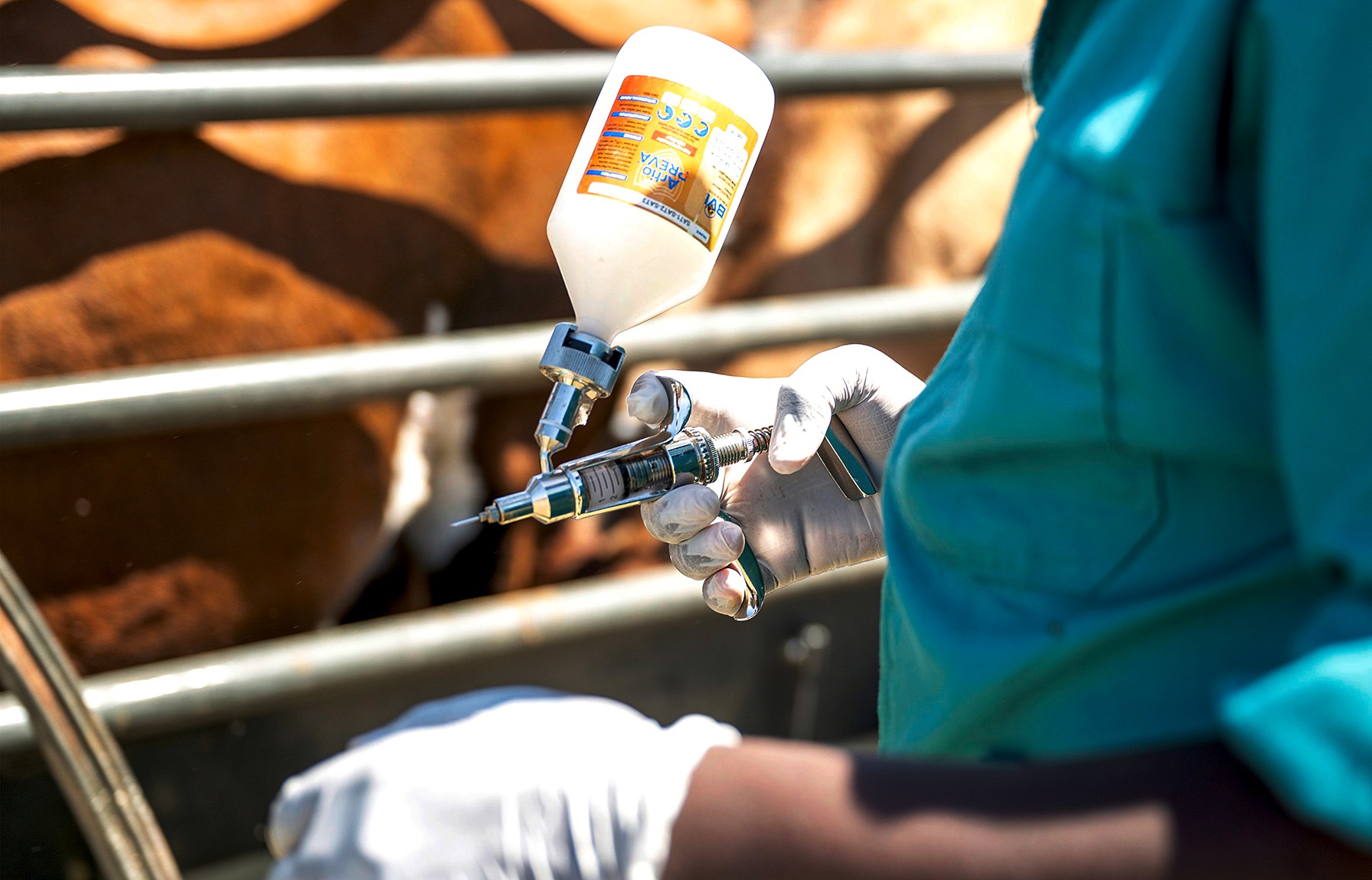
 The vaccination process of cattle against foot-and-mouth disease in Fisantekraal on 15 February 2026 in Cape Town, South Africa. Recent outbreaks, particularly in KwaZulu-Natal, highlight that vaccinating a herd over a year does not equate to protecting enough animals at any one time to halt the disease’s spread.(Photo: Gallo Images / Die Burger / Jaco Marais)
South Africa’s foot-and-mouth disease (FMD) response is built around the wrong question.
The government keeps asking how many doses have been imported, how many animals have been vaccinated, and whether the country will reach 80% by December. Those are administrative questions. The biological question — how many susceptible animals are immune in the same area at the same time — is the only one that controls the disease.
SA is treating FMD as an administrative problem. The countries that succeeded in controlling the disease treated it as a biological problem.
A target is not an outcome
Vaccinating 80% of the national herd over 12 months sounds impressive. But FMD does not move through annual totals. It moves through susceptible animals available today. The relevant question is not how many animals eventually passed through the programme. It is whether enough animals were immune at the same time to stop transmission.
The recent dairy herd outbreaks in KwaZulu-Natal, where vaccinated cattle were exposed in areas where neighbouring cattle remained unvaccinated roughly eight weeks after vaccination, show exactly what happens when not enough cattle are protected at the same time. The disease continues to spread under high viral pressure, and vaccinated cattle can still become infected.
A vaccination target is an administrative measure. Population immunity is a disease-control outcome. The two are not the same thing.
The arithmetic
On a simple rolling-coverage model, the government’s 80% annual target does not translate into 80% of cattle with protection at any one time. FMD vaccine immunity lasts about six months. If a campaign takes 12 months to complete, only roughly half the vaccinated animals are within their useful protection window at any point.
That turns an 80% annual vaccination target into something closer to 40% point-in-time protection. Once imperfect vaccine responses by some cattle, timing gaps, missed animals and uneven area coverage are factored in, effective population immunity can sit closer to 35%.
That is the difference between a target that sounds like 80% and a disease-control position that equates to only 35% of animals being immune at the same time.
Technical advice says the same thing
A technical paper published in April – written by a member of the Ministerial Task Team advising the government and contributed to by senior veterinary scientists – sets out the same distinction in plain terms.
It states that “there is a false narrative that the aim is to vaccinate 80% of the animals in SA when, in fact, the aim is for immunity in 80% of the country’s susceptible species”.
There is a difference between vaccinating 80% of animals over time and having 80% immune to FMD at the same time. It adds that, because not all animals respond equally to the vaccine, achieving 80% immunity requires vaccinating “almost 100% of the national herd”.
And it specifies the operational requirement: “A tight vaccination window of four to eight weeks is required to vaccinate the entire country and ensure that enough animals are immune simultaneously to achieve 80% herd immunity.”
It is hard to be clearer than that. In short, top veterinarians have told the government that vaccination has to be conducted very quickly and target nearly every cattle herd in the country. The current rollout simply does not reflect the science or the government’s own advice.
What is actually required
The World Organisation for Animal Health does not grant FMD-free-with-vaccination status because a country reports many doses administered. It assesses evidence of how many animals are immune to the disease simultaneously. The Terrestrial Animal Health Code is explicit: a country seeking the status must demonstrate compulsory systematic vaccination that has achieved “adequate vaccination coverage and population immunity”.
In other words, SA’s dossier will have to show population immunity at a point in time, supported by surveillance evidence that transmission has stopped. It will not be enough to count how many doses were administered between February and December.
No country has ever achieved FMD-free-with-vaccination status using a slow, rolling, state-gated programme that measures cumulative vaccination activity rather than synchronised area-wide immunity. Argentina did not. Brazil did not. Uruguay and Paraguay did not. These countries used compressed regional windows, prepared vaccine supply before those windows, and built the operational scale required to immunise full areas inside the time the biology demands.
Brazil and Argentina treated FMD as a biological problem
Brazil and Argentina treated FMD as a biological problem. They built systems that matched the speed and scale the disease demanded – defined campaign windows, multiple supply lines, private veterinary and producer capacity working under state audit. They did not confuse administering vaccines with achieving immunity.
The plan does not match the diagnosis
The current gazetted vaccination scheme authorises private veterinarians and gazettes the conditions under which they may participate. It is permission to vaccinate. But it lacks time frames for when vaccination should take place. It is not a system designed to produce synchronised population immunity inside compressed regional windows.
The rollout is producing pockets of high, low and no immunity, exactly as the technical paper warned. The virus is doing what the virus does in that scenario. It is finding the gaps and continuing to spread.
A high court ruling delivered in late May removes a legal impediment to private vaccination. It does not solve the biological problem. The judgment confirms what farmers have been arguing for months: the scheme as gazetted is voluntary participation, not a system designed to produce synchronised population immunity. The court has cleared a legal pathway.
What still has to be built is the synchronisation – vaccination windows, supply timed to those windows, delivery capacity activated as full execution capacity, and coverage that reaches the cattle in the gaps between commercial farms. The ruling makes that possible. It does not make it happen.
What the target should be
The measurable objective is not 80% vaccinated by December. It is enough animals immune at the same time, in defined regions, to interrupt transmission.
In practice, that means aiming closer to 90% or higher vaccination coverage, depending on vaccine response and field conditions, to produce roughly 80% effective immunity, and completing that coverage inside compressed regional windows of four to eight weeks. It means securing vaccines before each window opens. It means private veterinarians, producer organisations and approved logistics activated as full delivery capacity, working under state audit. It means measuring immunity and transmission, not just animals vaccinated. And it means building the World Organisation for Animal Health dossier from day one.
These are not preferences. They are operational requirements of the disease.
The wrong target
The government is confusing a vaccination target with population immunity. Eighty percent vaccinated over a year may look like progress on a government dashboard. It is not the same as 80% population immunity at a point in time. One is effort. The other is outcome.
A plan that measures only the first will not deliver the second. DM
Andrew Morphew is a commercial farmer and spokesperson of FMD Response SA, a group of over 250 farmers developed to enhance the private sector response to the disease.
Comments
Scroll down to load comments...