



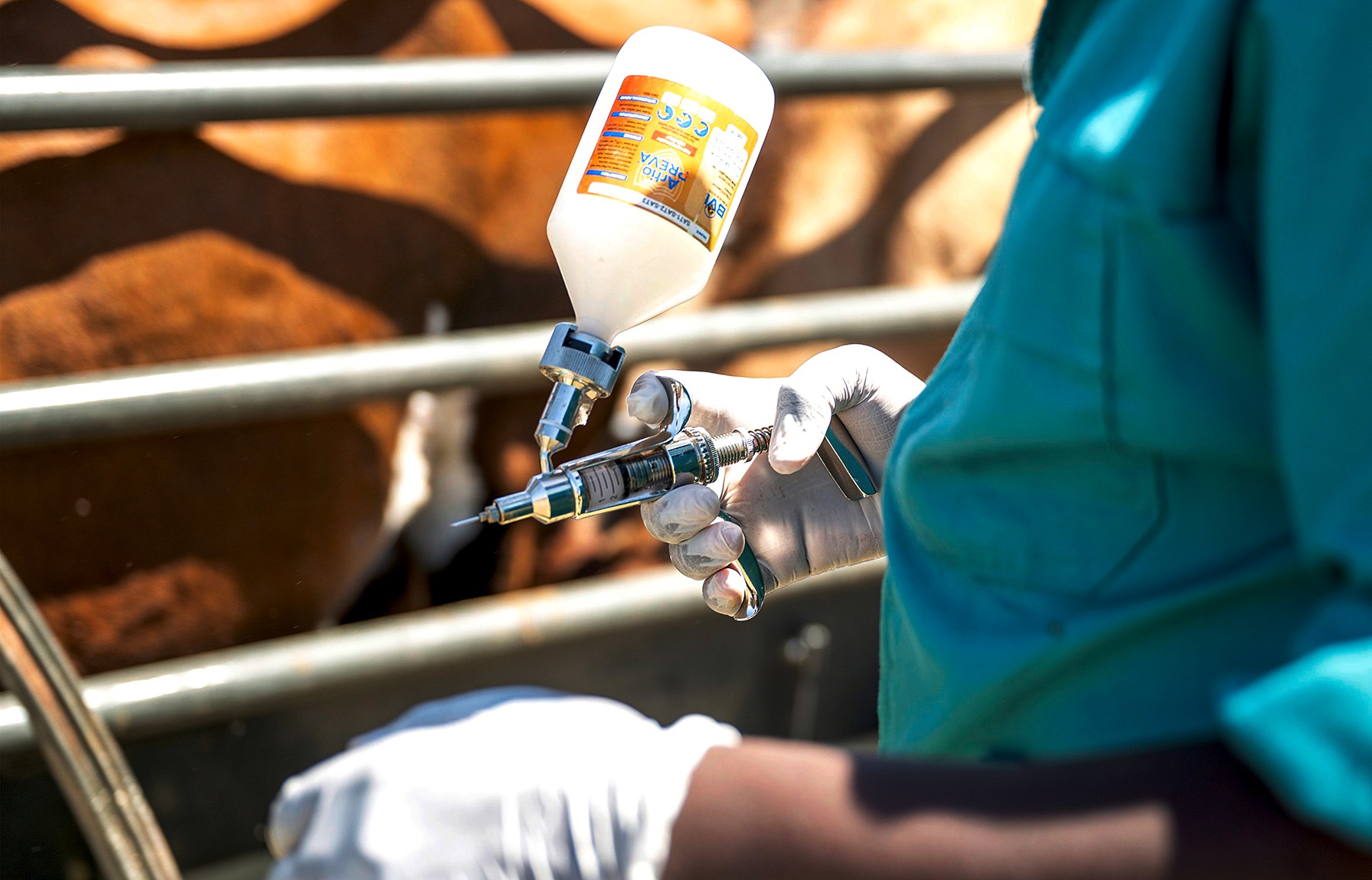
 Cattle in Fisantekraal, Cape Town, are vaccinated against foot-and-mouth disease on 15 February 2026. (Photo: Jaco Marais / Gallo Images / Die Burger)
South Africa’s foot-and-mouth disease (FMD) drive is kicking into a new gear with 13.5 million doses procured since the end of February and 4 million more expected this month.
This update was provided on Monday by Agriculture Minister John Steenhuisen, who has faced a stampede of criticism over the government’s response to a crisis that has trampled South Africa’s livestock sector, which also faces the spectre of a looming El Niño.
“As of the 28th May, we have vaccinated just under 4.4 million animals across the country. This is the largest vaccine acquisition programme ever undertaken by the South African state,” said Steenhuisen.
“The vaccination programme is now being implemented at a scale never before seen in South Africa.”
/file/attachments/orphans/ED_587094_552469.jpg "The minister of agriculture, John Steenhuisen. (Photo: Sharon Seretlo / Gallo Images)<br>")
The extent of the crisis has called for a rethink of government policy — never an easy task in South Africa — from a reactive system to a proactive, preventative biosecurity model against the backdrop of withered capacity at SOEs such as Onderstepoort Biological Products.
The goal is to vaccinate 80% of South Africa’s national cattle herd, which numbers around 14 million, to create a version of “herd immunity”. If El Niño turns out to be a whopper and unleashes a scorching drought in this region again, that task may be made easier as livestock will have to be culled in the face of rising feed costs and parched grazing lands.
None of this will be welcomed by livestock farmers, who are bearing the brunt of what could prove to be a double whammy.
“KwaZulu-Natal remains at the centre of the vaccination effort with more than 1.1 million animals vaccinated,” said Steenhuisen. In the Eastern Cape, more than 720,000 animals have been vaccinated, while in Mpumalanga the number stands at 430,000.
“We have had to secure extensive vaccine supply chains, expand diagnostic capacity, strengthen surveillance systems, coordinate provinces, engage industry and rebuild the machinery required for a truly national response,” said Steenhuisen.
“There is little value in restoring production if producers cannot access markets. We have therefore engaged extensively with trading partners to maintain confidence in South Africa’s animal health systems and to secure practical solutions that allow trade to continue wherever possible under appropriate risk management measures.”
So, South Africa is exporting red meat products to countries that include Jordan, the UAE, Kuwait and Hong Kong.
The costs to South Africa’s cash-strapped government — which is grappling with slowing economic growth as it tries to contain swelling debt levels — have been significant, with R494-million to date spent on vaccine procurement and deployment. But that is testimony to the continuing costs of state failure and the inability to rise to the occasion when this crisis emerged.
The costs of this crisis are mounting, but at least the vaccines are rolling into the country and out into the countryside. DM
Comments
Scroll down to load comments...