




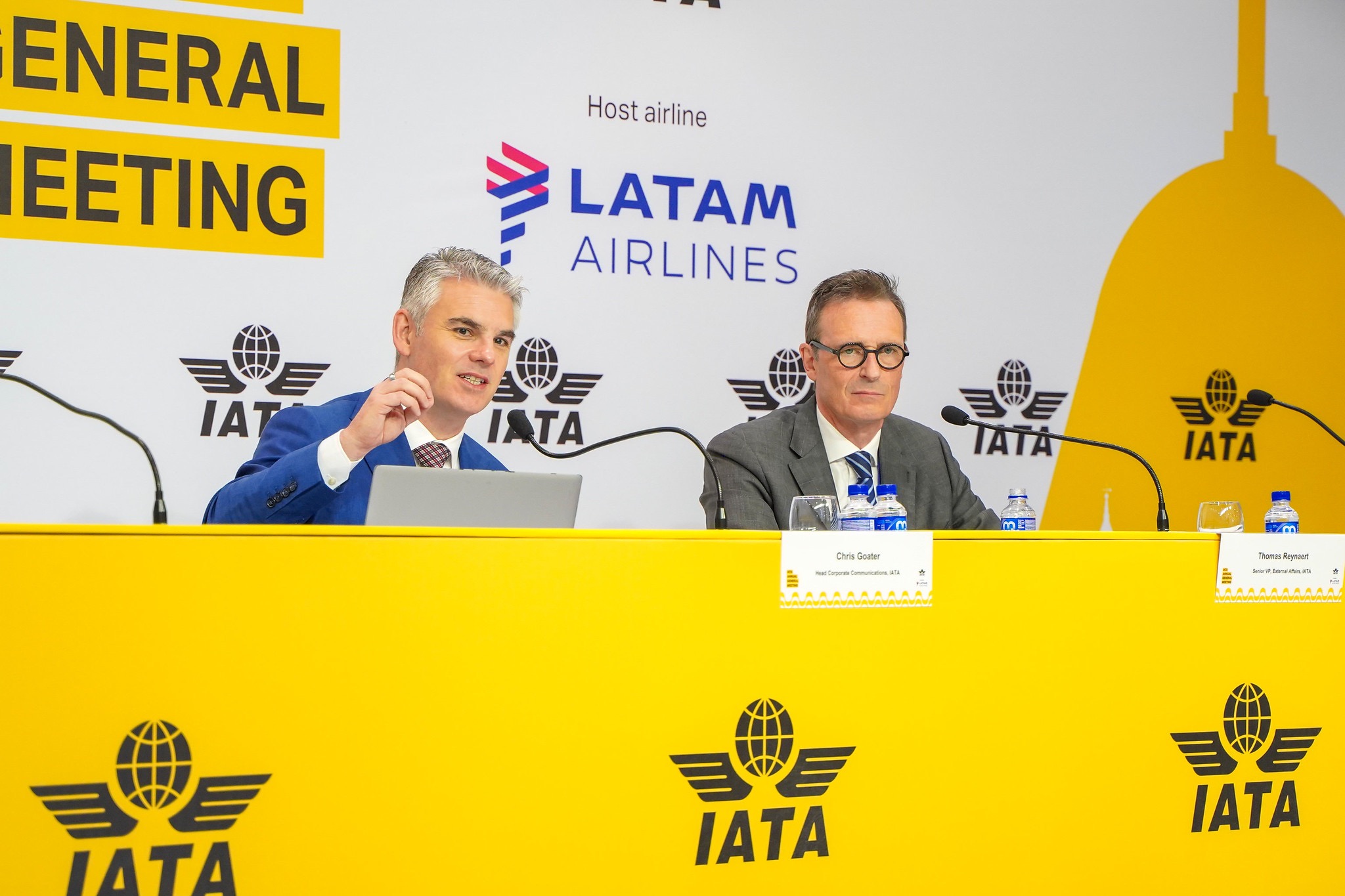
 Chris Goater, head of corporate communications (left), clarifies the IATA’s advocacy position for Daily Maverick. Thomas Reynaert, senior VP, external affairs, is sat alongside. (Photo: IATA)
 “Joohannesborgo! JOOHANNESBORGO!”
Flight LA3875 from Rio de Janeiro to Sao Paulo landed 43 minutes late. The airplane wheels touched down after boarding had already begun for the transatlantic flight LA8058 to Johannesburg. Covering the near 600m of walkway between terminals T2 and T3, plus a passport check, was always going to be an uncomfortable challenge.
To make things worse, someone (me) had sky-checked his carry-on because of a full flight and limited overhead storage on the Airbus A321 – which meant a detour to baggage collection (sky-check on the opposite leg of the journey sent the baggage to the carousel, but I should’ve checked the tag this time).
With many metres of retractable belt having caught the corners of my stuffed roll-top backpack, I handed my passport to the official just as the clock ticked to boarding closure. Hearing the sweet yell of a ground staff employee walking in search of the missing passengers almost brought me to tears.
It also made me consider the point IATA senior vice-president of external affairs, Thomas Reynaert, made about airlines needing more tax cuts to help enable more connections for citizens. The moustachioed man butchering the name of the Place of Gold definitely deserves a raise.
I guess we’re talking about taxes…
You catch more flights with honey
“At the end of the day, airlines are businesses [and] we need to make commercial decisions… governments should realise because we run these airlines, [we] want to run them in an efficient way,” explained Reynaert during a media briefing about advocacy.
“We want to make a profit, but we also want to connect people...” he continued, catching himself almost implying something negative.
He warns that treating aviation as a cash cow repels travellers. This premium tax “will be disastrous for these countries... in Latin America, in Africa and so forth... with a premium tax what you do is you scare away business folks travelling to your country”.
The argument the IATA is making is that increased air traffic and passenger arrivals to a country has a direct positive impact on economic growth.
In response to Daily Maverick’s questions about the costs governments already have to pay to comply with aviation standards, Reynaert explained that he wants to see governments “promoting aviation rather than punishing it, that’s the answer”.
The airline industry lobby’s communications lead, Chris Goater, pitched in with some added clarity:
“Obviously what we’re really looking at here is extra taxes on on top of what’s, you know, the standard thing. Obviously we’re not saying that aviation shouldn’t pay its way with usual corporation taxes and so on. It’s these extra passenger taxes and charges and things which layer on top of that. That’s the problem.”
A view from the top
Outgoing IATA director-general Willie Walsh was asked specifically about the Nigerian market and how governments can be persuaded to reduce taxes and charges, which are a major disincentive to African air travel. He said that governments are often afraid to let go of direct, guaranteed tax revenue in exchange for broader, indirect economic growth.
“It is this balance between governments that can count the tax revenue because they can see it, or believe in the economic benefit that you’re going to get.”
“So it’s a leap of faith on the part of governments to believe that you’ll get greater economic benefit overall and you’ll grow your tax base rather than rely on the taxation that you’re getting from airlines.”
Of course they would say that, but it does slap a little differently in an African context where the airline industry doesn’t net as much revenue as, say, the rail network that moves minerals to the sea ports.
What really scares Reynaert is the French proposal to levy a solidarity tax on its passengers to help fund developing economies. He also believes that despite any government support for infrastructure, taxes inherently add to the cost of flying, which plays a major part in diminishing connectivity (number of flights and routes).
/file/attachments/2993/IMG_0607_275217.jpg "Outgoing IATA director-general Willie Walsh engages with African and Middle East journalists during a roundtable discussion. (Photo: Lindsey Schutters)")
Another kind of advocacy
There is, of course, also the advocacy for the consumer that the IATA does not not agree with: the EU261 passenger rights regulation.
Europe is pressing to lower the threshold for passenger compensation to three hours (for delays) – which would be a significant reduction from the current four hours and drive costs (by his calculations) from the current €8-billion to €15-billion.
Had the LA3875 flight delay happened in the Schengen region and caused me to miss my international flight – and my wife’s milestone birthday – the airline would be on the hook to find me a rerouting as well as cover my stay and meals.
This, of course, is a dangerous idea if other governments begin adopting similar policies for a global industry that already pays more than $60-billion in aviation taxes on operating profits of $67-billion.
As long as the flights are still willing to be merciful to desperate husbands sprinting to be by their wife’s side on her birthday, I am almost willing to advocate for the moustachioed men butchering the names of distant cities.
As it turns out, the detour to the baggage claim was an unnecessary waste of precious connection time because the bag was checked to OR Tambo. DM