




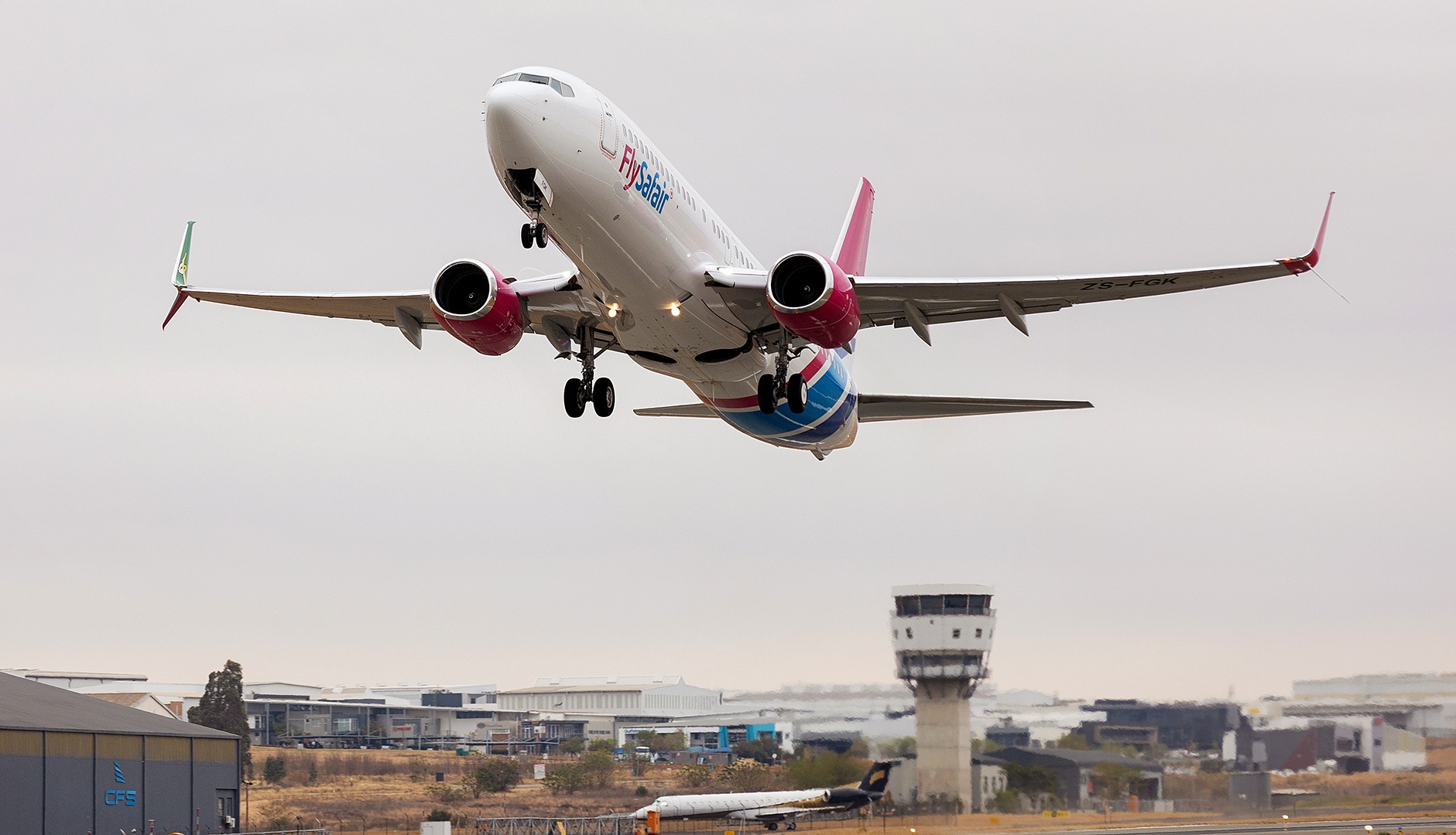
 FlySafair is being taken to the National Consumer Tribunal for overbooking flights. (Photo: Supplied)
Frequent domestic flyers know the quiet comfort of the vacant middle seat. And since FlySafair pioneered the practice of seating up to the bulkhead of the local planes, that privilege has become an ever more endangered species. Low-cost airlines squeeze every gram of efficiency out of each seat, and one of the industry fail-safes has now been passed on for scrutiny by the National Consumer Tribunal (NCT).
When it’s the result of a no-show, that empty seat is what happens when the airline gets the maths correct: there is sufficient demand on the route and flight timing that the airline could sell out the flight. If there is consistent enough sellouts, it could mean the need to invest in another airplane for an additional flight or a bigger plane that can seat more passengers.
But enough no-shows can also allow enough room to overbook existing flights and get additional revenue – and carry the risk of a refund or bumping overflow passengers to alternative flight arrangements. In algebra that simple binary is called a binomial distribution problem.
The National Consumer Commission (NCC) calls it “unconscionable conduct” that violates section 47 of the Consumer Protection Act (CPA) – along with other transgressions of sections 19(2), 22(1), 40(1), 41(1), 48(1), and 49.
Fair objection
FlySafair has a policy of an option of a full refund when the passenger does not accept being bumped to another flight or a R1,000 cash compensation baked into its business foundations.
The airline says that this is in line with the Consumer Goods and Services Ombud (CGSO) Advisory Note 9 of 2021 which has since been removed from the CGSO website, but is still the agreed industry standard for airline bookings – unless the tribunal finds different.
The core tenet of the NCC argument is, of course, section 47 of the CPA, which states that where a supplier fails to supply goods or services on an agreed date or time because of a shortage of stock or incapacity, the supplier must provide same or equivalent goods or services to the consumer, or the supplier must refund the consumer all amounts paid with prescribed interest and incidental costs for breach of the agreement.
Subsequently, the NCT referral follows an investigation into passenger bookings from November 2024 to January 2025, which revealed that FlySafair systematically overbooks flights, affecting more than 5,000 passengers monthly during the assessed period – which was only the second Dezemba period of truly open and back-to-normal festive travel after Covid.
NCC acting commissioner Hardin Ratshisusu summed it up best in the statement:
“The NCC’s investigation has found FlySafair’s booking practices to be inconsistent with multiple sections of the CPA, which is the basis of the referral of the matter to the tribunal. The CPA prohibits suppliers from taking consumers’ money for goods or services they cannot provide.”
To go boldly
The airline’s marketing chief, Kirby Gordon, is confident that “the facts will show that we’ve acted lawfully and in good faith and in accordance with the guidance of the CGSO’s advisory notes on the topic of overbooking”.
Gordon’s statement, which was shared with Daily Maverick, actually wears the accusatory data as a badge of honour:
“While approximately 5,000 passengers were over-booked during the period in question, more than 99.98% of customers travelled exactly as booked because of anticipated no-shows. And every single passenger who was affected or denied boarding was offered re-accommodation or a refund and compensation.”
His stance is grounded in international precedent, where overbooking is a standardised, legal and highly regulated mechanism used to offset the 5%–15% of passengers who statistically do not show up for flights.
Even the Department of Transport for the notoriously litigation-heavy US market is against banning it. Instead, Barbara Creecy’s American counterpart enforces strict denied boarding compensation of up to 200% of the fare for short delays and 400% of the fare for long delays on domestic flights, to disincentivise airlines from involuntary bumping.
The practice is governed under Regulation (EC) No 261/2004 in the EU. While it’s a lot more complicated, it basically says that passengers who are bumped receive flat-rate compensation of €250 to €600 based on flight distance, alongside an airline burden of absolute duty of care (read: free meals, hotel accommodations).

No comfortable solutions
The NCC is shooting straight past the R1-million minimum fine and going after the maximum outcome of 10% of FlySafair’s annual turnover.
This creates an economic problem unique to the notoriously rigid business dynamics of airlines. Banning overbooking entirely would likely have severe economic consequences for South African consumers.
Airlines need to achieve what is known to the industry as a break-even load factor – that math problem from earlier where the flight needs to fill a certain number of seats to cover the cost of the flight. Historically that is around 57.8%, and overbooking accounts for the natural 5%–15% no-show rate.
Completely removing that buffer means flights will depart with empty seats and, to compensate for this lost revenue, most likely increase baseline domestic airfares by 5%–10% or drop certain flights from the schedule to increase the average demand on routes.
The passenger loses on all sides of the equation. DM
Comments
Scroll down to load comments...