




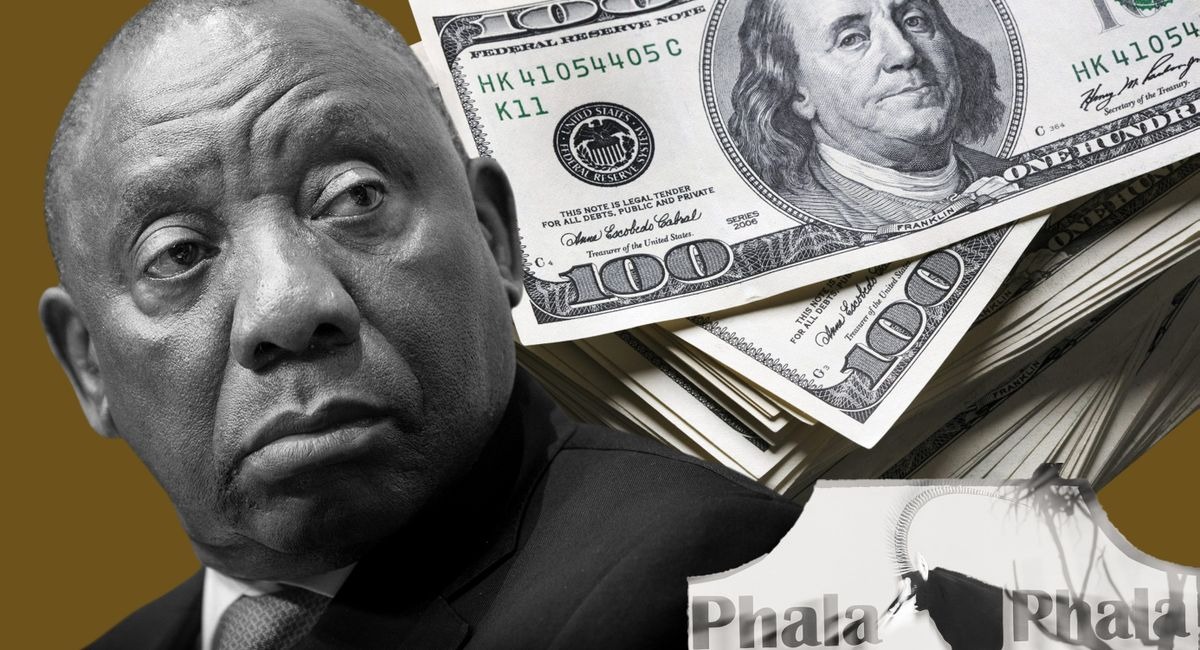
 Illustrative image: President Cyril Ramaphosa. (Photo: Jaco Marais / Gallo Images) | US dollars. (Photo: iStock) | President Cyril Ramaphosa’s Phala Phala farm in Limpopo. (Photo: Leon Sadiki)
Six years after the theft of at least $580,000 (about R8-million) at President Cyril Ramaphosa’s Phala Phala farm, the leadership of the South African Police Service (SAPS) has offered a simple explanation for why no senior police officials were ultimately found guilty of misconduct in the saga: there wasn’t enough evidence.
Appearing before Parliament’s Portfolio Committee on Police on Wednesday, 10 June 2026, SAPS and the Independent Police Investigative Directorate (Ipid) were questioned about the handling of the investigation into the 2020 burglary and the subsequent disciplinary process involving members of the Presidential Protection Service.
The police argued that the “not guilty” findings were not the result of favouritism or political interference, but rather insufficient evidence.
“The findings therefore reflect evidentiary insufficiency within the disciplinary process, rather than a dismissal of the seriousness of the allegations,” SAPS said in its presentation.
Simply put, SAPS admitted the allegations were serious, but investigators could not find enough evidence to prove misconduct during disciplinary hearings.
Different findings, different standards
A major part of SAPS’s presentation focused on explaining why oversight bodies and disciplinary hearings reached different conclusions.
According to SAPS, bodies such as Parliament and other watchdog institutions can identify possible wrongdoing and recommend action. Disciplinary hearings, however, require evidence to be tested before a finding can be made.
“Different outcomes may therefore arise, not from a rejection of oversight findings, but from the application of distinct processes and evidentiary standards,” it said.
SAPS said this explains why some officials were cleared despite concerns raised by oversight bodies.
Why no criminal case was opened
One of the biggest questions in the Phala Phala matter has been why a criminal case was not immediately opened after the theft took place in February 2020.
According to SAPS, investigators found no evidence that any police officer refused to open a case, instructed others not to do so, or stopped a case from being registered. Instead, SAPS argued that responsibility for reporting the crime rested with the person in control of the farm, the farm manager.
“The allegation therefore relied primarily on inference rather than direct or corroborated evidence.”
Ipid’s investigation
The police watchdog, Ipid, however, found that the theft case was mishandled by members of the Presidential Protection Service and that an unlawful informal investigation was opened without first opening a criminal case or inquiry.
It recommended disciplinary action against Major General Wally Rhoode, head of the Presidential Protection Service, and Constable Hlulani Rekhoto, finding “information of evidential value” that both breached police rules and legal obligations.
It seems those findings were not implemented.

In its presentation to the committee, Ipid responded to a number of questions. In one of them, it was asked whether it had any recourse when SAPS disciplinary outcomes appear inconsistent with its recommendations, the directorate’s response consisted of a single word: “None.”
Elsewhere in the presentation, Ipid acknowledged that while Section 30 of the Ipid Act requires SAPS to initiate disciplinary proceedings within 30 days of receiving recommendations, the watchdog lacks any meaningful enforcement mechanism.
“Ipid does not have any legal recourse if SAPS fails to implement or take steps that are not proportionate to the misconduct committed,” the presentation states.
The watchdog further admitted that existing legislation does not adequately empower it to ensure implementation of its findings.
The problem of delayed reporting
SAPS told MPs that the biggest challenge was that the theft was only formally reported to investigators about two years after it happened.
“The incident, which occurred in 2020, was only formally reported to investigative authorities in 2022, materially affecting the availability of evidence.”
According to SAPS, by the time investigators became involved, it was too late to properly process the crime scene.
“The handling of the crime scene was significantly affected by the delayed reporting of the incident.”
The police said no physical evidence could be collected and standard forensic investigations could not be done.
“This limitation meant that no physical exhibits were recovered and that traditional forensic methods could not be applied.”
Instead, investigators had to rely mainly on witness statements and documents to reconstruct what happened.
‘No evidence’ against Ramaphosa
The police also addressed allegations that Ramaphosa influenced the handling of the matter.
According to SAPS, investigators found no evidence that the President gave instructions or directed any police operations linked to the theft.
“Based on the evidentiary record, no information was identified to indicate that instructions were issued or that operational decisions were directed by the Executive Authority.”
SAPS also said investigators found no evidence showing that Ramaphosa had direct knowledge of specific operational actions taken by police officials.
The meeting comes against the backdrop of a ruling in May 2026 in which the Constitutional Court ordered Parliament to establish an impeachment committee to probe the findings of a Section 89 panel that declared Ramaphosa had a case to answer over the theft.
MPs not convinced
Speaking to Daily Maverick after the meeting, Portfolio Committee on Police chairperson Ian Cameron said members were frustrated by what they viewed as SAPS repeating old explanations without answering important questions.
“The one was the monotonous repeat of the disciplinary-related information,” said Cameron, from the DA.
“It just seems as though the impression today that we got was that SAPS, specifically with regards to the disciplinary matter, just regurgitate the same old policy.”
Cameron said MPs repeatedly challenged SAPS over its explanation that responsibility for opening a criminal case rested with the farm manager, “which is a totally unacceptable answer”.
He also questioned why Rhoode was cleared.
“It was as though they were clearly openly protecting General Wally Rhoode because if Rhoode is the head of Presidential Protection Services, there’s no doubt in my mind whatsoever that he had some kind of responsibility to follow up on the case.”
“So I just struggle to buy it,” Cameron said.
/file/attachments/orphans/Major-General-Wally-Rhoode_777108.jpg "Major General Wally Rhoode, head of the Presidential Protection Service. (Photo: DA / Facebook)")
ATM leader and committee member Vuyo Zungula was even more critical about the quality of answers the leadership gave to MPs.
“I think what we took as members is how SAPS and Ipid compiled a whitewash of a report to protect the president and the people who were somewhat involved,” Zungula told Daily Maverick.
“Because if you look at the evidence that was there, it really shows how the president was involved.”
‘Have they seen the couch?’
Zungula said one of the most worrying admissions during the briefing was that investigators had not physically examined the couch where foreign currency was allegedly hidden.
“Members also asked about the couch. Have they seen the couch? Have they examined the couch?” he said.
“And they agreed, no, they’ve not seen the couch. They’ve not examined the couch.”
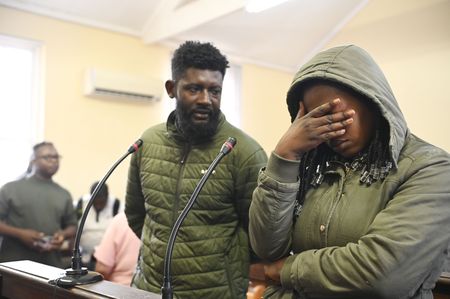
For Zungula, that raised serious concerns about the quality of the investigation into the theft which is currently on trial at the Modimolle Magistrate’s Court in Limpopo.
“And then the question was, how then do they proceed with the criminal case without checking the evidence?”
What now?
Zungula said committee members were unhappy with many of the answers provided by both SAPS and Ipid.
“We were not happy back then, we’re still not happy even now,” he said.
The committee is now expected to compile a report and consider making recommendations on possible next steps, including whether it should call more witnesses.
However, Cameron cautioned that summoning people like Rhoode could complicate parallel parliamentary processes.
“The risk is that yes, we can call Wally Rhoode, for example, to come and testify at the committee, but at the same time, if he’s testifying on half of the same thing at the impeachment committee, it could potentially harm the inquiry.”
“So we need to make sure that us and the impeachment committee are on the same page,” added Cameron. DM
Comments
Scroll down to load comments...