




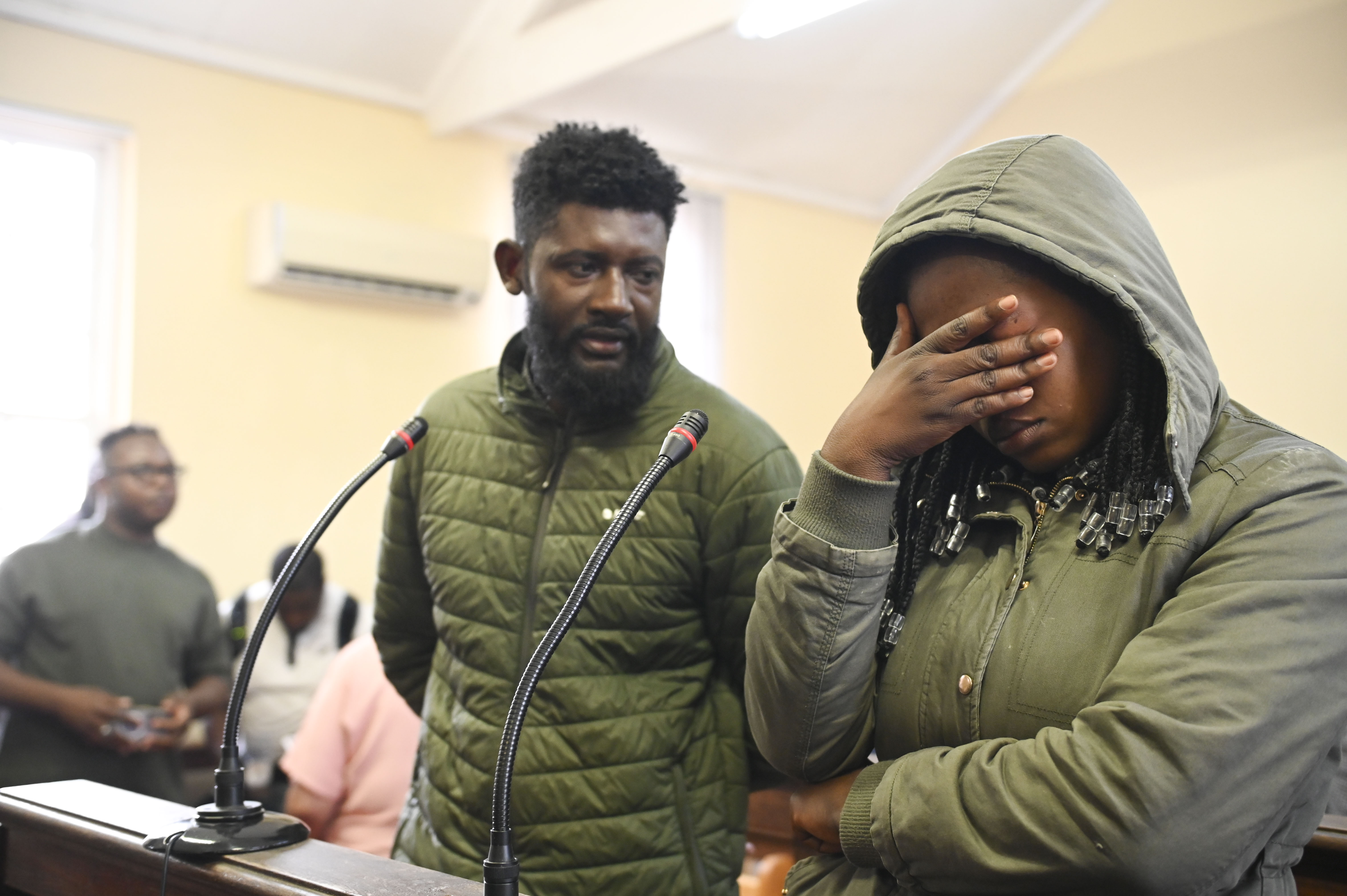
 Imanuwela David and Floriana Joseph appear in the Bela-Bela Magistrates’ Court in November 2023 in connection with the 2020 heist at President Cyril Ramaphosa’s Phala Phala farm. (Photo: Deaan Vivier / Gallo Images / Beeld)
The trial over the alleged theft of at least $580,000 from President Cyril Ramaphosa’s farm, Phala Phala in Limpopo, is drawing to a close, with two of the three accused opting not to testify, potentially weakening the State’s case against them.
The State alleges that the second accused, Floriana Joseph, who was employed as a cleaner at the farm, saw the money hidden inside a couch and alerted her brother, Ndilinasho Joseph, the third accused.
He allegedly then informed the first accused, Imanuwela David, whom the State has described as the mastermind behind the burglary.
When proceedings continued in the Modimolle Magistrates’ Court in Limpopo last week, the Joseph siblings were expected to testify about their version of events.
/file/dailymaverick/wp-content/uploads/2025/10/IMG_3128.jpg "From left: Ndilinasho Joseph, Floriana Joseph and Imanuwela David in the dock at the Modimolle Magistrates' Court last week. (Photo: Nonkululeko Njilo)")
Daily Maverick understands that the State had hoped that during cross-examination they would turn against or implicate one another, which would have strengthened the State’s case.
However, on Friday afternoon, the siblings’ lawyer, advocate Relleng Masipa, informed the court that they had elected not to testify.
Although Masipa did not elaborate on the reasons, Daily Maverick understands that the defence believed the siblings had no case to answer to.
National Prosecuting Authority spokesperson Mashudu Malabi said the State remained confident of its case against the siblings.
“We were not taken aback by that development. It is part of the trial. They elected not to take a stand, and they are exercising their rights,” she said.
Two months ago, after the State wrapped up its case, the three accused launched a Section 174 application, arguing that the State had failed to present enough evidence to sustain the charges against them.
Tough questions
To date, the bulk of the State’s evidence has implicated David.
David, who took the stand and was cross-examined, faced tough questions from the prosecutor, advocate Nkhetheni Munyai, about how his financial circumstances appeared to change dramatically after the alleged 2020 break-in at Phala Phala. The State relied on evidence from a financial analyst who examined David’s bank records for the two years before and after the alleged burglary.
Those records showed total account activity of about R181,000 in 2018 and R126,000 in 2019, rising sharply to more than R3-million in 2020.
The court also heard from witnesses who claimed to have assisted David in exchanging dollars for rands, as well as a vehicle salesman who facilitated the purchase of five luxury vehicles and other questionable transactions, including the purchase of properties.
The court heard that David spent R253,000 on a set of custom-made dental grills and R70,000 on diamonds to add to his Rolex watch.
David denied that the money came from the Phala Phala burglary, maintaining that he had legitimate businesses, including a logistics company. However, the State presented evidence showing a significant difference between his income before the burglary and the assets he acquired afterwards.
His lawyer, Koena Matlala, told the court that some of the money came from a construction company owned by David’s uncle, a business in which David said he had “helped”.
To back up the claim, Matlala submitted an invoice showing that more than R1-million was allegedly paid into David’s account for an excavation truck three months before the robbery. The invoice, however, raised more questions than answers.
Munyai objected to its admission, arguing that it lacked key details, including a relevant company registration number.
The magistrate also questioned the authenticity of the document and how it had been obtained, saying that what was before the court was merely a copy. Matlala responded that it had been received via email.
After hearing arguments from both sides, the magistrate ruled that the invoice would be “provisionally” admitted as evidence.
During his cross-examination, David hardly implicated his co-accused. He was asked questions relating to more than 80 calls and messages between them, which the State alleged were used to plan the break-in. Apart from that correspondence, little evidence has been led on the Joseph siblings.
“The suggestion placed before court is that you were communicating in relation to committing that offence? What’s your response to that?” asked Masipa.
“I told the investigating officer that prior to the break-in of Phala Phala, we [had known each other from way back] and we used to communicate on a daily basis. It’s not that our conversation was to talk or plan the break-in at Phala Phala,” David responded.
The background
In June 2022, former correctional services commissioner Arthur Fraser filed a criminal complaint alleging that Ramaphosa had concealed the theft of $4-million in cash hidden in couches and mattresses at Phala Phala.
This led to criminal investigations and a political storm that tested Ramaphosa’s presidency and fuelled calls for his resignation.
Four years later, Ramaphosa has said he will not resign after the Constitutional Court ordered Parliament to establish an impeachment committee to probe the findings of a Section 89 panel that declared he had a case to answer over the theft. The President is challenging the Section 89 panel’s findings in court.
Before that ruling, a report by the Independent Police Investigative Directorate revealed that the theft had been mishandled by members of the Presidential Protection Service.
Closing arguments in the case are set to commence on Friday, 12 June. DM
Comments
Scroll down to load comments...