




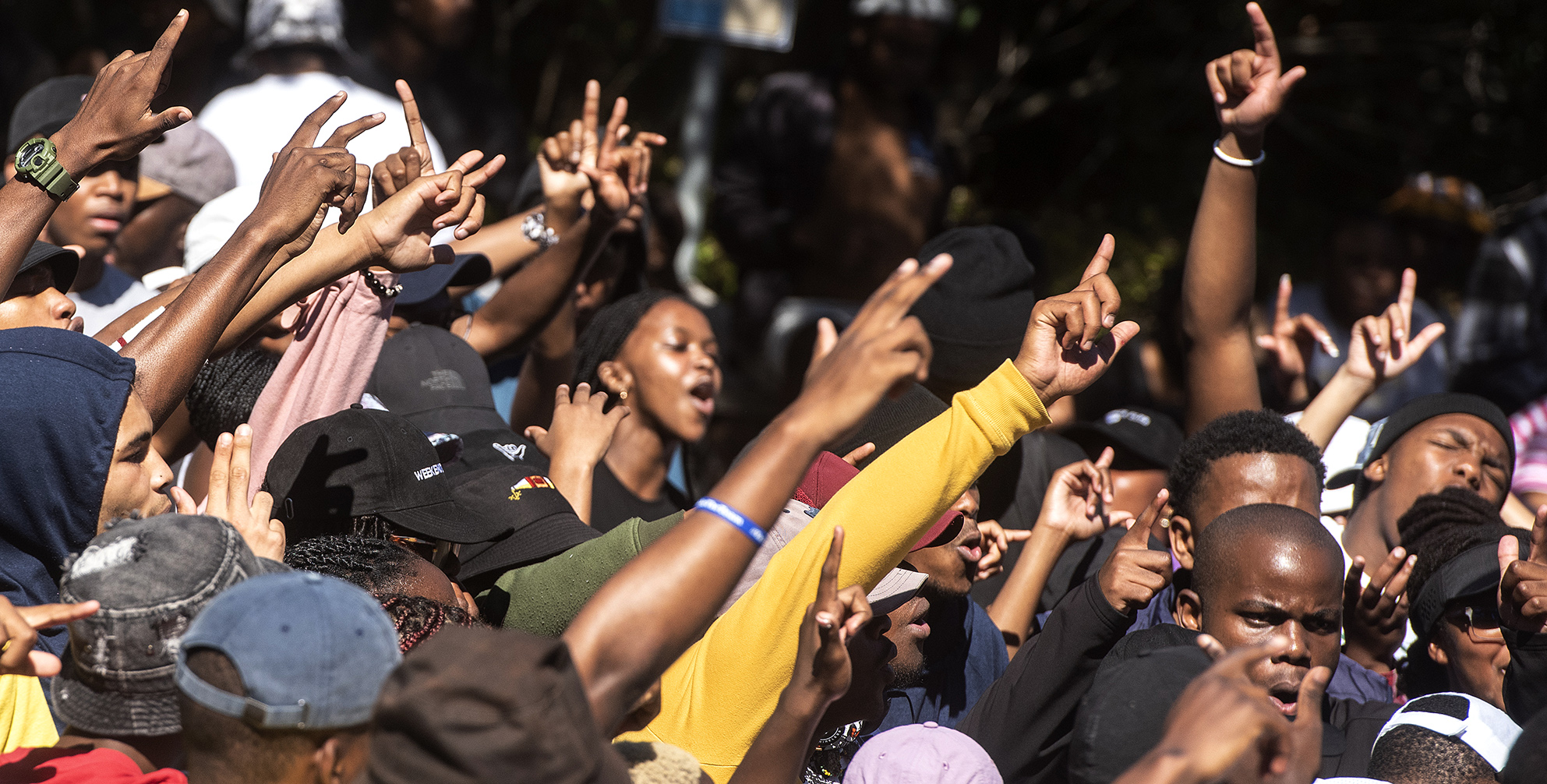
 University of Cape Town students protest on the Bremner Building Middle Campus on 10 March 2023 after the institution maintained its position that it would not scrap students’ historical debt. (Photo: Gallo Images / Brenton Geach)
South Africa is facing a higher education crisis that should alarm every citizen, policymaker, employer and taxpayer. More than 165,000 graduates have completed their studies but cannot access their qualification certificates because of unpaid fees.
Some estimates place the figure even higher, at more than 188,000 graduates. At the same time, student debt across the higher education sector has surged to an astonishing R59-billion. These are not merely numbers on a balance sheet. They represent human lives, lost opportunities and a growing threat to the future of the country.
The irony is difficult to ignore. South Africa desperately needs more skilled professionals to drive economic growth, reduce unemployment, strengthen public services and compete in a rapidly changing global economy. Yet thousands of graduates are being prevented from entering the labour market because the very institutions that educated them are withholding proof of their qualifications.
This is not simply a student problem. It is a national development problem.
The current situation creates a vicious cycle. Graduates cannot secure decent employment without certificates. Without employment, they cannot repay their debt. Universities, meanwhile, cannot recover outstanding fees and continue accumulating financial losses. As debt grows, institutions become increasingly financially vulnerable, creating pressure to tighten debt recovery measures further. Everyone loses.
The crisis also exposes deeper structural weaknesses in South Africa’s higher education funding system. The National Student Financial Aid Scheme (NSFAS), which was designed to expand access to higher education, now appears to be at the centre of a growing governance and sustainability challenge. Universities report that nearly half of all outstanding student debt is linked to NSFAS-funded students. Reconciliation disputes between institutions and NSFAS remain unresolved in some cases for years. Delayed payments, accommodation funding caps, governance failures and repeated administrative interventions have contributed to growing instability.

The recurring pattern has become familiar. A crisis emerges. A task team is established. A new board is appointed. An administrator takes over. Temporary stability follows. Then the same problems reappear. Students suffer. Universities absorb the financial consequences. The cycle repeats itself.
South Africa cannot continue managing higher education through crisis response. What is required now is structural reform.
The first step should be an immediate national graduate certificate release programme. Graduates who have completed their qualifications should not be permanently excluded from employment opportunities because of historical debt. The government, universities and financial institutions should work together to establish an income-contingent repayment mechanism that allows graduates to access their certificates while committing to repay debt once they enter formal employment. Such models have been successfully implemented in countries such as Australia and the UK.
Unlocking certificates is not charity. It is an investment in economic productivity. Every graduate who gains employment becomes a taxpayer, contributes to economic growth and improves the likelihood of debt recovery.
Second, South Africa must finally address the “missing middle” crisis. For years, public debate has focused on students who qualify for NSFAS support and those who can comfortably afford higher education. Yet a large group of students falls between these categories. Their family incomes exceed NSFAS thresholds but remain insufficient to cover university costs. These students often accumulate debt despite academic success and are disproportionately represented among graduates whose certificates are withheld.
A dedicated missing-middle funding scheme, supported by the government, development finance institutions and the private sector, is urgently needed. Without such intervention, debt will continue accumulating regardless of how much NSFAS funding expands.
Third, the country must rethink the relationship between universities and student funding. Public universities are increasingly dependent on tuition fees because government subsidies have not kept pace with enrolment growth and rising operational costs. This is unsustainable. Universities cannot simultaneously expand access, maintain quality, invest in infrastructure, support research and absorb billions in unpaid fees.
Higher education should be viewed not as a private consumer good but as a strategic national investment. Countries that successfully transformed their economies invested heavily in universities, research and human capital. South Africa cannot build a knowledge economy while underfunding the very institutions responsible for producing knowledge.
Fourth, there is an urgent need to strengthen graduate employability. Rising debt levels are partly linked to unemployment and underemployment. Universities, employers, industry bodies and government departments must collaborate more closely to ensure that academic programmes remain relevant to labour market demands. Work-integrated learning, internships, entrepreneurship support, digital skills development and stronger university-industry partnerships should become central features of higher education policy.
Finally, South Africa needs a comprehensive review of the entire student funding architecture. The recurring instability within NSFAS suggests that the problem is not merely administrative. It is systemic. The country requires a funding model that is financially sustainable, transparent, accountable and capable of supporting the scale and complexity of contemporary higher education.
The real tragedy is not the R59-billion debt figure. The real tragedy is the lost potential represented by thousands of graduates whose futures are being delayed. Every withheld certificate represents a teacher who cannot teach, an engineer who cannot build, a nurse who cannot serve or an entrepreneur who cannot create jobs.
South Africa’s higher education system has demonstrated remarkable resilience over the past three decades. But resilience alone is no longer enough. The country must move beyond managing symptoms and confront the root causes of the crisis.
The question is not whether South Africa can afford to reform student funding. The question is whether it can afford not to.
For the sake of students, universities and the future of the economy, the answer should be obvious. DM
Emnet Tadesse Woldegiorgis is professor and director of the Ali Mazrui Centre for Higher Education Studies at the University of Johannesburg. His research focuses on higher education transformation, internationalisation, decolonisation, governance and social justice in African higher education.
Comments
Scroll down to load comments...