




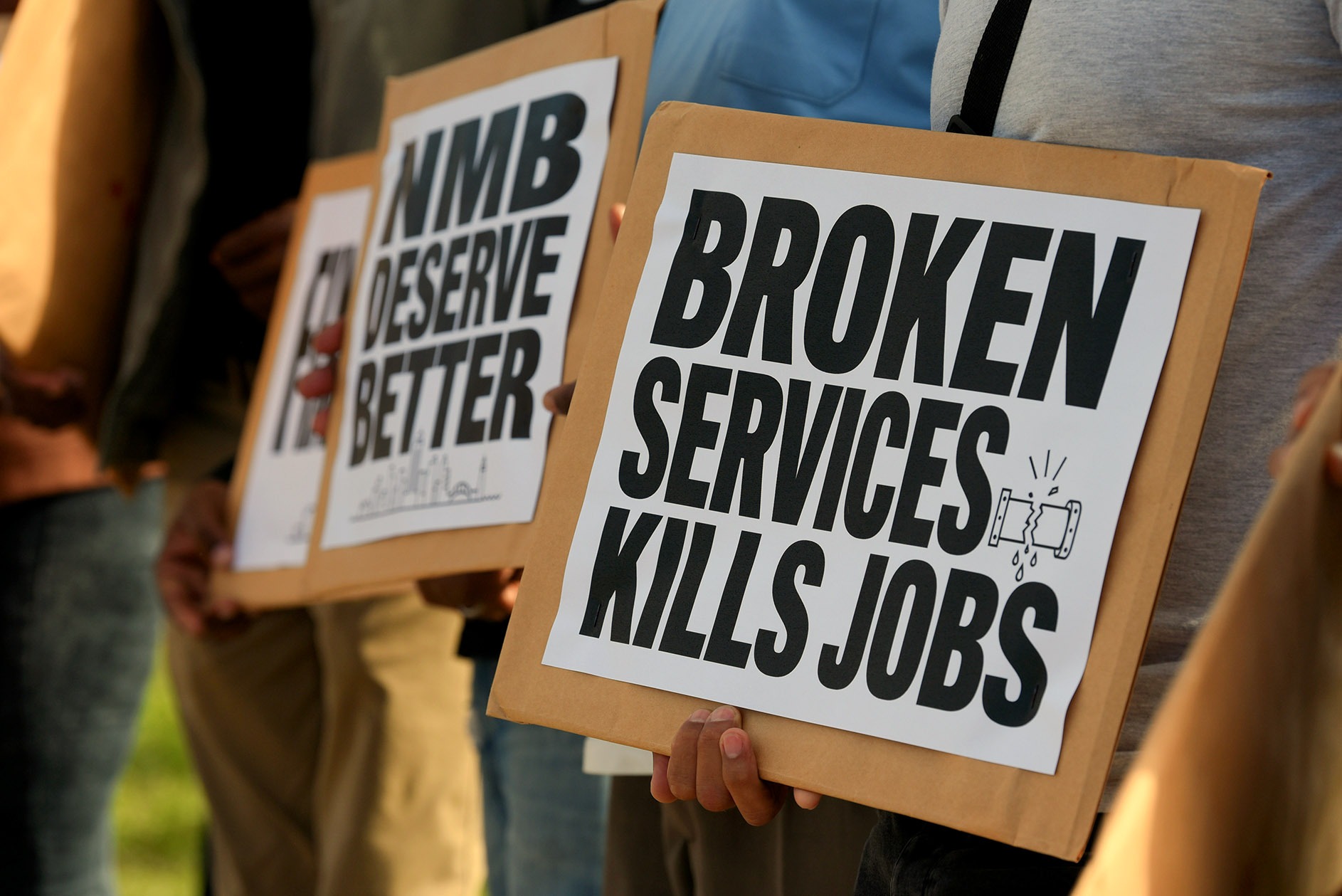
 In May a picket was organised by the Nelson Mandela Bay Civil Society Coalition where they demanded better service delivery and good governance from metro officials. (Photo: Deon Ferreira)
Nelson Mandela Bay’s DA councillor and budget and treasury spokesperson Brendon Pegram says the municipality could have reduced its rates tariff by as much as 24% had it tackled the R863-million loss in its troubled electricity department – but instead the council voted to pass the steepest package of tariff increases in eight years.
Pegram argued that the municipality had not made a sufficient attempt to curb non-technical losses – electricity lost to theft and illegal connections – that were bleeding the department dry.
Addressing those losses alone, he said, could have allowed the City to reduce its rates tariff by almost a quarter.
Pegram was commenting after a council meeting on Monday evening where the metro’s controversial 2026/27 budget was adopted. It was opposed by the DA, FF Plus and ACDP. The budget was supported by the EFF, ANC, National Alliance, Defenders of the People, PAC, AIM, AIC and Good.
The vote follows weeks of controversy after the National Treasury found that an earlier version of the budget was unfunded, forcing the municipality to revise its revenue and expenditure projections before resubmitting it for approval.
Residents will now see a tariff increase of:
- Property rate increase of 5.5%, effective from 1 July.
- An electricity price increase of 10.95%, pending approval from the National Energy Regulator of South Africa.
- An increase of 6.5% across the board for water, refuse collection and sanitation rates.
The budget was supposed to be adopted by 31 May, at least 30 days before the start of the new financial year. However the Municipal Finance Management Act (MFMA) provides mechanisms for municipalities to address situations where a budget has not yet been approved by the council before the start of the financial year on 1 July.
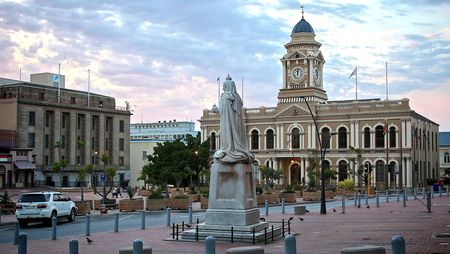
Nelson Mandela Bay mayor Babalwa Lobishe said she welcomed the adoption of the 2026/27 budget by the council following a robust democratic process that included extensive public participation, engagements with stakeholders, and careful consideration of the City’s financial realities.
Lobishe said the tariff increases were driven by National Treasury guidelines, escalating bulk service costs, inflation, infrastructure maintenance requirements and the need to keep the municipality financially sustainable.
She said the municipality was mindful of the pressure on household finances, and that the budget sought to protect vulnerable residents through indigent support programmes and targeted social interventions.
“A municipality cannot spend money it does not have. The National Treasury requires municipalities to adopt credible, funded budgets that balance the needs of residents with the financial sustainability of the institution. Our responsibility as council is to protect both current service delivery and the future of the City. This budget seeks to do exactly that.
“That is precisely why we have worked to ensure that support mechanisms remain available for qualifying indigent households while at the same time safeguarding the municipality’s ability to maintain infrastructure, respond to service delivery challenges, and invest in the future growth of Nelson Mandela Bay,” Lobishe said.
/file/attachments/orphans/WhatsAppImage2026-03-24at115525_580642.jpeg "Nelson Mandela Bay Mayor Babalwa Lobishe appeared before Parliament’s Portfolio Committee on Cooperative Governance and Traditional Affairs in Cape Town on 24 March 2026. (Photo: Phando Jikelo / RSA Parliament)")
“The choice before council was not whether costs exist, but whether we would adopt a responsible budget that secures the future of Nelson Mandela Bay. A financially sustainable municipality is the foundation upon which service delivery, economic development and social progress are built. This budget reflects that responsibility,” she said.
ACDP councillor Lance Grootboom accused the ANC-led coalition of “extorting” residents through tariff increases to compensate for what he described as years of financial mismanagement and failures to curb electricity theft.
Lobishe rejected that assertion, saying this it both inaccurate and irresponsible.
“The reality is that municipalities across SA are facing significant cost pressures. Bulk electricity purchases, water provision, infrastructure maintenance, fuel, fleet operations and the cost of delivering services continue to rise. To suggest that council is extorting residents ignores both the legislative framework within which municipalities operate and the practical realities of sustaining service delivery.”
‘Significant revenue losses and deteriorating infrastructure’
Speaking during the budget debate, Grootboom said residents were being forced to shoulder higher property rates and service charges while the municipality failed to address significant revenue losses and deteriorating infrastructure.
“You are extorting the honest, law-abiding ratepayers of this city. You are slapping them with a brutal 5.5% hike on property rates and a crushing 6.5% increase on service charges. Why? Because your Electricity Directorate loses a shocking R1.5-billion every single year to theft and network tampering.
“We spend R7.8-billion buying power from Eskom, but we only recover R6.9-billion. You are draining the hard-earned money of honest, paying citizens to cross-subsidise lawlessness! It is pure administrative failure.”
Grootboom claimed the municipality was effectively using tariff increases to cross-subsidise losses caused by electricity theft and non-payment, rather than tackling the root causes of the problem.
He also questioned the financial sustainability of the budget, alleging that municipal officials had made last-minute adjustments after the National Treasury initially flagged the budget as unfunded.
/file/attachments/orphans/LanceGrootboom_133737_382791.jpg "ACDP councillor Lance Grootboom. (Photo: Deon Ferreira)")
According to Grootboom, the municipality recorded an operating deficit of nearly R470-million before capital transfers and was unable to generate sufficient revenue to cover its day-to-day operating costs.
He alleged that officials subsequently increased proposed water and electricity tariffs and reduced expenditure projections to ensure the budget complied with Treasury requirements.
“This entire budget is a multibillion-rand financial illusion cooked up in just nine days to cheat a computer compliance check,” Grootboom told the council.
He further raised concerns about the municipality’s cash position, arguing that while the City reported nearly R3-billion in available cash, it was carrying more than R6-billion in current liabilities owed to suppliers and contractors.
Grootboom said this was one of the reasons local contractors often waited extended periods to be paid, delaying repairs to water, electricity and road infrastructure.
He also criticised what he described as inadequate spending on infrastructure maintenance. He argued that the municipality should be spending substantially more on maintaining existing assets and warned that underinvestment would accelerate the deterioration of roads, water infrastructure and other municipal facilities.
“No wonder our infrastructure is crumbling before our eyes,” he said.
Grootboom further accused the municipality of failing to spend available grant funding, claiming billions of rand intended for infrastructure development had either been forfeited or returned to the National Treasury because of procurement delays and project implementation failures.
Money earmarked for housing, water infrastructure and public lighting projects had been lost while communities continued to experience service delivery failures, he said.
Pegram painted a damning picture of the City’s infrastructure failures, noting that the municipality had roughly 22,000 faulty streetlights, more than 7,500 unattended water leaks, and more than 20,000 gaping potholes, while allowing over R1.5-billion in conditional grant funding to be forfeited to the National Treasury unspent.
“The same people behind decisions that have resulted in power pylons collapsing, extended water outages, and deteriorating streets now want residents to foot the bill for their inaction and maladministration.
“And even as they pass a budget that will place immense pressure on the residents of this metro, they continue to budget for more waste,” Pegram said.
/file/attachments/orphans/WhatsAppImage2026-03-05at140956_394505_945876.jpeg "NMB DA councillor Brendon Pegram. (Photo: Andisa Bonani)")
Pegram further warned that the coalition had failed to allocate enough funding to tackle the City’s growing maintenance backlog, increasing the risk of further infrastructure deterioration.
“There are hardly any incentives to encourage economic growth in a province with the highest unemployment in the country.
“The ward-based budgets are an absolute shambles. Proposed capital spending ranges from just R55 per person per year in Ward 25, to R4,715 per person per year in Ward 41,” Pegram said.
FF Plus councillor Bill Harington said residents were being punished by paying more for services while service delivery across the city was abysmal.
“Madam Speaker, the real question is not how much residents are expected to pay. The real question is what they are receiving in return for these increases,” Harington said in council on Monday.
“Across Nelson Mandela Bay, residents are confronted daily by pothole-ridden roads, sewage flowing through communities, ageing infrastructure, unreliable water supply, failing public facilities and deteriorating municipal assets. Service delivery continues to decline while the financial burden on residents continues to increase.”
/file/dailymaverick/wp-content/uploads/2025/09/Bill-Renaldo-1.jpg "FF+ Nelson Mandela Bay caucus leader Bill Harington (left) welcomes Renaldo Gouws to the party. (Photo: Supplied)")
Harrington said he was “deeply disappointed” by Lobishe and her mayoral committee, arguing that effective leadership should be measured by the quality of service delivery, infrastructure maintenance and value provided to residents, rather than by increases in tariffs.
“Unfortunately, this administration, your administration, has failed that test,” he said.
“The executive mayor and her mayoral committee cannot continue to ask residents to pay more while failing to address the very problems that continue to plague this metro. Ratepayers are not an endless source of revenue to compensate for poor governance, wasteful expenditure, weak financial controls and a lack of political leadership.
“Madam Speaker, what is particularly concerning is that these tariff increases are being proposed while questions and uncertainty continue to surround aspects of the budget process itself. Public trust can only be restored through transparency, accountability and sound governance,” Harington said. DM