




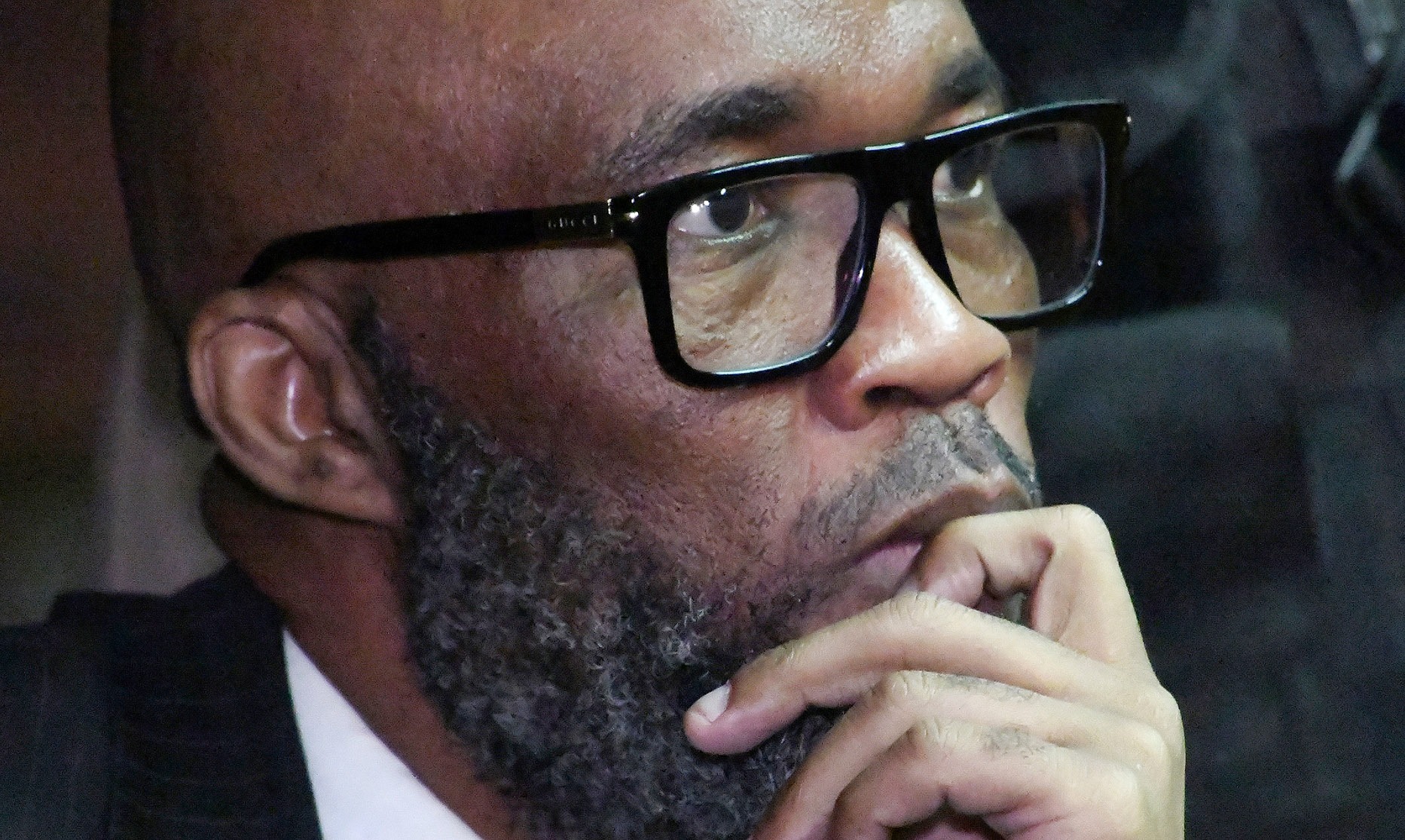
 Vusimuzi ‘Cat‘ Matlala appears at the Pretoria Magistrate’s Court on 25 March 2026, where he faces charges relating to a dubious contract alongside several senior police officers. (Photo: Frennie Shivambu / Gallo Images)
A police witness has told the Madlanga Commission of Inquiry that he knew Vusimuzi “Cat” Matlala as an informant and only later heard allegations that he was using the police service to “eliminate his rivals”.
The witness testified under the pseudonym Witness I on Tuesday, 9 June 2026.
He did so via audio only, in keeping with a ruling to protect his identity for security reasons.
Witness I, who used to be a member of the now-defunct crime investigation unit the Scorpions, and who was also part of the South African Narcotics Enforcement Bureau and involved in various drug investigations, said he knew Matlala from police work.
Matlala is now at the centre of South Africa’s law enforcement scandal, hinged on accusations that a drug cartel has infiltrated the criminal justice sector.
He has been accused of being part of that cartel and of corrupting various police officers.
Matlala ‘the informer’ and John Wick
“I know Vusi Matlala as he was an informer that assisted [the Tactical Operations Management Section] TOMS with tip-offs regarding several successful operations,” Witness I said, reading from a statement prepared for the Madlanga Commission.
“The tip-offs came through Captain Felani Zungu who worked at TOMS, [and these] resulted in the permanent arrest of mostly wanted, feared and dangerous suspects.”
Witness I listed one of these suspects as James Nkwana, also known as John Wick, a fictional character’s name once assigned to an individual targeting Boko Haram gang members in Mamelodi. (Matlala was previously also thought to be operating under the name John Wick.)
Matlala has not previously been named as an informant during the Madlanga Commission proceedings.
/file/attachments/2992/ED_608782_836849.jpg "Vusimuzi ‘Cat’ Matlala appears in the Pretoria Magistrate's Court on 13 May 2026. He faces criminal charges along with several police officers over a dubiously awarded health services contract that has since been terminated. (Photo: Frennie Shivambu / Gallo Images)")
Instead, the focus has been on his extensive criminal background, including his conviction for a residential robbery in 2001.
Other cases Matlala faced included a 2006 cash-in-transit crime for which he was acquitted, a 2012 house robbery matter that was withdrawn, and a 2018 attempted murder accusation that was also withdrawn.
Matlala now faces various criminal charges and is behind bars.
Mogotsi and ‘the favour’
During Tuesday’s Madlanga Commission proceedings, Witness I also testified that in 2020, he first met Brown Mogotsi, a figure whose name has repeatedly surfaced in Madlanga Commission proceedings and who is now facing criminal charges for allegedly faking his own attempted murder.
According to Witness I, another meeting involving Mogtosi in 2025 was facilitated by Matlala.
Witness I said at that meeting, he was ultimately asked to help clear Crime Intelligence officer Feroz Khan in a scandal involving cocaine, and that in return, he would get a promotion and “a bag”. (Presumably with money in it.)
A large part of Tuesday’s proceedings focused on Khan and the cocaine matter.
MADLANGA COMMISSION | Witness I says he first met Brown Mogotsi in 2020 around Rustenburg as a source who provided information on alleged illegal conduct and practices in the North West. pic.twitter.com/nAJnUjwrAM
— SABC News (@SABCNews) June 9, 2026
This comes a day after Khan was told he is expected to testify before the Madlanga Commission next month, and after communications, gleaned from a device seized during his unrelated recent arrest, were made public because of legal action he initiated and which backfired.
Khan’s name has repeatedly been linked to the cocaine saga that involves a consignment, weighing 715.86kg and worth about R286-million, that was shipped to Durban in Scania truck parts and then transported to Aeroton, a Johannesburg industrial area, where it was intercepted on 9 July 2021.
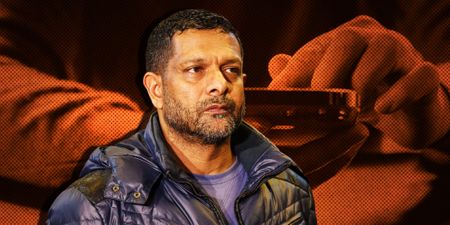
This interception – and what unfolded at that scene – has increasingly become mired in controversy.
Khan previously faced accusations that he brought the police service into disrepute because of his actions at the Aeroton bust, but he was cleared.
‘He hijacked the scene’
Witness I on Tuesday testified that when Khan had arrived at the Aeroton scene, he “did not introduce himself to the attending members”.
He said the driver of the truck carrying the cocaine had been detained, but Khan released him and ordered that those who had located the drugs be detained instead.
Witness I testified that Khan’s actions appeared to protect the truck driver and to obscure the vehicle and its contents.
/file/attachments/orphans/WhatsAppImage2026-05-12at122459_380488.jpg "Cocaine worth around R286-million was discovered concealed in a consignment of truck parts in Aeroton, Johannesburg, in 2021. (Photo: Madlanga Commission of Inquiry)")
“General Khan just hijacked and took over the scene,” he said.
“As an experienced investigator, my observations at the scene indicated potential abuse of power and rank, the reasons for which remain unclear.”
Witness I said that in 2023, he heard there was a departmental investigation into the Aeroton saga.
A police general conducting the investigation had concluded Khan and Gauteng Hawks head Ebrahim Kadwa, who had also been at the scene and faced related complaints, were doing their jobs.
“I did not find this comforting,” Witness I said, adding there had been “hearsay” allegations that Khan was overseeing drugs moving out of KwaZulu-Natal or that he was part of related transactions.
‘Interference’
Earlier during Tuesday’s commission proceedings, Takalani Zelda Maphosho, assistant director of investigations at the Independent Police Investigative Directorate’s (Ipid) national office, testified for a second consecutive day.
Maphosho maintained that, based on information obtained from complainants who approached Ipid, “General Khan interfered in the whole [Aeroton] crime scene”.
However, it was put to Maphosho that she was basing this on what the complainants told her and was not taking into account Khan’s and others’ versions of events.
/file/attachments/orphans/ED_608566_200387.jpg "Senior Crime Intelligence officer Feroz Khan appears in the Kempton Park Magistrate’s Court on 11 May 2026. He faces allegations in an illicit precious metals case. (Photo: Gallo Images / OJ Koloti)")
Four individuals were arrested in connection with the Aeroton cocaine case: local businessman Tumelo Nku; Warrant Officer Marumo Magane of the Zonkizizwe Police Station in Gauteng; Warrant Officer Steve Phakula, a National Investigation Unit member; and Samuel Mashaba, who was involved in traffic services in Gauteng.
(On Monday, the Madlanga Commission proceedings focused on messages about cocaine, allegedly between Nku and a forklift operator known as Alpha.)
The court case against the four was subsequently withdrawn, but investigations into this matter have since been revived.
‘Corrupt law enforcer tactic’
Two main versions of the Aeroton cocaine saga have surfaced so far via the Madlanga Commission.
One is that Nku, Magane, Phakula and Mashaba were among the first to intercept the cocaine in what became a bungled crackdown.
The other is that they actually planned to seize the cocaine and move it to an undisclosed location before other police officers arrived at the scene.
In other words, the second version is that Nku, Magane, Phakula and Mashaba were part of the trafficking chain.
They previously approached Ipid with complaints because they felt they were treated unfairly at the Aeroton scene.
/file/attachments/2992/2026-05-1212_55_46-Greenshot_648049_415049.jpg "Warrant Officer Marumo Magane, commander of the Crime Information Management and Analysis Centre at the Zonkizizwe Police Station in Gauteng, gives evidence at the Madlanga Commission in Pretoria on 12 May 2026. (Photo: SABC News)<br>")
Magane testified before the Madlanga Commission and said that Khan made him sit in a police bakkie, which he (Magane) drove to Aeroton.
“I did as instructed, and he, General Khan, started calling us tsotsi police and said he was going to teach us a lesson,” Magane said
All this ultimately saw Ipid recommend disciplinary action against police officers who were at the Aeroton scene, including Khan.
Maphosho testified on Tuesday that a warning statement in this regard was requested from Khan in 2023 and he had indicated that he wanted more information from Ipid.
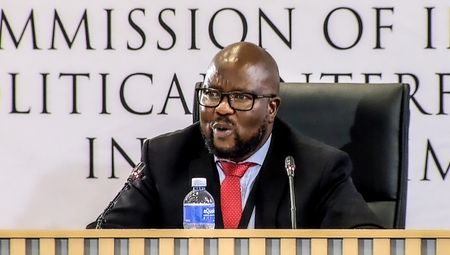
A message from Khan to Ipid was screened during Tuesday’s proceedings.
It said he trusted that the Director of Public Prosecutions official, who was assisting Ipid with its investigation, had been in contact with the state advocate dealing with the matter.
This, Khan said, was “to avoid that your complainant/s scutter or prejudice the criminal trial against them by opening a false parallel charge against police officials on the scene”.
Khan’s communication to Ipid added: “You should know that this is often the tactics employed by corrupt law enforcement officials with an understanding of the criminal justice system and concomitant legislation.”
‘Lack of interrogation’
Maphosho, while testifying on Tuesday, said those who lodged complaints against Khan and other police officers for their actions at the Aeroton cocaine scene were not interrogated.
“We don’t normally investigate our complainants,” she added.
Commission chair Justice Mbuyiseli Madlanga put it to Maphosho that her broader testimony gave him “the distinct impression you basically just accepted anything and everything” the complainants had put to Ipid.
He said it seemed as if their versions were accepted without any questioning.
Maphosho responded that several statements had been taken.
But Madlanga said: “It doesn’t matter if you pile up statement after statement if you’re not critical.”
Maphosho agreed.
Khan and controversy
Khan, meanwhile, was arrested last month, along with the Hawks’ Kadwa.
The pair were detained for allegedly contravening the Precious Metals Act and defeating the ends of justice.
When Khan was arrested, devices including cellphones were seized.
He turned to a court to try to prevent investigators from accessing the contents of those devices.
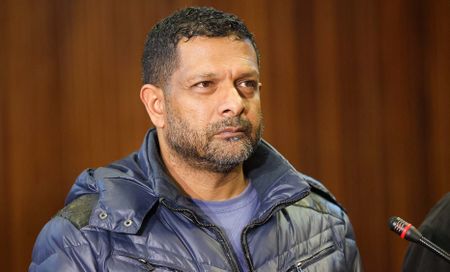
Khan failed, and the Madlanga Commission has since obtained some of the contents he tried to prevent authorities from accessing.
Some of the contents were released to the media late on Monday and show questionable communications between Khan; the co-founder of the Carnilinx tobacco company, Mohamed Sayed; and Economic Freedom Fighters leader Julius Malema.
The Madlanga Commission proceedings are expected to resume on Wednesday. DM
Comments
Scroll down to load comments...