



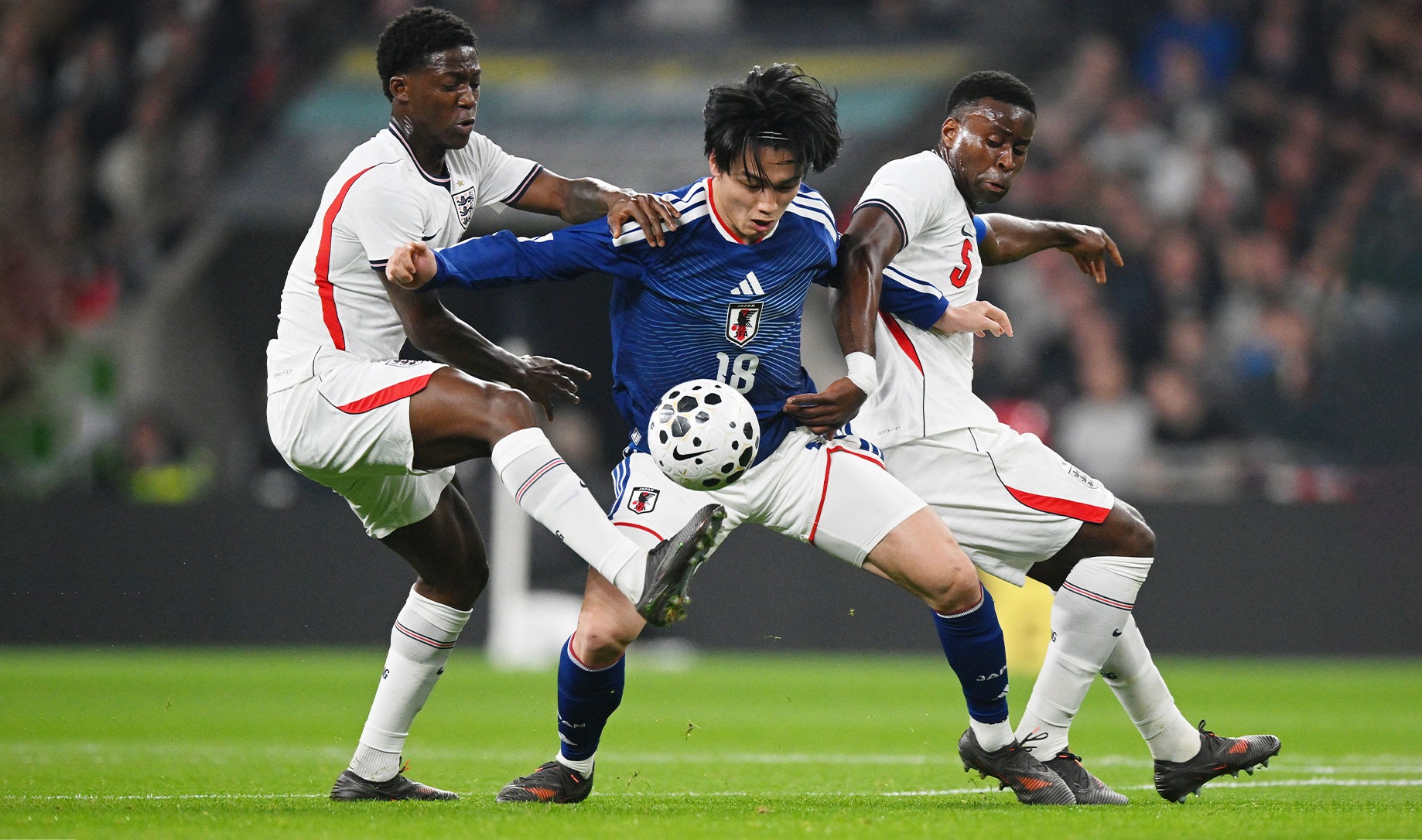
 Japan's Ayase Ueda is challenged by England's Kobbie Mainoo and Marc Guehi at Wembley Stadium on 31 March, 2026 in London, England. (Photo: Mike Hewitt / Getty Images)
Japan
The Plan
Japan are no longer at a stage where speaking openly about “winning the World Cup” invites ridicule. Their historic victories over Germany and Spain in 2022 proved that they are capable of producing much more than just a one-off upset. Over nearly eight years in charge the head coach, Hajime Moriyasu, has built a side capable not merely of surviving against the world’s elite, but of defeating them too. This was backed up by wins against Brazil in October and England – at Wembley – in March.
The expected system is a 3-4-2-1, though Japan also experimented with a 3-1-4-2 against England, suggesting tactical flexibility depending on the opponent. Pressing aggressively from the top is important with players such as Takefusa Kubo, Ritsu Doan, Keito Nakamura and Junya Ito all excellent at putting pressure on opponents.
Leading the line is Ayase Ueda, who won the Eredivisie Golden Boot in 2025-26, scoring an impressive 25 goals in 31 appearances. The spine is strong with Parma’s Zion Suzuki in goal with Hiroki Itō, Shogo Taniguchi and Tsuyoshi Watanabe key defenders.
Daichi Kamada and Kaishu Sano are set to anchor midfield and the fact that players such as Takehiro Tomiyasu and Wataru Endō have to settle for a place on the bench at times is evidence that Japan’s squad depth has never been stronger. Injuries to Takumi Minamino and Kaoru Mitoma are very unfortunate but, again, this team is not so fragile as to collapse because of the absence of one or two missing star players.
Still Group F will be tough with the two European sides, the Netherlands and Sweden, having strong squads, while Tunisia may in fact turn out to be the most difficult stylistic matchup of the three.
Hopes are high back home though, and the former Japan coach Akira Nishino, who led the side at the 2018 World Cup in Russia, says of the current squad: “It’s not about individuals acting like egoists. This group of players fight together and within that unity, individuality emerges. There is a strength in these ‘Japanised’ individuals.”
This team genuinely believes it can win the World Cup.
/file/attachments/orphans/2279054834_410168.jpg "Takefusa Kubo of Japan. (Photo: Koji Watanabe / Getty Images)")
The coach
As a player, Hajime Moriyasu played as a defensive midfielder for Sanfrecce Hiroshima and the Japan national team. Since taking charge of Japan following the 2018 World Cup, he has built the squad step by step. He has respected experienced players while gradually integrating a new generation that now forms the core of the team. His methods – focused on harmony, discipline and continuity rather than radical change – can at times appear conservative, but there is no denying his ability to create a stable and highly competitive environment. With the World Cup in sight, Moriyasu continues to shape his blueprint for success. “By making use of Japan’s ability to steadily build and the qualities of Japanese people, I want football to change the belief that Japan cannot become the best in the world in a contact sport,” he says.
Star player
The player who brings the greatest spark to Japan’s attack is Takefusa Kubo. Receiving the ball on the right flank, he draws defenders in with delicate touches and his unique sense of timing, exploiting even the smallest openings to create chances. Having been labelled the “Japanese Messi” early on in his career, he signed for Real Madrid at the age of 18 in 2019. Several loan spells followed before joining Real Sociedad in 2022. There he has become the focal point of the attack and he continues to play a decisive role for the national team as well. Against Bahrain, he assisted the opening goal before scoring another that effectively sealed Japan’s qualification for the World Cup.
One to watch
The man entrusted with keeping Japan’s goal safe is Zion Suzuki. Blessed with outstanding physical attributes, he also possesses every essential quality expected of a top-class goalkeeper. At the Asian Cup two years ago, his inconsistency drew criticism, exposing him to the harsh realities of being Japan’s number one. Then, last November, he fractured his left hand, with his grip strength dropping to just 8kg. Even so, he continued to gain experience at club level before returning to the national team’s goal. His potential is immense and he could be the face of Japan’s goalkeeping position for a decade to come.
Unsung hero
Standing at 1.88m, left-footed and capable of playing both centre-back and left-back, Hiroki Itō offers a rare combination of size, versatility and technical quality. Injuries may have disrupted his progress at club level, but the very fact that a Japanese defender now plays for Bayern Munich speaks volumes about how much the landscape of the country’s football has changed. “In Germany I have had to learn how to defend smartly,” says the 27-year-old who played a lot of futsal and spent some time with Santos in Brazil as a youngster.
/file/attachments/orphans/2279086397_110882.jpg "Tough defender Hiroki Itō of Japan. (Photo: Hiroki Watanabe / Getty Images)")
What to expect from fans at games?
Japan’s supporters are widely regarded as one of the most disciplined fan groups in world football. The stands are filled with the national team’s signature blue, while chants of “Nippon” echo in rhythm with the drums. Unlike the overwhelming intensity or flamboyance often associated with European or South American crowds, Japanese supporters are defined by their organisation, discipline and respect for opponents.
Their habit of cleaning up trash in the stands after matches drew international attention at both the 2018 and 2022 World Cups, offering a glimpse into the sense of courtesy and responsibility often associated with Japanese culture. At this tournament, with more locally based fans expected to join them, the sea of blue inside stadiums will likely be even more visible than at the last World Cup.
Relationship with the US/Trump?
It is unlikely that the Japan national team or the Japan Football Association will make any political statements regarding the US or President Donald Trump. Part of that stems from the longstanding relationship between Japan and the US, but it also reflects a broader Japanese tendency to avoid unnecessary controversy while showing respect toward the host nation. The feeling is mutual with US Secretary of State, Marco Rubio, recently saying: “Under President Trump, we have ushered in a new golden age for US-Japan relations that upholds a free and open Indo-Pacific and brings peace and prosperity to the region.” — By Takashi Ogami
The Netherlands
The plan
Has Ronald Koeman ever started a major tournament with more headaches? Probably not. He is known as an exceptionally ambitious perfectionist, which means that the preparation for this World Cup has been the most troublesome of all his years as the national coach.
Injuries are part and parcel of the game but it becomes a real problem when, in the run-up to a major tournament, around half the starting XI is either ruled out completely or sidelined for months. In the spring Koeman said he would only take players who were fully fit and playing regularly, but that stance became difficult to maintain.
Tottenham’s Xavi Simons suffered an ACL knee injury at the end of the season and won’t be back until next year, with PSV midfielder Jerdy Schouten also recovering from the same injury. Matthijs de Ligt, who has often partnered Virgil van Dijk in central defence, has not regained full fitness after a back problem.
Barcelona’s Frenkie de Jong missed most of the season, Inter’s Denzel Dumfries was out for four months while Stefan de Vrij (also of Inter) spent much of the campaign on the bench. Manchester City’s Tijjani Reijnders and Nathan Aké were also often on the bench while Memphis Depay sustained a serious hamstring injury at the end of his season in Brazil.
Koeman, a disciple of Johan Cruyff-school of football thinking, prefers attacking football and, during the qualifiers, stuck to a very traditional Dutch style, but he may have to abandon his favoured 4-3-3 system for the tournament.
The Netherlands – who are in a tough group with Japan, Sweden and Tunisia – must now select their fittest and strongest players, rather than the most talented ones that reflect the Dutch footballing philosophy. The KNVB (Royal Dutch Football Association) has made reaching the semi-finals a minimum target, but Koeman wants to go even further and win the tournament. That will require a lot of hard work.
“What I’d like people to say about my team is that they play with a lot of intensity, that they can’t say we didn’t do enough,” Koeman told Fifa in May. “I want them to play with confidence, with personality, understanding what their qualities are. And to always respect every opponent despite the fact there may be so-called smaller nations at the World Cup.”
/file/attachments/orphans/2279756153_924087.jpg "Dutch coach Ronald Koeman. (Photo: Roy Lazet / Soccrates / Getty Images)")
The coach
While at Barcelona, Johan Cruyff once asked Ronald Koeman to share a room with a young talent named Pep Guardiola. The two developed under Cruyff’s highly attacking philosophy and took that with them into coaching. Koeman is the only coach in the Netherlands to have enjoyed success with all three major rival clubs – Ajax, Feyenoord and PSV Eindhoven – both as a player and as a manager. For that reason, he is widely respected across the country, has a strong reputation, and has long enjoyed a positive relationship with his international players.
Koeman heads to the World Cup during a time when his wife, Bartina, is fighting cancer. She was diagnosed with breast cancer in 2010 and it came back in 2018 and 2023. During the qualification campaign, Koeman occasionally left the training camp to be with her. “If I had to leave [the camp] it was to be with my wife but she is incredibly strong and positive,” he said. “That is something very special. [But] it is very difficult. She cannot do everything she used to and she gets tired more easily because of the side effects [of chemotherapy]. But we focus on the things that matter most to us and give her energy. That is something beautiful to see.”
Star player
For decades the Netherlands’ star players were forwards but the Dutch have struggled to produce world-class strikers in recent years so for the first time, the team’s strongest section is the defence, led by the formidable Virgil van Dijk. The Liverpool defender is effectively Koeman’s extension on the pitch. The 33-year-old is the undisputed leader and the most vocal figure in the dressing room and on the field. He represents the squad in discussions with the federation and regularly consults with Koeman on tactics. He is not immune to criticism from Koeman though, who says: “I have to stay on his back to make sure he remains sharp. He knows that – it has been the case since our time at Southampton. But he is a fantastic leader.”
/file/attachments/orphans/2278932778_591033.jpg "Towering central defender Virgil van Dijk is a key figure for the Dutch. (Photo: MAURICE VAN STEEN / ANP / Getty Images)")
Unsung hero
Micky van de Ven has come under the spotlight in the Netherlands for having to battle relegation with Tottenham and has been left out of Koeman’s squads in the past because the head coach was concerned about the defender picking up muscle injuries by playing too much. Van de Ven was never part of a big club academy and had to fight his way to the Premier League via Volendam and Wolfsburg. He brings energy and power to the team with his exceptional pace, strong tackling and relentless running. At international level, he has long competed with Nathan Aké for a place in the centre of defence but appears to have won that battle just ahead of the World Cup.
/file/attachments/orphans/2279665631_629883.jpg "Holland's Micky van de Ven shadows Algeria's Riyad Mahrez during a friendly at De Kuip on 3 June, 2026 in Rotterdam. (Photo: Dean Mouhtaropoulos / Getty Images)")
What to expect from fans at games?
One thing the Americans can be certain of: the Oranje march will set the cities of Kansas, Dallas and Houston alight. The famous orange double-decker bus was shipped to the US a month before the World Cup and will travel to every city where the Dutch are playing. Thousands of Dutch fans will take part in their traditional procession from the city centre to the stadium, led by this bus. On its top deck, well-known Dutch artists, DJs and bands will perform, setting the tone and creating a good atmosphere. The World Cup will also feature the famous “Links Rechts” (left right) routine by Snollebollekes, which saw 60,000 Dutch fans take part before each match at Euro 2024.
Relationship with the US/Trump?
King Willem-Alexander and Queen Máxima have made several visits to Trump in the White House. These visits are viewed as a strategic strengthening of relations between the Netherlands and the US, with the king acting as a diplomatic bridge. However, public opinion in the Netherlands towards Trump is largely negative and prominent Dutch politicians have in the past been outspoken, with some describing Trump as “a political charlatan”. — By Marcel van der Kraan
Sweden
The plan
Sweden’s attempts to qualify for the World Cup could hardly have gone worse, picking up just one point from the first four games under Jon Dahl Tomasson, before, in October 2025, the Dane was sacked following a 1-0 defeat against Kosovo.
In came Graham Potter, who had his breakthrough in coaching at Swedish side Östersund between 2011 and 2017, taking them from the fourth tier to Allsvenskan, winning the Cup and beating Arsenal in the Europa League.
Under Potter’s leadership the focus shifted to more traditional values associated with the Swedish national team, with a stubborn defence coupled with effective counterattacks. Having initially said he prefers a back four he set up with a 5-3-2 in the playoffs, with a focus on keeping things quiet at the back.
With the Nations League having offered Sweden a route back into the World Cup qualifying process, they put in an impressive performance against Ukraine in Spain in the semi-final, winning 3-1 after a Viktor Gyökeres hat-trick. The final, against Poland, was much tougher to watch with the visitors better for much of the game, but Gyökeres again stepped up, scoring an 88th-minute winner in a 3-2 thriller.
“It’s hard to explain, hard to describe,” said a delighted Potter. “Just an incredible evening, just so proud to be part of that and obviously proud to experience it. It was just the best night I’ve had in football. Incredible, like I was having some sort of out-of-body experience. I’m looking at the goal and suddenly all our bench is running and you’re thinking, am I here? I’m just grateful to be part of that.”
So Sweden made it to the World Cup despite collecting two points from six games in the group. They now face Tunisia, Netherlands and Japan with hope of getting out of the group – that’s the Potter effect for you.
Injury wise they are without captain Dejan Kulusevski, whose influence on this team cannot be overstated. They will miss him in North America. There are also huge question marks over Alexander Isak’s form and fitness.
/file/attachments/orphans/2279862865_958025.jpg "Sweden's Viktor Gyökeres. (Photo: Linnea Rheborg / Getty Images)")
The coach
In October 2025 Graham Potter gave an interview to Fotbollskanalen that was not so much expressing an interest in becoming Sweden coach, but more of a come-and-get-me-plea. “I have feelings for Sweden,” he said. “I love the country and I love Swedish football. Coaching the national team would be an incredible opportunity for me, absolutely.” A few days later he was in the job and, despite not winning any of his first two games, the Swedish FA was so smitten by him that they offered him a contract extension to 2030 in March. Potter speaks very good Swedish and, for him it was the perfect job after difficult spells with Chelsea and West Ham.
Star player
Alexander Isak became the most expensive transfer in Premier League history last year when he moved from Newcastle to Liverpool for £125, but after a tough first season at Anfield there is no question about who the talisman is for the national team: Viktor Gyökeres. The Arsenal forward also struggled initially at his new club but has hit form recently and scored four of Sweden’s six goals in the two playoff ties. His popularity took another upturn after the late goal against Poland, with people from all over the country posting their own versions of his goal celebration, which is taken from Bane, the character played by Tom Hardy in The Dark Knight Rises film.
One to watch
Celtic’s Benjamin Nygren aside, one player that might play a bigger role than expected for Sweden in North America is Gustaf Lagerbielke. The Braga defender put in a crucial performance against Poland in the play-off final against Poland, scoring with a thunderous header and keeping Robert Lewandowski quiet at the back. The fact that the former Celtic defender is a baron and 254th in line to the Swedish throne only adds to the intrigue. There are talks of a move to a big-five league this summer and a good showing at the World Cup will only increase the chances of that happening.
Unsung hero
If Sweden are to succeed this summer, they will have to win battles against a very technical side in the Netherlands and a very tenacious and technical Japan side. If they are to do that Jesper Karlström will have to play a big part. Captain of Serie A side Udinese, Karlström is a late bloomer who took time to establish himself at Djurgården before a move to Polish side Lech Poznań. Has talked about how he struggled with a gambling addiction at DIF but that the club and his family helped him beat it. Karlström possesses all the classical traits of a deep-lying midfielder, being solid in the tackle and capable of dictating play. The 30-year-old’s calming presence will be key in North America as he is surrounded by youngsters such as Yasin Ayari and Lucas Bergvall in midfield.
/file/attachments/orphans/2279862104_280705.jpg "Sweden striker Alexander Isak is back to full fitness after an injury plagued year with Liverpool FC. (Photo: Linnea Rheborg / Getty Images)")
What to expect from fans at games?
Swedish supporters have a reputation of coming in large numbers for tournaments and making themselves heard. Fans of “Blågult” (blue and yellow) tend to be friendly and full of banter, interacting nicely with opposition fans. The go-to song of the supporters is “Kanna på”, a song referencing beer pitchers that keep on arriving. Yes, the Swedes like a beer or six. The song also states: “We are coming with 100,000 men,” and, while there may not be another Viking invasion expected in America, there will be a large yellow-and-blue delegation at the World Cup.
Relationship with the US/Trump?
“Look what happened in Sweden last night”. Those were the words of Trump in 2017, when talking about problems with large-scale immigration and subsequent terrorist attacks. The only problem was that nothing of any dramatic nature had happened in Sweden the night before. Trump said later he had been referring to a TV report on Fox News, which did not clarify things greatly. Swedish paper Aftonbladet then summed up what had happened in the country on the day Trump was referring to: 1. Famous singer Owe Thörnqvist suffered technical problems in rehearsals. 2. A man set himself on fire at a plaza in central Stockholm. 3. There were road closures in northern Sweden due to “harsh weather”. — By Samuel Parts
Tunisia
The plan
Tunisia completed their qualification campaign without conceding once in 10 matches – a record shared with Côte d’Ivoire in Africa – but the faces in the dugout were constantly changing. Three different coaches led the team on the road to this World Cup: Jalel Kadri, Montasser Louhichi and Sami Trabelsi. Kadri, now managing Al-Hazem in Saudi Arabia, was Tunisia’s head coach during the 2022 World Cup in Qatar. Trabelsi was later replaced by the current manager, Sabri Lamouchi, shortly after Tunisia were knocked out of the Africa Cup of Nations in January.
“I am Tunisian, my roots are Tunisian, and I am happy to be here,” Lamouchi said during his first press conference. Why is this significant? Because in 1993, Lamouchi was on the verge of representing Tunisia rather than France. He came, took part in the warm-up, but did not come off the bench – and never returned afterwards. The versions differ between Lamouchi and Youssef Zouaoui, the manager at that time, but the outcome remained the same: Lamouchi never wore the Tunisia shirt. It remains a painful memory that supporters have never forgotten.
Tunisia’s first training camp under Lamouchi, which included two friendly matches, took place in March. His first squad selection highlighted a major shift. The message was clear: Tunisia would rebuild around young players. Another decision warmly welcomed by supporters came during Lamouchi’s first press conference in February: “For the 2026 World Cup, there will only be three goalkeepers.” It is worth remembering that Tunisia’s decision to take four goalkeepers to Qatar had sparked significant controversy. This time, Lamouchi kept his promise.
From a tactical perspective, Lamouchi set Tunisia up in a 4-3-3 system for his first match against Haiti. A few days later against Canada, he experimented with a 4-2-3-1 formation. It remains to be seen how he will approach each of the World Cup games.
/file/attachments/2993/fifa_2026_groups_533614.png)
The coach
Sabri Lamouchi’s playing career took him to France, where he won Ligue 1 titles with Monaco and Auxerre, and Italy, where he played for Parma and Inter. His first job in coaching came with the Côte d’Ivoire national team in 2012, reaching the quarter-finals of Afcon 2013 and exiting the 2014 World Cup at the group stage. He went on to manage several clubs, notably Rennes – where he coached Wahbi Khazri, a legendary figure in Tunisian football and now a member of his coaching staff – as well as Nottingham Forest, before heading to Qatar and Saudi Arabia. After 14 years in management, Lamouchi is still waiting for his first major trophy. As for this World Cup, no specific objective has been included in his contract. For the next Afcon, however, targets have been clearly defined.
Star player
Hannibal Mejbri. The midfielder who chose Tunisia in 2021 has gradually become the face of this national team. After joining Manchester United Under-18s from Monaco for a reported £8-million, Hannibal struggled to establish himself. Loan spells at Birmingham and Sevilla followed but his performances have consistently improved since joining Burnley permanently two years ago. Wearing Wahbi Khazri’s iconic No 10 shirt, Hannibal embodies the role: playmaker, unofficial captain and undisputed star. Everyone wants his shirt; everyone wants a picture with him. At the last World Cup, he played only 10 minutes. Since then, everything has changed. He is the first name on the teamsheet now.
/file/attachments/orphans/2278623088-1_704534.jpg "Hannibal Mejbri of Tunisia. (Photo: Christian Bruna / Getty Images)")
One to watch
Developed at Paris St-Germain, the 22-year-old attacking midfielder Ismaël Gharbi now has the opportunity to showcase his talent on the world stage. Born in Paris to a Tunisian father and a mother from Madrid, Gharbi idolised Cristiano Ronaldo – “I used to copy everything he did, from his haircut to his boots,” he told Fifa last year – as well as Isco and Eden Hazard. Loaned by Braga to Augsburg for the 2025-26 campaign, Gharbi’s situation became complicated after the coach who brought him to Germany, Sandro Wagner, was dismissed only weeks after his arrival. Since then, his appearances have been limited. But he has one major advantage: Sabri Lamouchi believes in him and has included him in Tunisia’s World Cup squad.
Unsung hero
Despite struggling for a while with a hernia problem, the left-back Ali Abdi has always given everything for the national team. He used to have to live in the shadow of Ali Maâloul, one of Tunisia’s greatest players in his position. As a result, Abdi spent several years as a substitute before finally earning his place in the starting lineup. Since then, he has continued to battle through pain and adversity. Generous on the pitch, he has consistently delivered both defensively and offensively. After defeats, he was often the first player to face the media, defend his teammates, explain the situation, and apologise to supporters.
/file/attachments/orphans/TL_2501155_391532.jpg "Abrasive defender Ali Abdi. (Photo: Mahugnon Leopold Soglo / Gallo Images)")
What to expect from fans at games?
Tunisia are expected to be backed by strong and passionate support despite the cost of travelling to the US and Mexico for group matches. It should also be noted that, apart from the incidents involving Tunisia and England supporters before the 1998 World Cup match in Marseille, Tunisia’s fans have not developed a reputation for violence. On the contrary, both in Russia and Qatar, they acted as ambassadors for their country, even launching initiatives promoting tourism in Tunisia. Videos of their travels and the vibrant atmosphere they created in the streets remain a powerful testimony to that spirit.
Relationship with the US/Trump?
Neither the players nor members of the Tunisian football federation have made public statements regarding Trump or the policies of his administration. As for ticket prices, Tunisian supporters – like fans from many other nations – naturally voiced their dissatisfaction. However, the Tunisian federation has made lower-priced tickets available for supporters. A $15,000 visa deposit has been waived by the Trump administration for Tunisia fans travelling to the US with valid match tickets. — By Ahmed Adala
Comments
Scroll down to load comments...