




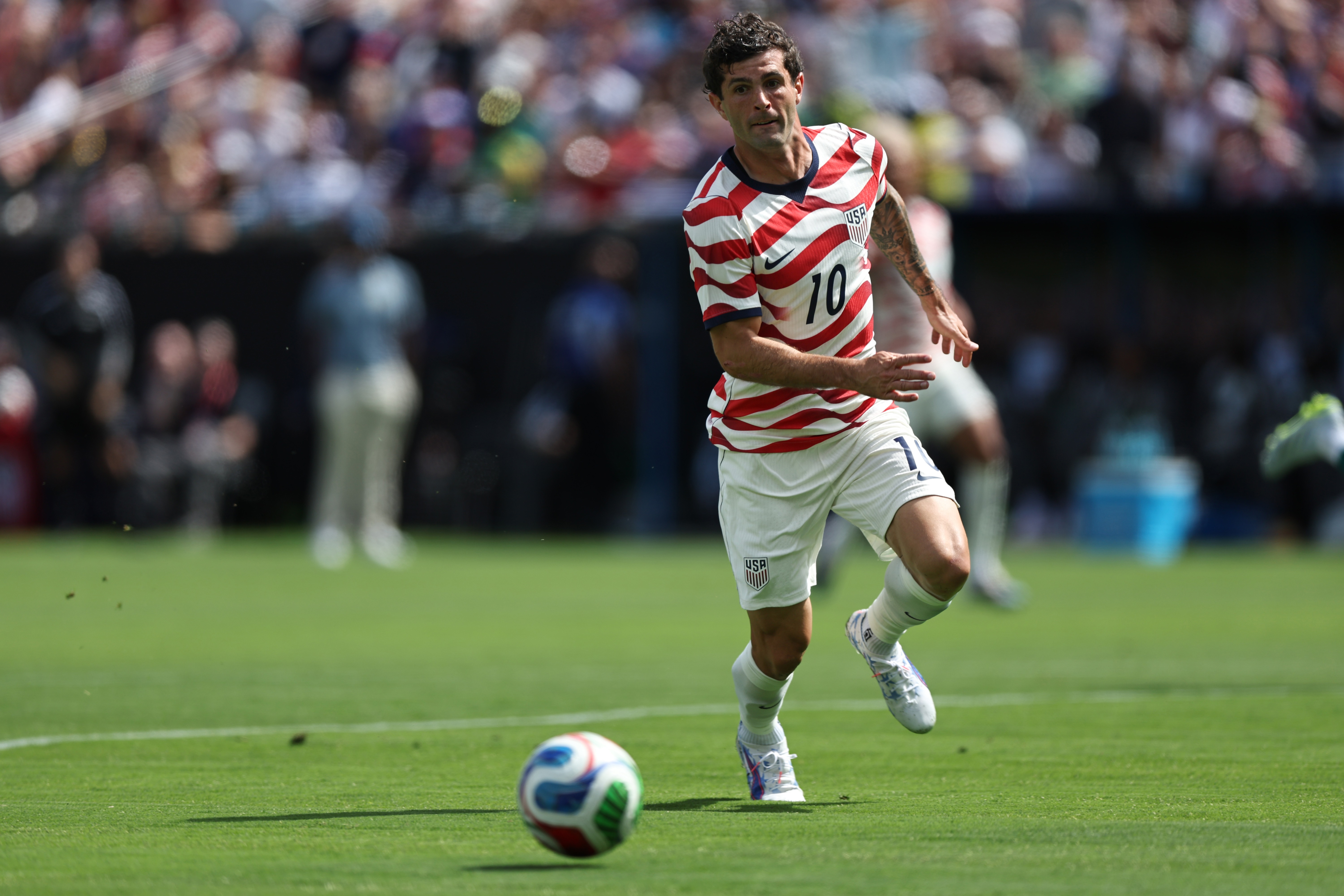
 United States striker Christian Pulisic carries the hopes of a nation. (Photo: Omar Vega / USSF / Getty Images)
Australia
The plan
The Socceroos are stepping into the unknown as much as any side with a new crop of eye-catching attacking talents playing alongside a more experienced midfield and defensive core. Qualification for a sixth consecutive World Cup was sealed without needing to tread carefully through the playoffs for the first time since 2014, but only after a change of direction when Tony Popovic replaced Graham Arnold as coach.
The renowned disciplinarian demanded a greater physical intensity and defensive zeal across all areas of the field, with results quickly improving and building into an eight-match unbeaten run that locked in a World Cup spot. The Socceroos have since suffered from mixed fortunes as Popovic has cast the net wider to give opportunities to fringe players and the next generation.
The side has become better organised defensively with three centre-backs, two wing-backs and a pair of battle-hardened midfielders, a common set-up especially in first halves when Popovic likes to keep the contest tight. The emergence of young forwards Nestory Irankunda and Mohamed Touré – and Jordan Bos on a wing – adds a spark to the lineup and can be especially threatening on a counter-attack late in games.
After reaching the Last 16 for just the second time in their history in 2022, the hope is that the Socceroos can break through to win a first knockout game this time around. It will be easier said than done while starting in an evenly-matched group but, as is his way, Popovic has insisted the side is up to the challenge.
“We’re always deemed as the underdog or the team that will be fighting for the bottom spot, and we have an opportunity through our actions and our performances and results to show that that can be different,” the Socceroos coach said in early May.
The coach
Tony Popovic coaches like he played as a hard-nosed defender across 58 matches for the Socceroos, including as part of the renowned 2006 World Cup squad.
The 52-year-old values substance over style, but finds a way to make it work with a coaching record that includes two A-League premierships and an Asian Champions League crown.
Popovic quickly put his fingerprints all over the Socceroos when taking charge in September 2024, with their World Cup qualification hopes floundering. His steely determination and the side’s newfound sharper edge booked their ticket to a sixth consecutive global showpiece. Now they are ready to face arguably the trickiest group in North America.
/file/attachments/orphans/GettyImages-2279703287_452591.jpg "Manager Tony Popovic of Australia looks on during a training session at Oakland Roots and Soul Sports Club on 3 June 2026 in Alameda, California. (Photo: Lachlan Cunningham / Getty Images)")
Star player
The Socceroos might lack star power, but Nestory Irankunda is their human highlight reel. The 20-year-old attacker launches rockets from outside the box, beats defenders with pace and has a bag full of tricks.
He can often be seen celebrating his goals with a backflip and a Michael Jackson dance move. This tournament can be the stage for Irankunda to bring those talents to the world. Meanwhile, Mohamed Touré might just upstage his childhood friend if he can carry his red-hot goalscoring form across from club to country.
One to watch
Jordan Bos has become a darling among the most ardent Socceroos fans. He will soon bring himself to the attention of the nation if he carries his club form across to the global stage.
The 23-year-old has helped light up the Eredivisie in his first season with Feyenoord, becoming the first Australian to win a player of the month award in the Netherlands’ top flight. Bos’s pace, power and technique down the left flank are a huge asset for club and country, whether he is picked as an attack-minded wing-back or as part of the midfield. He can also be dangerous near goal and recently scored in three consecutive appearances for the Socceroos.
/file/attachments/orphans/GettyImages-2268592465_913358.jpg "Australia’s Nestory Irankunda. (Photo: Brendon Thorne / Getty Images)")
Unsung hero
Alessandro Circati might fly under the radar with a role at centre-back, but the 22-year-old has quickly emerged as one of the most important pieces of coach Popovic’s Socceroos puzzle.
His physicality sets the tone while his composure calms the nerves – while also having the skill and polish on the ball that helps the Socceroos turn defence into attack.
Circati’s standing within the national team was revealed when he became the youngest player to captain the side in a friendly against New Zealand last year. The defender has also risen through the ranks at Parma in line with the club’s rise from Serie B to Serie A and should relish the opportunity to test himself at the highest level.
What to expect from fans at games
When it comes to the World Cup, Australia’s fans fall into three groups. The national sporting psyche is subconsciously activated, and even the most sport-agnostic find themselves shaking their fists at the TV. The sport appreciators quickly rekindle their love of the round-ball game and wonder why they don’t watch more.
The tried and true Australian football devotees shout from the rooftops, “We’ve been here all along!” as the country duly unites around them and the men in green and gold. Some will make the trip, but many may have been turned off by costs and uncertainty on the ground. At home, the unusually agreeable kick-off times lend themselves to full pubs, watch parties or office huddles. A national crisis was averted when the decision to ban screenings of matches at Melbourne’s iconic Federation Square was overturned in less than 24 hours.
Relationship with the US/Trump?
While Australian politicians toe the line on Donald Trump, refusing to call out even his most egregious statements for what they are, one outspoken Socceroos veteran has not been shy about his view.
St Pauli captain and midfielder Jackson Irvine has become the leading critic of Fifa among current players, and took aim at football’s governing body for awarding a peace prize to the US president. “As an organisation, you would have to say decisions like the one that we saw awarding this peace prize make a mockery of what they’re trying to do with the human rights charter and trying to use football as a global driving force for good and positive change in the world,” Irvine said in May. By Jo Khan and Martin Pegan
USA
The plan
Host nations get a direct runway to the tournament field, but a qualifying campaign would have probably helped clarify the US’s ideal approach.
While Mauricio Pochettino has overseen immense tactical fluctuation throughout his half-cycle in charge, the aim is always to retain at least shared custody of proceedings.
The US had around 60% of possession against lower-ranked opponents such as Paraguay, Australia, and Ecuador last autumn, while clashes with presumed favourites (recently: Uruguay, Japan, and Belgium) saw closer to a 50/50 split. His longtime penchant for high-pressing has largely been absent in this role, instead focusing on establishing a mid-block defence to try limiting the opponent’s final-third touches.
In possession, the US works to string passing sequences up the channel, recently using a pair of attacking midfielders and a double-pivot behind them to better navigate the heart of the park.
/file/attachments/orphans/GettyImages-2279116977_187292.jpg "The US’s Falarin Balogun celebrates after scoring against Senegal at Bank of America Stadium on 31 May 2026 in Charlotte, North Carolina. (Photo: Jamie Squire / Getty Images)")
Width almost entirely falls on full-backs or wing-backs, with midfielders occasionally drifting off-centre to create numerical advantages. Despite a thin centre back corps, Pochettino saw great success with a back-three and wing-backs last autumn… only to revert to a 4-2-3-1 in a disastrous 5-2 thrashing against Belgium in March.
It’s a classic predicament: will Pochettino get his team in its best structure with five defenders (5-1 win over Uruguay), or get more of his best players on the pitch in spite of the tactical ramifications (the Belgian bummer)?
“Belgium and Portugal have, in the top 100 players, [a] few or some players in that top 100. I think we don’t have [any],” Pochettino said after a 2-0 loss to Portugal. It was their final match before his squad was named. Gulp!
The coach
One of a few celebrity managers at this tournament, Mauricio Pochettino opted to test international soccer after a gruelling and thankless stint with Chelsea.
As a player, he represented Argentina at the 2002 World Cup, offering physicality and sharp tactical reading at centre back. He’s forever a beloved figure in north London after guiding Tottenham through its best stretch of the modern era. Appointed in 2024 after the USMNT was grouped at a home Copa América under Gregg Berhalter, Pochettino is expected to return to the club scene after this tournament.
/file/attachments/orphans/GettyImages-2279117208_824911.jpg "US head coach Mauricio Pochettino. (Photo: John Dorton / USSF / Getty Images)")
Star player
While Pochettino and The Guardian’s voting panel have omitted him from the top 100 players in the world, Christian Pulisic is a proven match-winner for the US and Milan alike. The 27-year-old has been the face of the programme since they missed the 2018 World Cup, bearing immense pressure to lead the US men into a brave new era of contention rather than competence.
The 2026 season has been tough for the Hershey-born forward, goalless from January into mid-May in all arenas. Nonetheless, his ability to bypass opponents and set up a shot makes him a marking priority in every match.
One to watch
Following the exits of Jozy Altidore and Clint Dempsey, the US got through the 2022 cycle with a striker-by-committee approach. It was a coup, then, when Folarin Balogun committed to his birth nation over England and Nigeria: an Arsenal-raised striker worth over $40-million in the transfer market.
Balogun is a fine finisher, with the requisite movement to earn tap-ins away from opponents and the turn-and-shoot chops to fire from just about anywhere inside 25m with the right service.
His form with Monaco has fluctuated, but he was largely in form this spring. He’s the latest dangerman to wear the #20 shirt for the US, following Brian McBride and a young Landon Donovan.
/file/attachments/orphans/GettyImages-2278513338_320116.jpg "Christian Pulisic. (Photo: Omar Vega / USSF / Getty Images)")
Unsung hero
Aside from possibly Tyler Adams, no player is more irreplaceable in this US roster than Chris Richards. An FA Cup-winner with Crystal Palace in 2025, Richards is the surest presence along the backline in the programme, a modern centre-back with strong defensive rates on the ground or aerially and the range of passing to work into possession schemes.
His club exploits were largely overshadowed by Marc Guéhi until the latter’s departure; similarly, his partnership with Tim Ream was an unheralded strength for much of this cycle. A dependable set of shifts this summer could inspire the next generation to appreciate the art of defending.
What to expect from fans at games?
Optimism is in short supply after the calamitous March window, coupled with feeling wrung out for every dollar with this World Cup’s pricing model.
The rates are so lavish, in fact, that it’s hard to guarantee similar support to past tournaments with far friendlier pricing models. The four-figure get-in point could alter morale in the stands with more pressure to justify the outlay. You know the rest: red, white and blue, “U-S-A! U-S-A!” and cosplayers as Revolution patriots and bald eagles abound.
What’s at stake?
While hosting the 1994 World Cup catalysed this nation’s interest in the game, 2026 was seen as a trampoline upon which the sport would spring to even more prominence. Domestic leagues have synced their mid-to-long-term planning with this summer, hoping to maximise reach to newcomers.
If fans don’t flock (again: it’s insanely expensive to get in) to find their local club, some worry about attrition among the investor class.
As for the lads on the field: round of 16 exits in 2010, 2014, and 2022 have left the programme without a quarter-final showing since 2002. Once hyped as a possible golden generation, a deep run would make amends for an up-and-down cycle and justify Pochettino’s lavish wages. If not, fans will be eager to get on to the next generation in hopes of becoming a bona fide top-10 programme worldwide. By Jeff Rueter
Turkey
The plan
The last time Turkey made it to the World Cup, the likes of Arda Guler and Kenan Yildiz were not even born. After a 24-year hiatus, the Crescent Stars ended their World Cup exile by navigating a tense playoff path, eliminating Romania and then Kosovo. The coach, Vincenzo Montella, has guided the national team to back-to-back international tournaments with arguably their strongest squad yet.
Turkey lost just one game in their qualifying campaign – against Spain, the reigning European champions – picking up 13 out of a maximum 18 points. “I wouldn’t trade these players for anyone,” Montella beamed after the Kosovo win. “They have shown they can make sacrifices.”
Guler and Yildiz were just breaking into the team at Euro 2024; the team now revolves around the star duo. Turkish football has built a reputation for throwing around the term wonderkid loosely, but Guler of Real Madrid and Yildiz of Juventus merit the title.
Elsewhere, Ugurcan Cakir is a safe pair of hands and heads into the tournament having just lifted the league title with Galatasaray. A centre-back pairing of Abdulkerim Bardakci and Merih Demiral provide a fairly solid defence.
The right-back Ferdi Kadioglu is well known to Brighton fans after a terrific season. Hakan Calhanoglu is now the elder statesman and has assumed a deep-lying playmaker role, while Besiktas’ Orkun Kokcu is in hot form and could make a name for himself this summer.
The team is young, but the spine remains largely unchanged from the European Championship two years ago. And the same problem persists: Montella does not have a proven striker who has earned his trust yet. The position is still up for grabs, with Eintracht Frankfurt’s rising star Can Uzun a contender. The side will enter the World Cup capable of both magic and madness.
/file/attachments/orphans/GettyImages-2278702562_797803.jpg "Star Turkish winger Arda Guler will be a key player. (Photo: BSR Agency / Getty Images)")
The coach
Vincenzo Montella has been the architect behind the national team’s resurgence since his appointment in 2023. L’Aeroplanino – “the little airplane” – has fully immersed himself in the culture – and he definitely gets the Turkish psyche.
“Turkish culture is very close to that of the place where I spent my childhood. I was born and raised near Naples,” he said.
Montella has managed the team better than most Turkish coaches of the past. Gone are the major fractures or squabbles between players and staff that have haunted Turkish football. The Italian’s default is a 4-2-3-1 setup, but he is not afraid to mix things up and has proven to be an astute tactician. Montella is a stylish, composed, likeable character who has built one of the strongest Turkish teams in modern history.
Star player
Arda Guler has successfully managed the transition from a prodigy to an established force at Real Madrid. The 21-year-old is unfazed by pressure, which is a blessing considering the weight of the country’s expectations is on his shoulders.
Described by Thierry Henry as “an undisputed, elite world-class talent”, he is a talismanic figure and the creative spark in this team with an eye for goal. The midfielder has risen to the occasion and delivered for his country when called upon. The national team is not short on talent, but there is no doubt that Guler is a game-changer.
One to watch
An argument could be made for Kenan Yildiz – whose surname does actually mean star – being just as important and talented as Guler. Long tipped for success since making a name for himself in the Bayern Munich academy, Yildiz has come into his own at Juventus and is poised for a breakthrough on the world stage this summer.
The charismatic forward has technical elegance and physical power in equal measure, a joy to watch for the neutral, and loves to take on defenders and go on mazy runs. While Montella is not yet clear on who his No 9 is, Yildiz is a winger with an eye for goal. With 11 goals and 10 assists for Juventus in the season just gone, and three goals in qualifying for Turkey, he could be the outlet for his team.
/file/attachments/orphans/GettyImages-2268573719_693201.jpg "Winger Kenan Yildiz. (Photo: Burak Kara / Getty Images)")
Unsung hero
Orkun Kokcu’s move from Benfica to Besiktas last year appeared strange on the face of it. But it made more sense after he revealed it was a childhood dream to play for the Black Eagles – and it has turned into an inspired move.
A hard worker who does the dirty work that is often unnoticed, he also plays a key role in attack. Kokcu scored 10 goals and provided nine assists for Besiktas in all competitions; impressive numbers for a central midfielder.
The 23-year-old is a multi-faceted player who also possesses impressive technique and passing range. Like Ferdi Kadioglu, another unsung hero, he was born in the Netherlands.
What to expect from fans?
While not comparable to the Turkish diaspora population in Europe, there is a sizeable community in the US, with estimates ranging from 250,000 to 500,000. Turkish fans do not get the opportunity to see the national team often at the World Cup, but, considering the distance and the exorbitant price of travel and tickets, there won’t be many organised ultra groups making the trip. Expect lots of flags, but not so many flares.
Relations with the US/Trump?
Turkish-US relations are less complicated than those of some of their neighbours in the region. There are no major ongoing diplomatic rows, and Recep Tayyip Erdoğan and Donald Trump get along well. After a phone call on 20 May, Trump said: “Isn’t it nice to have relationships with some very tough people? He’s a tough guy, and I have a relationship with him that nobody else has.” Hopefully, though, the focus will be on football – which is a relief considering Turkey and the US are in the same group. By Emre Sarigul
/file/attachments/2993/fifa_2026_groups_842401.png)
Paraguay
The plan
Paraguay earned their place on football’s greatest stage by going back to their roots: defensive strength and collective intensity. For years, the team tried to play a possession-based game without succeeding in either defence or attack.
Then, in August 2024, Gustavo Alfaro arrived with a clear message from day one: “Paraguayan DNA, intensity and clean sheets. That’s what will take us to the World Cup”. He was not wrong.
The Argentinian coach remained faithful to the 4-4-2 formation in almost every match, only switching to a back five in the high-altitude games against Ecuador and Bolivia. At the World Cup, he seems most likely to favour that classic 4-4-2, with perhaps an occasional 4-2-3-1.
Since replacing Daniel Garnero – sacked after a dismal Copa América – Alfaro has transformed the team. From his very first match, away against Uruguay in Montevideo, Paraguay looked a different side. Subsequent home victories against Brazil and Argentina convinced even the biggest sceptics that the “new” Albirroja was real.
Away from home, Paraguay have lost only once under Alfaro, against Brazil. They earned heroic draws in Bolivia, 4,100m above sea level, in Ecuador at 2,800m, and in the suffocating heat and humidity of Barranquilla against Colombia.
Qualification was sealed with a tense 0-0 draw at home against Ecuador. The result triggered national euphoria. The celebrations were so intense that the country’s president, Santiago Peña, declared the following day a national holiday.
While Paraguay’s greatest strength lies in their intensity and physicality, they can also produce good football, building smoothly from the back and relying on the game-changing talent of Julio Enciso.
The coach
Gustavo Alfaro has inspired the rebirth of the national team after years of failure. The Argentinian retired as a footballer in 1992, aged only 30, to concentrate on a burgeoning coaching career.
Relying on toughness and defensive discipline, Alfaro guided humble Arsenal de Sarandí to glory, winning the 2007 Copa Sudamericana and the 2012 Argentinian Primera División.
Those triumphs defined his whole career: to this day, he is still regarded as a defensive coach. He once used a quote widely attributed to the former basketball player and executive Pat Riley to explain his philosophy: “If I want to build an offensive team, the first thing I have to do is work on defensive discipline, otherwise my ass is going to be out of here.”
One of his greatest achievements came when he led a young Ecuador side to the 2022 World Cup. A well-read man, who often uses philosophical phrases in press conferences to explain things, Alfaro is also known as “El Cazador (The Hunter)” in reference to the book he wrote after taking la Tri to Qatar, titled Cazadores de Utopías Imposibles, Hunters of Impossible Utopias.
/file/attachments/orphans/GettyImages-2219569132_937034.jpg "Julio Enciso of Paraguay will bring a strong threat to opponents. (Photo: Wagner Meier / Getty Images)")
Star player
Julio Enciso. One of the greatest players produced by Paraguayan football in the past 20 years. La Joya (The Jewel) amazed with his talent in Libertad – who gave jobs to both his mother, a house cleaner, and his father, a street vendor, to convince them to move to Asuncion when their son was just 12 – and debuted for the national team at 17 before making the bold leap to the Premier League.
He had some good moments in Brighton, scoring a Puskás Award-worthy screamer against Manchester City. However, injuries and managerial changes gradually eroded his impact.
Enciso married and found a new beginning in Strasbourg, where he now plays. Fast and direct, a difference-maker, a game-changer in the final third, Enciso is a special talent.
In honour of his grandfather, he fulfilled his dream of playing in a World Cup. “I dedicate this to him. He’s surely watching me from heaven,” he said.
One to watch
Damián Bobadilla. Unlike his father, the former goalkeeper Aldo Bobadilla, Damián Bobadilla never put on the gloves. And it’s a good thing he didn’t – he has become an excellent midfielder. But his father remains his great hero.
“My dad didn’t have a cape, but he flew from post to post,” he once said affectionately. Bobadilla burst on to the scene at his boyhood club Cerro Porteño in 2021, showing all the strengths of a high-quality box-to-box midfielder: physicality, calmness and clever decision-making.
Since 2024, he has been playing for São Paulo in Brazil’s top division, where he has already established himself as one of the team’s key players. Now 24, if he continues performing at this level, he looks ready for the next big step in his career.
Unsung hero
The entire team structure relies on Andrés Cubas. He provides balance, wins duels and fights for every ball as if it were the last challenge he will ever have to make.
Although he is primarily a defensive midfielder, Cubas is also capable of initiating quick transitions into attack after regaining possession. Born in Argentina, and a former Argentina international at Under-20 level, Cubas promised his mother – who was born in Paraguay – that he would represent her country if he was given the chance. And he was. At 1.65m, he is not physically imposing, but his intelligence, positioning and tenacity more than make up for it.
What to expect from fans at games?
Travel agencies in Paraguay are offering round-trip packages to the United States that include tickets to all three group-stage matches, with prices starting from US$20,000.
Considering the average monthly wage in the country is around $450, it is an enormous sum of money. Nevertheless, thousands of Paraguayans fans are expected to make the journey to support La Albirroja at the World Cup after a 16-year absence. The streets of Inglewood and Santa Clara are likely to be filled with red, white and blue – not the stars and stripes, but the traditional Tricolour of Paraguay and the Albirroja jersey. And those colours will be joined by the iconic chanting: “La Albirroooo, la Albirroooo, la Albirroja, la Albirroooo!” on repeat.
Relationship with the US/Trump?
Paraguay and the US have been long-term allies, and there has been little to suggest that is about to change: Santiago Peña, the 47-year-old who has served as president of Paraguay since 2023, described Donald Trump’s re-election as “a dream come true”, while Marco Rubio described Peña as a “strong American ally”.
Earlier this year, however, Trump described his Paraguayan counterpart as a “young, handsome guy”, which turned out not to be as positive as it initially appeared. “It’s always nice to be young and handsome. It doesn’t mean we have to like you,” Trump continued. “I don’t like young, handsome men. Women, I like. Men, I don’t have any interest.” By Christian Pérez and Óscar Gómez
Comments
Scroll down to load comments...