



 In May the basic food basket decreased by R4, but the basket remains R50 more expensive than the R370 SRD grant. The grant is meant for the countrys most vulnerable. The vast majority of South Africa’s population are vulnerable to climate and economic shocks, making recovery next to impossible, because shocks like flooding and drought overlap.
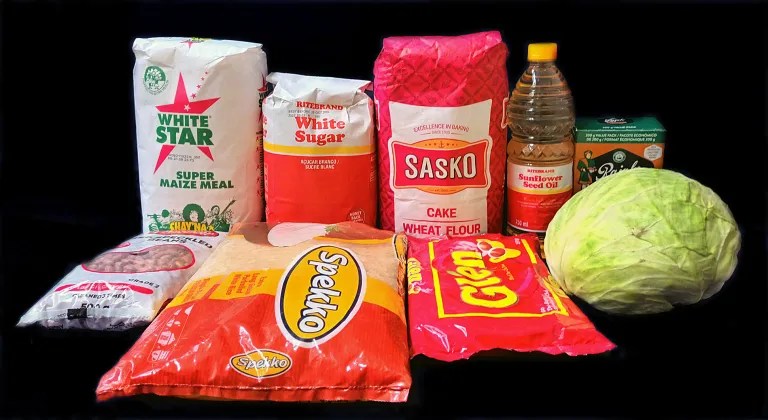
Maverick Citizen has been tracking the prices of 14 basic food items that can be bought with the R370 Social Relief of Distress (SRD) grant. Between April and May, Daily Maverick’s food basket decreased by R4 to R419.86. While flour increased in cost by R5, rice decreased by R12. The food basket is about R50 more expensive than the R370 SRD grant.
The Pietermaritzburg Economic Justice and Dignity’s Household Affordability Index tracks 44 basic food items. In May, their household food basket cost R5,479.26, increasing by R27.17 since April.
The basic nutritional basket with a household of seven members now costs R6,634.22, an increase of R15,23 since April.
“It means that in May 2026, families living on low-incomes may underspend on basic nutritional food by a minimum of 17%,” the Household Affordability Index said.
/file/attachments/orphans/Food-prices-April-May-2026_324916.jpg)
“The SRD grant remains a scandalous R370 a month, barely enough to survive for a few days in today’s economy,” said Zwelinzima Vavi, Saftu General Secretary, at the World Hunger Day media briefing with the Union Against Hunger, on 26 May 2026.
“The state funds that are given to social grant recipients are taken from them, not in the grants themselves, but in the food that goes into their mouths. Someone who had a social grant in 2004 and 2005 has less food on their plate today,” said Nomzamo Zondo, the Executive Director of the Socio-Economic Rights Institute of South Africa at the World Hunger Day media briefing.
Flooding — La Niña
Climate change means more unstable and extreme weather. SA is not immune. The government declared a national disaster following heavy rainfall and flooding in the Western Cape, North West, Free State, Eastern Cape, Northern Cape and Mpumalanga, which began on May 4.
Limpopo also saw heavy flooding in January.
/file/attachments/orphans/IMG-20260519-WA0049_419445.jpg "Ali Sablay, spokesperson and project manager at Gift of the Givers, said after the floods in the Western Cape, Gift of the Givers stepped in to help the small-scale farmers in Sandvlei and Macassar, as their grazing lands had been destroyed, donating 1,000 bales of oat hay. (Photo: Gift of the Givers)")
“Our teams are working extensively in the Breede Valley district, we’ve seen total destruction of vineyards in the Rawsonville area and the De Doorns area,” said Ali Sablay, spokesperson and project manager at Gift of the Givers. “Within a few hours, many vineyards got washed away.”
Sablay reported that SA Social Security Agency grant recipients in Rawsonville could not withdraw their money as the ATMs were offline. He visited homes that were completely destroyed, and saw three homes that were washed away by the floods.
One of those homes belonged to Mekjies Esbach (63), who is blind and has spent her entire life on the farm. She told her grandson that the rain did not sound right. As they went outside a few minutes later, the house washed away, Sablay said.
A fourth-generation farmworker from Rawsonville told Sablay that she had never seen flooding like this. The river was not close to their house, but it burst its banks and flooded the area. Her home was completely destroyed.
/file/attachments/orphans/motion_photo_4843600172647312226_874806.jpg "Ali Sablay, project manager at Gift of the Givers, hands Sanna Cleophas (61) a food parcel as they sit in front of her destroyed house in Kleinberg, De Doorns, after severe flooding in the Western Cape in May. (Photo: Gift of the Givers)")
“We can see the huge impact it has had on farmworkers – because some of them are seasonal workers – and now with vineyards destroyed, they will be unemployed. Many of them took years to build their lives and within a few seconds it was destroyed.”
Since 11 May, Gift of the Givers teams had provided an excess of 150,000 meals, more than 1,000 blankets, bottles of water, hygiene packs and baby care packs. They had assisted in Tulbagh, Wolseley and Ceres and continued working in the neighbouring areas. The damage was extensive and hundreds of thousands of people were affected, he said, with damage to agricultural lands including bridges and pack houses washed away.
The La Niña weather phenomenon of cooler weather and greater rainfall is coming to an end. Now, southern Africa potentially faces an El Niño.
Looming drought — El Niño
Forecasts warn of a strong El Niño, with an 82% chance of it developing in May to July 2026, with an even stronger likelihood in December 2026. One way to measure it is by rising temperature in the Pacific ocean, which is currently above normal.
The last El Niño that caused severe effects led to drought, water shortages and grazing land and crop loss in SA from 2015 to 2016. While a strong El Niño does not necessarily mean drought, scientists are concerned by the signs for 2026 and 2027.
A study conducted on maize and sorghum in Lesotho and parts of SA found that knowledge of an El Niño event at the time of planting meant farmers planted much less and saw lower yields. Farmers chose to reduce their cropping area – even though sorghum is a drought-resistant crop, and requires less rainfall to reach maturity.
Dr Ferial Adam, executive director at WaterCAN, spoke at the Union Against Hunger’s Rally Against Rising Food Prices on 16 May, to connect the two struggles: food and water.
While South Africa received half the average global rainfall, it did not justify the lack of access to water, she said.
“If you ask [the] government, they will say that about 80% of the population have access to water, about 75-76% have access to clean sanitation. Now I think it is important, even with regards to food, to question this word ‘access’, because if we unpack it, only about half of South Africa’s population have a tap inside their home, and with that tap, not everyone’s getting water.”
Adam outlined:
- 66% of groundwater is used by commercial farming.
- Every 10 seconds, there are 500,000 litres of raw sewage flowing into rivers and streams.
- About 10% of the population rely on rivers and streams as their main water source that could also be used for subsistence farming and small community gardens.
- About 70% of SA’s water treatment works are in a poor to critical state.
- Our region is hit hard by climate change with floods and drought.
The dams in the Western and Eastern Cape were low prior to the floods of May. We need to also be concerned about a super El Niño, Adam said, that would affect food prices in the future.
There was a need to link water with food and health, she stated, as having safe drinking water, proper sanitation and food meant people could take their medicine, and were less likely to get diarrhoea from contaminated food and water.
In some areas, during water cuts, the elderly spend R20 per day, using their grant money to get people to carry water from the water trucks to them, Adams said.
“What we see – with the state of our water, the state of our land, and climate change – is that the food price is increasing.”
/file/attachments/orphans/IMG-20260519-WA0022_644935.jpg "Ali Sablay, spokesperson and project manager at Gift of the Givers, said residents in Rawsonville, Western Cape, emphasised that they had never seen such severe flooding before. (Photo: Gift of the Givers)")
Repeated disasters meant less time for communities to recover. Economic and climate shocks happened simultaneously. The majority of the country were unable to afford a healthy food basket, and faced increasing challenges with access to clean water. This all lessened people’s ability to rebuild with dignity.
“We need to build climate resilience and have better risk management in place that does not silo food, water and climate impacts,” Adam told Daily Maverick. DM
Comments
Scroll down to load comments...