



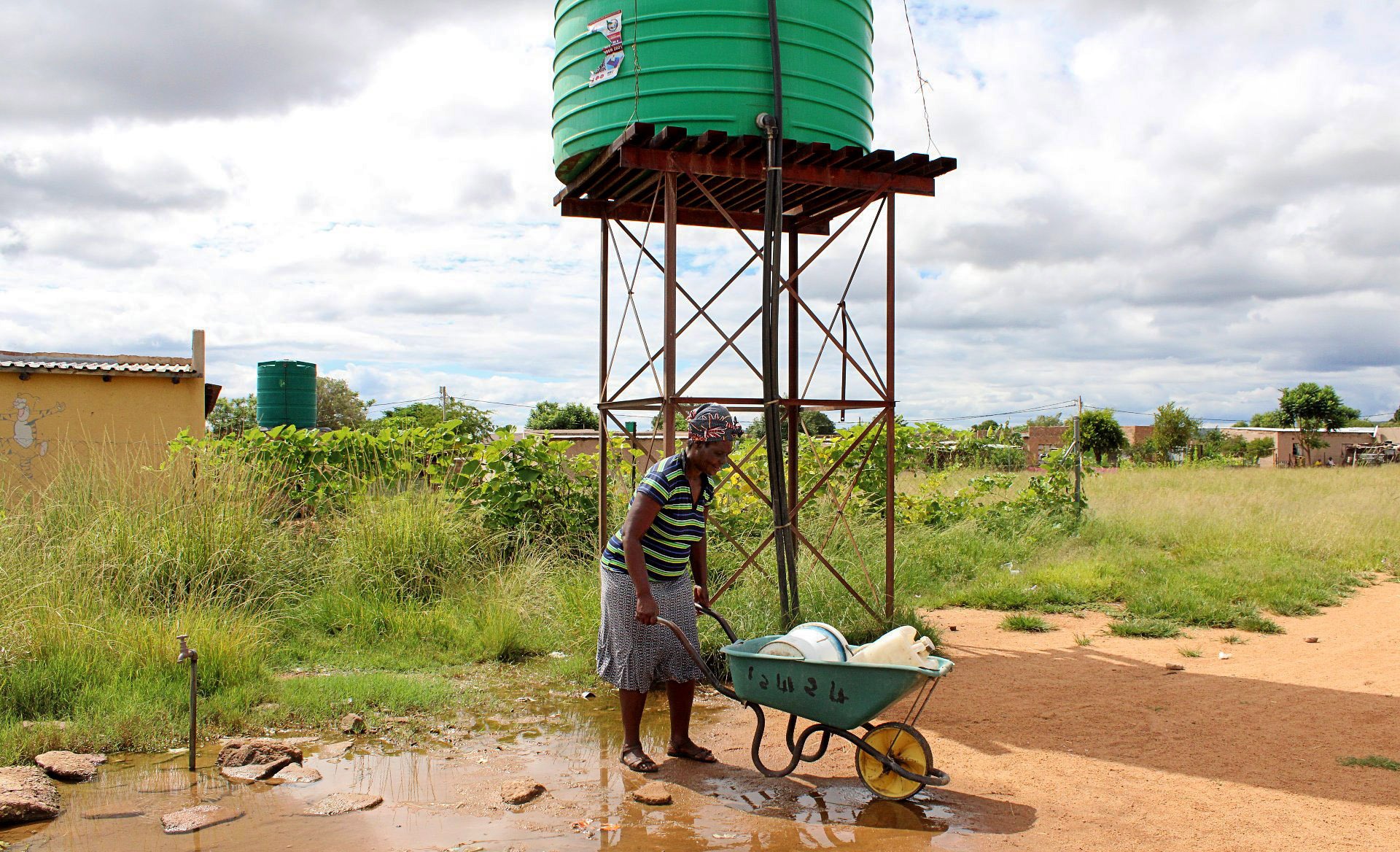
 Maki Mlauza makes several trips a day to collect water from a municipal borehole tank in Tambo village, Limpopo. A new global study suggests a 57% decline in groundwater in parts of this province. (Photo: Masego Mafata)
People have relied on buried reservoirs of clean, life-giving water for thousands of years. But there are limits to how much can be sucked out of the ground before the wells run dry – or other unpredictable problems emerge.
Now, evidence of significant, long-term declines in groundwater levels across five continents has emerged in a review study by a group of Netherlands-based researchers, heightening concern about the unsustainable rate of the abstraction of water stocks in many countries.
/file/attachments/2992/erlae651ff3_hr_955583.jpg "Impacts of groundwater level decline on (upper left) water supply, (upper right) agriculture, (lower left) ecosystems and (lower right) infrastructure and land. (Source: iopscience)")
The study, led by hydrogeologist Dr Feifei Cao and colleagues at the International Groundwater Resources Assessment Centre (Igrac), is based on data from roughly 42,000 monitoring wells in 47 countries, collected over the past 20 years.
They caution about the hidden costs when sinking ever deeper wells to chase declining water stocks.
Quite apart from depleting the water needed to supply taps or nourish crops, the proliferation of drilling and pumping is altering the natural flow of underground water in some areas, exposing people to a range of unexpected risks.
One example comes from West Bengal in India, where groundwater is polluted with sewage or by heavy metals from tanneries. Digging and sucking larger volumes of water can also lead to arsenic and other naturally occurring toxic minerals being dissolved and released into drinking water.
Cao notes that deep well abstraction can induce downward water gradients that enable the transport of arsenic-rich water.
/file/attachments/orphans/tonywaterground2arsenichandsPhotoIndiaWaterPortalflickr_556858.jpg "The hands of a villager in Chhattisgarh state, India, show signs of arsenical keratosis, a skin condition caused by long-term exposure to arsenic. (Photo: India Water Portal)")
Similar problems have been detected by the SA Medical Research Council in a recent study of residents in the Giyani area of Limpopo, an area known to have high environmental arsenic concentrations.
In another part of Limpopo, the Igrac researchers also found a decline in groundwater levels in 57% of monitoring wells. Underground water levels had dropped by about 2.6m in parts of the Pietersburg Plateau over the past two decades, accelerating faster over the past 10 years.
Elsewhere, it’s dropping even faster.
In parts of central Chile, almost 80% of monitored wells showed declining groundwater trends, with an average drop of 9m over the past two decades.
Cao and her colleagues note that nearly half of the world’s population still relies on groundwater as a primary drinking water source, with groundwater dependence intensifying in many of the world’s large cities and smaller towns as well as in rural areas.
At a global level, Igrac says boreholes supply roughly 40% of water for farm irrigation. In South Africa, a report published by the CSIR estimates that the main users of local groundwater are irrigated agriculture (66%), mining (15%) and domestic water (13%)
SA water users urged to update water abstraction
The publication of the new global groundwater study coincides with an appeal from the South African Department of Water and Sanitation, urging all water users to register or update their water use information as part of a nationwide effort to strengthen the management and protection of South Africa’s scarce surface and groundwater resources.
In a statement on 4 May, the department said it wanted a clearer understanding of who is using water, where it is being used, how much is being used and for what purpose.
“Unregistered users create critical data gaps that undermine planning and decision-making, disrupt fair distribution and place additional strain on already limited water supplies,” the department said.
Noting that people who failed to register could be liable to stiff fines and jail terms of up to five years, the department said the new registration period began on 24 April 2026 and would remain open for 90 days.
In some parts of the world, groundwater is being drained so fast that the land is sinking.
The best known example is Mexico City, where 70% of the drinking water supply is drawn from wells at depths of up to 3km below ground level. Groundwater abstraction began in the 1850s to support the growth of the most populous city in North America, now home to 9.2 million people (with 21 million in the wider metropolitan area).
However, over-abstraction has caused rapid groundwater level declines in 83% of the monitored wells, at an average rate of 0.5m a year.
/file/attachments/orphans/tonywaterground3MexicoCitygroundwatersubsidenceGrapuic_KaixinChen_899703.jpg "Mexico City is among the fastest-sinking cities in the world, with land subsiding at a rate of tens of centimetres a year, causing a series of cascading effects from infrastructure damage, such as cracks in buildings, roads or buried sewer and water pipes. (Graphic: Kaixin Chen / Igrac)")
Similar problems are emerging in Jordan, where more than 600 sinkholes have emerged along the shoreline of the Dead Sea (the lowest place on continental Earth) due to intensive farm irrigation projects. This has led to several farmers losing their land and the closure of large coastal areas, damage to buildings and disruption of industry and tourism.
In other coastal areas, depletion of underground water can also allow seawater to push inwards to pollute freshwater and kill vegetation due to high levels of salt. One South African example comes from the coastal port of Richards Bay, where saltwater has intruded inland to threaten crucial freshwater supplies, such as Lake Mzingazi.
What about food security?
According to the Igrac researchers, the High Plains Aquifer in the United States is undergoing one of the most severe cases of aquifer depletion globally, largely driven by irrigation pumping levels that far exceed the rate of natural recharge.
Here, nearly 81% of the wells showed declining trends (about 8m over 20 years), with an “alarming” accelerated rate over the past five years. According to US Geological Survey studies, some wells have dropped by up to 80m over recent decades.
The High Plains Aquifer is important because it supports about 20% of the nation’s corn, wheat and cotton production. The researchers say underground water depletion has pronounced consequences for regional agriculture, including increased pumping costs and drilling ever deeper to find water.
/file/dailymaverick/wp-content/uploads/2025/10/biopetrol-1-Rory-Doyle-Getty-Images.jpg "A combine harvester transfers maize to a grain cart in Mississippi, US. In some parts of North America, grain production is under increasing threat due to declining groundwater levels. (Photo: Rory Doyle / Bloomberg via Getty Images)")
In Hungary, one of Europe’s major cereal producers, about 72% of the monitored wells showed a declining trend.
In the Central and Norte Chico regions of Chile, almost 80% of monitored wells were declining, with an average drop of 9m over the past two decades. This is a region where groundwater is used extensively for cash crops such as table grapes, avocados and citrus fruits.
Igrac notes that the problems in Chile have been exacerbated by a megadrought, along with large-scale mining projects.
Back in Europe, several wells in Spain are still dropping, despite attempts by the Spanish Water Authority to reverse heavy abstraction rates that rendered some aquifer water too salty for irrigation due to seawater intrusion close to the coast.
In the French city of Bordeaux (where deep aquifers supply 97% of the tap water), similar restoration efforts have been made to curb overexploitation in the Aquitaine Basin.
However, the demands of a growing population were jeopardising conservation efforts, with stronger groundwater-declining slopes in the past 10 and five years than in the past 20 years.
/file/attachments/orphans/tonywaterground5namibiaboreholephotosaumanamibiaorg_856205.jpeg "A windmill used to pump water from central Namibia, where the Russian atomic energy agency Rosatom is hoping to extract uranium by pumping sulphuric acid into the Stampriet Transboundary Aquifer System. (Photo: Lsaumanamibia.org)")
Despite abundant water resources and usually shallow groundwater tables, some Northern European countries are also vulnerable to depletion, with more than half of wells in Southeast Sweden declining over the past 20 years.
During the summer of 2017, groundwater levels reached historic lows in many parts of Sweden, forcing municipalities to impose water consumption restrictions and provide emergency water supply as private wells ran dry.
Punjab State in India is cited as a prime example of a groundwater crisis. Often referred to as India’s breadbasket, groundwater has been pivotal in sustaining the country’s food security and alleviating poverty. But these benefits come at the cost of severe depletion of groundwater resources.
“Our results show that about 63% of monitoring wells display declining trends, with an average groundwater level drop of about 20m over the past two decades.”
One direct consequence is the rising cost of getting enough water out of the ground using submersible pumps. In many cases, costs become unaffordable for small-scale farmers, especially for crops such as winter rice and maize.
Across the water in Oceania, the city of Perth in Australia also relies heavily on groundwater, with the Gnangara aquifer system providing nearly 40% of the city’s drinking water, with some also used to irrigate sports fields and horticultural land. Here, Igrac found a 64% decline in local well levels.
In neighbouring New Zealand, a major aquifer system below the Canterbury Plains stores nearly 70% of the country’s total groundwater – now increasingly threatened by a gradual shift from sheep farming to more water-intensive dairy farming. DM


Comments
Scroll down to load comments...