




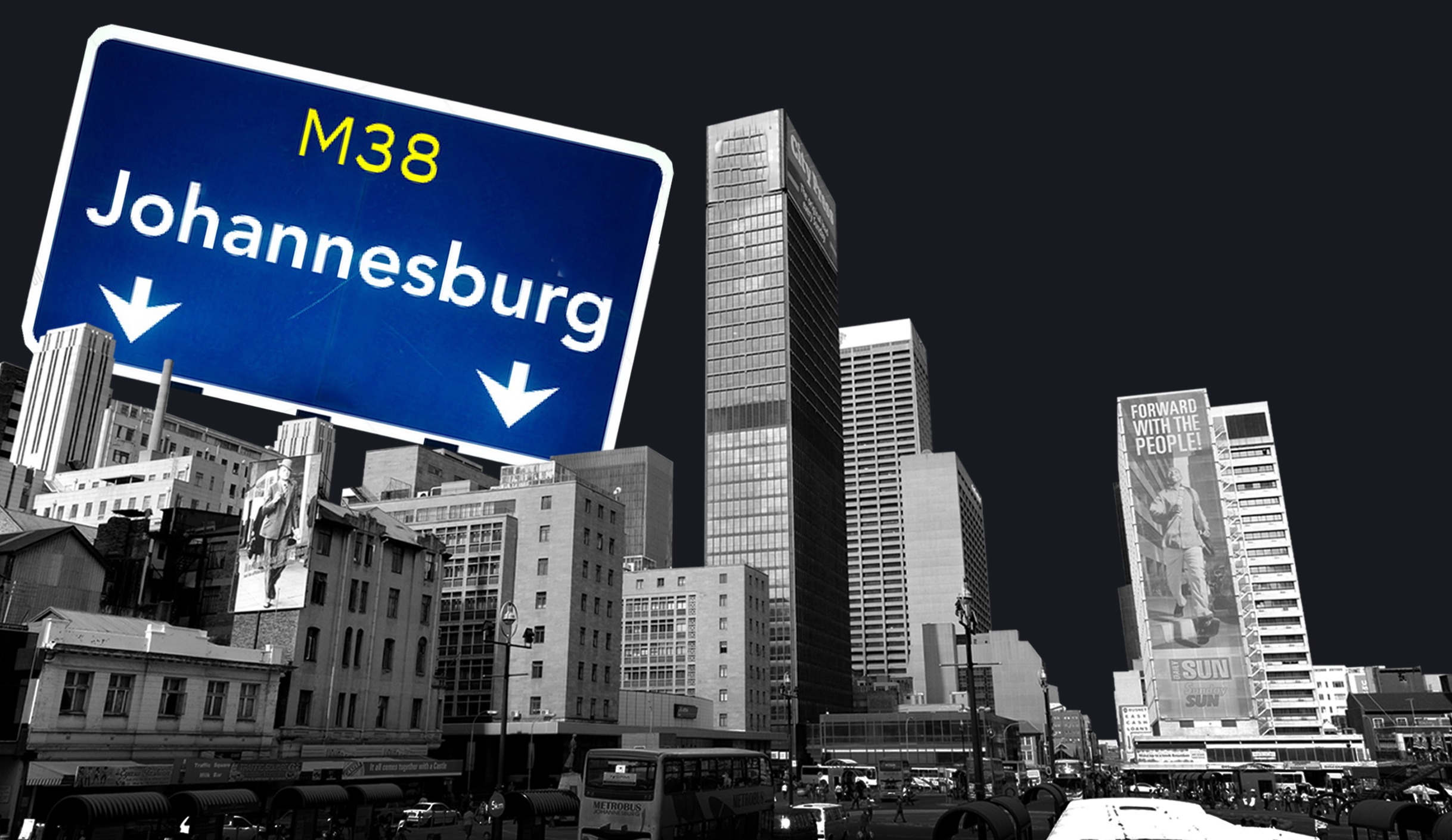
 Illustrative image: Johannesburg city centre. (Photo: Leon Sadiki / Gallo Images / City Press) | Johannesburg sign. (Photo: Flickr)
The City of Gold has long been losing its shine in the face of corruption, incompetence and maladministration, and business is gatvol with the unfolding collapse of South Africa’s financial centre and economic engine.
“When Johannesburg is in a state of visible decline, it undermines the national growth story at precisely the moment a more positive narrative is gaining credibility. This is not a local political problem. It is a national economic emergency,” Business Unity SA (Busa), Business Leadership SA (BLSA) and Business for South Africa (B4SA) said in a joint statement on Thursday.
“Business leaders are ready to play their part in rebuilding Johannesburg, strengthening South Africa’s growth trajectory, and creating jobs — in concrete, visible, and meaningful ways. We call on all those with authority and accountability to do the same.”
This is the first big public statement by the business community as the local government elections loom in November, and its tone and timing underline the mounting frustration within the private sector over the city’s pothole-riddled decay.
The statement pointedly noted that Johannesburg’s woes stand in stark contrast to the green shoots that are emerging in the national economic landscape — shoots that will not reach their full potential with a withered Joburg.
/file/dailymaverick/wp-content/uploads/2021/11/OD-Ferial-suspend2.jpg "Frustration is mounting in the business community over Johannesburg's pothole-riddled decay. (Photo: Christopher Moagi / Gallo Images / Daily News)")
“Business confidence is recovering, energy stability has been restored, and the country’s first sovereign credit rating upgrade in twenty years signals genuine momentum. Sustaining and accelerating that momentum requires Johannesburg to function,” it said.
And while the rot has been eating away at the city’s core for years, a tipping point has been reached.
“What is new is the severity and urgency of the situation. The Minister of Finance has formally placed the city on notice: its adjustment budget is unfunded, it is in severe financial distress. Eskom has indicated it may suspend electricity supply to the city over unpaid debt,” the statement said.
“The situation is serious, and it is the result of accumulated failures, not of a single administration.”
As the city hires new executives for no apparent reason, giving rise to suspicions of patronage and nepotism, capital expenditure — the money needed to fix or maintain stuff — now only accounts for 6% of its budget.
“Maintenance spending stands at 0.5% of asset value, roughly one-eighteenth of the metro average. Rates and service charges have increased by 124% in real terms over the past fifteen years, while service quality has deteriorated sharply,” the statement noted.
Property prices are also tanking, leaving ratepayers steaming at the evaporation of their hard-earned money.
“The situation is not due to a lack of financial resources. Corruption, criminality and maladministration appear to be increasingly entrenched within elements of the City. The Auditor-General estimates annual losses of approximately R12-billion through unauthorised and irregular expenditure,” the statement said.
Quid pro quo
So, how is this mess to be fixed before it’s too late?
For starters, the organisations that issued this statement stress that business is and will remain non-partisan — but not passive.
“We are addressing this statement to all political parties — those currently in government in the City, those in opposition, and those who will contest the upcoming local government elections. We are addressing it to the President and to the national GNU. We are also addressing this to the residents and businesses of Johannesburg, who bear the real cost of its failure.”
The statement will obviously be music to the ears of the opposition, notably the DA. But making no political endorsements makes business and political sense.
It asks all parties contesting the elections to provide specific remedies to the city’s fiscal crisis and calls on the current administration to immediately stabilise Joburg’s finances. And it calls on the President and the national government to use the powers at their disposal to support fiscal stability.
“Business leaders are already engaged: funding support to government departments working on local government reform; contributing to infrastructure repair including potholes, traffic signals, and inner-city maintenance; and partnering with government and civil society organisations to address local problems,” the statement said.
And business is prepared to do much more — provided there is a competent administration in place running the city.
“We are prepared to deploy appropriate private sector resources into a programme of structured support for Johannesburg’s recovery, on the condition that we have a counterparty capable of governing scrupulously, delivering for the City, and being held to account,” the statement said.
That is the quid pro quo being offered to the next administration.
The statement’s sentiments, it must be said, are also a fair reflection of the mounting anger among Joburg residents of all walks of life with the meltdown of what is touted as a “First-Class African City.”
It is that indeed, but that is despite the governance failures, which is testimony to the good people of Johannesburg who make this such a vibrant city. Almost all of Joburg’s residents, like the business sector, are gatvol. The only ones who are not gatvol have a vested interest in the gravy train that is bleeding the city dry, and their day of reckoning is likely to come in November. DM
Comments
Scroll down to load comments...