




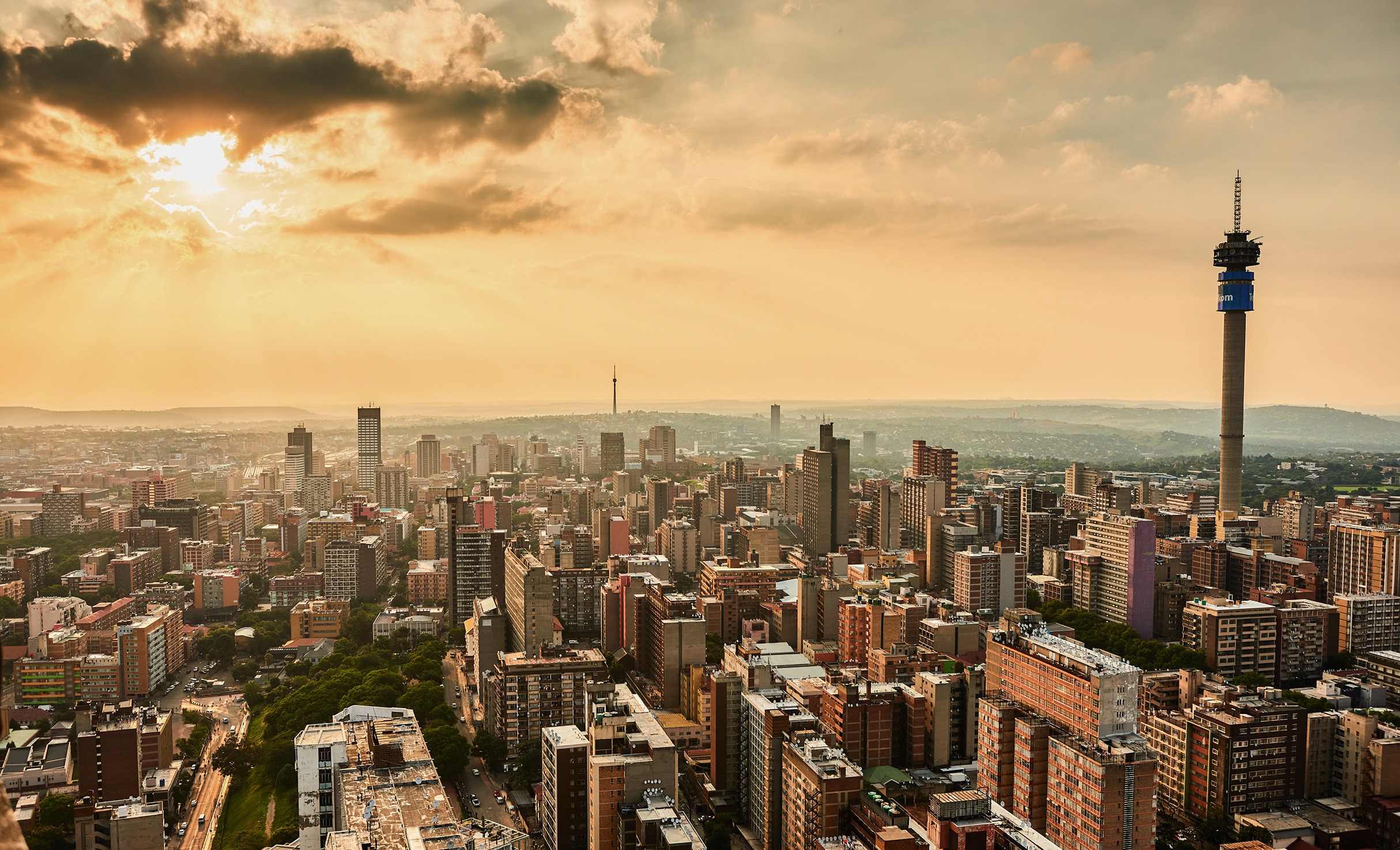
 The Telkom Joburg Tower, right, surrounded by residential tower blocks and commercial offices, viewed from the Ponte City Apartments building in the Berea district of Johannesburg, South Africa, 22 December 2022. (Photo: Waldo Swiegers / Bloomberg via Getty Images)
 Business is deeply committed to South Africa and believes strongly in its long-term potential. SA’s economic trajectory is improving. Business confidence is recovering, energy stability has been restored, and the country’s first sovereign credit rating upgrade in 20 years signals genuine momentum. Sustaining and accelerating that momentum requires Johannesburg to function.
Johannesburg accounts for approximately 16% of SA’s GDP. It is the country’s commercial capital and the city where a disproportionate share of domestic and foreign investment decisions are made. When Johannesburg is in a state of visible decline, it undermines the national growth story at precisely the moment that a more positive narrative is gaining credibility. This is not a local political problem. It is a national economic emergency.
Johannesburg’s fiscal and governance crisis has been building for years. It is not a new or partisan issue, and the failures of the past decade have occurred under successive administrations and shifting coalition arrangements. What is new is the severity and urgency of the situation.
The minister of finance has formally placed the City on notice: its adjustment budget is unfunded, it is in severe financial distress, and the July 2026 equitable share instalment is at risk unless corrective action is taken immediately. Eskom has indicated it may suspend electricity supply to the City over unpaid debt.

The situation is serious, and it is the result of accumulated failures, not of a single administration.
The data is not in dispute. Capital expenditure has collapsed to 6% of the City’s budget. Maintenance spending stands at 0.5% of asset value, roughly one-eighteenth of the metro average. Rates and service charges have increased by 124% in real terms over the past 15 years, while service quality has deteriorated sharply.
The situation is not due to a lack of financial resources. Corruption, criminality and maladministration appear to be increasingly entrenched within elements of the City. The Auditor-General estimates annual losses of approximately R12-billion through unauthorised and irregular expenditure.
Property value slump
Property values have fallen materially. This has made our residents and businesses poorer and reduces confidence in the City’s future.
Fragile and unstable coalitions have produced 10 mayors in 10 years, making coherent long-term governance virtually impossible. The instability is both historical and ongoing: in the past few months alone, three motions of no confidence have been filed against the current mayor by a party that is itself part of the governing coalition.
This is not about which political party governs the City, it is about how it is governed.
Business is and will remain non-partisan. But non-partisan does not mean passive. We are making this call now, before the local government elections, because the standards of governance the city requires cannot wait for another electoral cycle. Whoever forms the next administration will inherit an urgent, structural challenge.
Let us be clear: this is not about which political party governs Johannesburg, it is about how the city is governed.
We are addressing this statement to all political parties — those currently in government in the City, those in opposition, and those who will contest the upcoming local government elections. We are addressing it to the president and to the national Government of National Unity. We are also addressing this to the residents and businesses of Johannesburg, who bear the real cost of its failure.
Functional governance
We are setting out, publicly and specifically, what we believe functional governance in Johannesburg must deliver: capital infrastructure that is adequately funded and maintained; irregular and wasteful expenditure that is eliminated; service delivery measured against clear indicators and reported on transparently; leadership held accountable for outcomes; and consequence management applied consistently and without exception.
We are therefore asking for the following short-term commitments, from all parties with the authority and responsibility to act:
- From the current City administration: immediate stabilisation of the City’s finances, transparent reporting against clear service delivery indicators, and credible consequence management for corruption and irregular expenditure – starting now, not after the election.
- From all parties contesting the elections: specific, costed commitments on how they will address the City’s fiscal crisis, restore infrastructure, and re-establish functional governance – not broad promises, but plans that can be held to account.
- From the president and national government: active use of the powers available to the national and provincial government to support the structural and financial reforms that City-level leadership alone cannot deliver, and consistent enforcement of consequence management where governance standards are not met.
What business commits to doing
Business is the City’s largest ratepayer. Commercial properties represent 26.5% of property values yet contribute 55.4% of property rates revenue. That gives us both a direct financial stake in the City’s recovery and a direct responsibility to act.
Business leaders are already engaged: funding support to government departments working on local government reform; contributing to infrastructure repair including potholes, traffic signals, and inner-city maintenance; and partnering with government and civil society organisations to address local problems. These efforts are real, but fragmented. We want to systematise, coordinate and scale them.
As has been demonstrated through the measurable progress made in energy and freight logistics through the national Government Business Partnership, business can contribute expertise, execution capability, and resources where governance conditions enable effective collaboration. We are prepared to deploy appropriate private sector resources into a programme of structured support for Johannesburg’s recovery, on the condition that we have a counterparty capable of governing scrupulously, delivering for the City, and being held to account.
Once that counterparty is in place, we are prepared to work in partnership to develop a recovery programme covering infrastructure, service delivery, and fiscal stabilisation, and determine where business can most effectively contribute to its delivery. This would be modelled on the structures that have worked at the national level.
We will also work with the national government and the City to identify specific interventions where private sector expertise, funding and execution capacity can be deployed with speed and accountability.
We believe that publicly tracking and reporting on governance and service delivery commitments made by the City and by parties contesting the elections will help to ensure that accountability is maintained beyond local government elections. We undertake to assist with this.
Johannesburg’s recovery is a national imperative
Johannesburg has extraordinary underlying potential as a magnet for investment, a generator of jobs, and the engine of growth for the broader economy. We are issuing this statement because the situation is urgent and critical, because the cost of continued inaction falls on all South Africans, and because we believe that shining a clear public light on both the crisis and its potential solutions is our responsibility.
Business leaders are ready to play their part in rebuilding Johannesburg, strengthening SA’s growth trajectory, and creating jobs – in concrete, visible and meaningful ways. We call on all those with authority and accountability to do the same. DM
Mxolisi Mgojo is the President of Busa; Adrian Gore is the Chairperson of BLSA; Martin Kingston is the Chairperson of the B4SA Steering Committee.