





 Marchers during the 29 April protest against illegal immigration at Mary Fitzgerald Square in Johannesburg. March and March is demanding tighter immigration controls. (Photo: Gallo Images / Luba Lesolle)
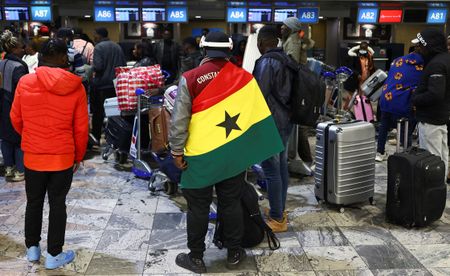
Sitting at Park Station, Johannesburg, on Thursday, 4 June 2026, 30-year-old James Alan was waiting with four friends for a bus to Malawi.
“I am leaving due to the anti-immigrant protests. My mother has been calling me back home. I think it is time I listen to her,” he said.
“I do not have a choice, I am leaving. It will not help me to wait and see what will happen first. We know what will happen. I think it is just safe for me to go home.”
As the anti-foreigner movement has been building throughout the year and has intensified over the past two weeks, migrants like Alan face a difficult choice: hope the protests, intimidation and violence subsides or leave South Africa.
Daily Maverick interviewed 10 foreign migrants in Johannesburg on Wednesday and Thursday to ask whether they had faced increased threats ahead of March and March’s 30 June deadline for undocumented migrants to leave the country, and what their plans were.
March and March hasn’t clearly explained its plans for what will happen on 30 June.
Daily Maverick didn’t question their immigration status, and due to fear, no one agreed to have their photo taken. Some requested anonymity.
/file/attachments/2993/ANTI-FOREIGNERPROTESTSINCE26MAY_365326_714381.png "(Illustration: Kevin Momberg)")
Alan worked as a street vendor in Johannesburg, but said he hadn’t been able to work efficiently since the protests started.
“I just decided to take the little money saved up and bought myself a bus ticket. I will figure it out at home. I think I will come back only if the situation dies down; we all know it will eventually.”
Other migrants at Park Station said they were travelling to other parts of South Africa to visit family members and sort out their visas while deciding what to do next.
Majakaza Mhlongo (42), from Mozambique, said he had been living in Joburg for four years, but was going to Queenstown, Eastern Cape, to see his brother there.
“If the situation is bad, I will be forced to go back home,” he said.
“I am afraid. I cannot live with fear. If I am forced to go, I will go,” he added.
“As you can see, some people are leaving. I will not be happy if I am forced to leave because I came to South Africa for work… I have been here for the past four years. I cannot just leave and start all over.”

Nigerian Sunnyboy Eba (54) was also at Park Station. He said he had been in South Africa for 25 years and had a family here. He lives in Durban but was in Joburg “to solve my paper, including Visa and passports”.
He said the anti-foreigner groups were “bothering everyone” and that most of his family had left in fear of the 30 June deadline, but he was determined to stay.
“My family lives here. My children were all born here. How can I close my shop and just go… Where will I get the money? I cannot just go without money.”
“To go is not an option.”
Pressure on spaza shops
Anti-foreigner groups have often focused on foreign spaza shop owners. In Soweto, those in spaza shops spoke of fear and confusion.
In May, four men travelling in a bakkie told the employees at a store owned by Ethiopians to close their store, or they would close it in two days. Two weeks later, the store is still in business.
“We received the order to close, and we respect it, but we could not just close the business based on random orders. It wouldn’t make business sense to close under those circumstances,” said one of the owners, who did not want to be named.
“If it was the police and they came to us directly, we would have had no problem heeding the order,” he said.
Another Soweto store owner, also an Ethiopian national, told Daily Maverick that “now, there is a lot of intimidation and threats”.
“One guy started to call us names and uttered anti-foreigner remarks, telling us to go back to our country because we would not give him credit.”
A Bangladeshi store owner said he was threatened daily. He said that over the past few weeks, the threats from some community members had increased.
“They threaten us with the 30 June date, and they say they don’t want us in the area after 30 June,” he said.
Asked if he had any idea what could happen on 30 June, he said he had none.
“That is why we expect to open and work like we always do, but if there is a problem, I am sure the authorities will help us because we are legal in the country.”
An Ethiopian store owner said he believed community members would support him if protesters tried to close his store.
Some customers, however, had asked. “When are you going back home because 30 June is coming?”
“I respect the law, but I also know what the law says. I cannot allow a random person who is not in law enforcement to force me to close. But if the government says I must close, I will close.”
“I am terrified by 30 June and what might happen, but I trust in the government and law enforcement. I trust that they will protect us. But as for being asked to leave, no one has asked me to leave,” he said. DM
Comments
Scroll down to load comments...