



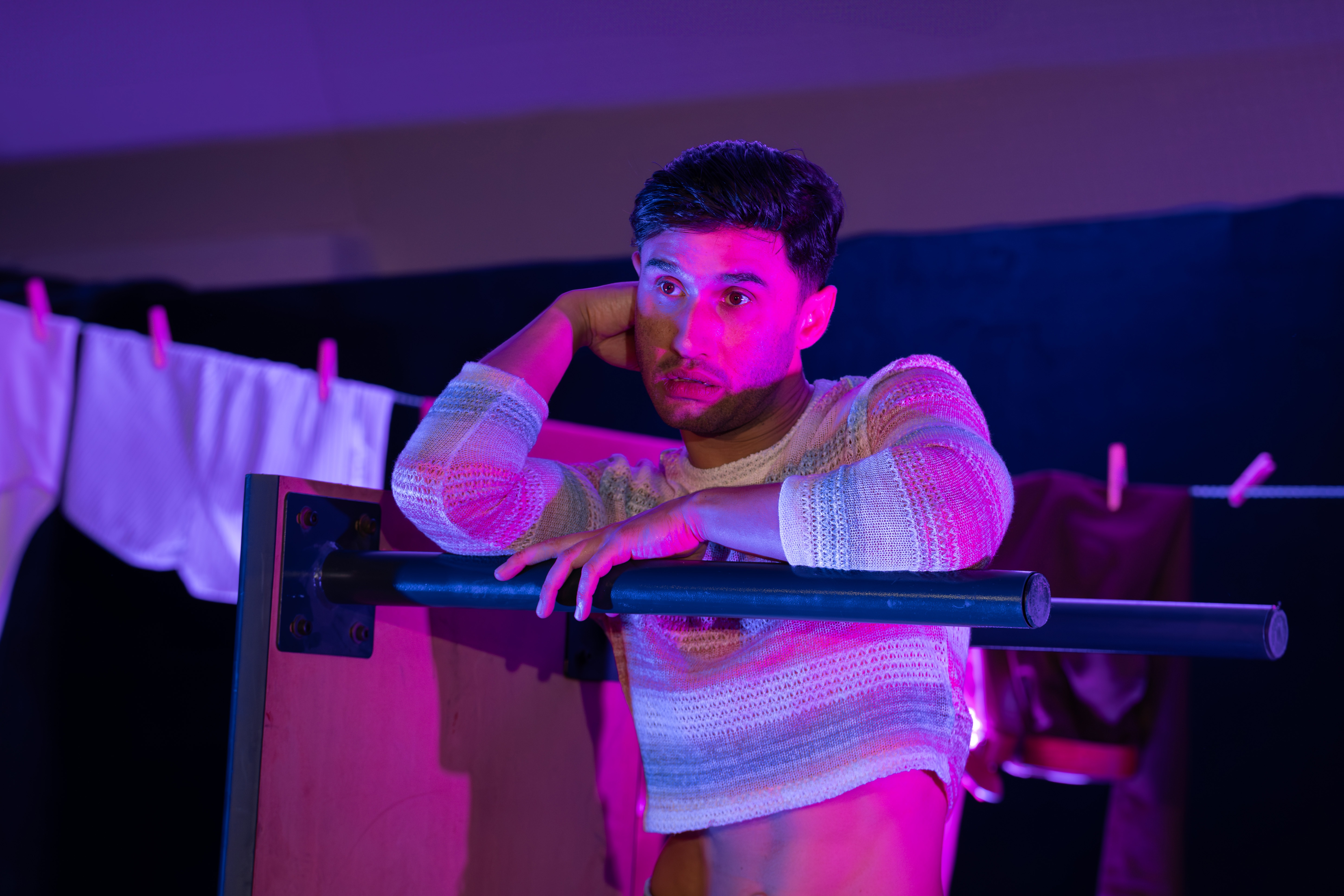
 Anzio September in Zubayr Charles’s Please, don’t call me moffie. (Photo: Jeremeo Le Cordeur)
 About four years ago, writer and director Zubayr Charles came across a local online personality spreading hatred about queer people on social media, using religious ideologies to justify their views.
But he noticed that this wasn’t limited to public figures. Many more people were expressing similar hateful opinions, and many of those people Charles knew personally.
So, he asked himself: “What can I do to comment on what was happening in society at the time?”
This led to his conceptualising the script for what would become Please, don’t call me moffie.
Following its performances at Suidoosterfees and KKNK in 2025 and 2026, respectively, the one-man production has opened for its official theatrical run at Cape Town’s Artscape Arena.
Please, don’t call me moffie is an intimate portrait of five queer, Coloured men in their late twenties. After being shocked by a viral video of a homophobic attack in an unnamed country, they face their past and present realities in monologue-style narrations, reflecting on their identities and belonging.
/file/attachments/orphans/AnzioSeptemberinZubayrCharlesPleasedontcallmemoffie_JeremeoLeCordeur_376575.jpg "Anzio September in Please, don’t call me moffie. (Photo: Jeremeo Le Cordeur)")
What began as a seven-person cast was distilled into a one-man show through a suggestion by lead actor Anzio September.
September – seen previously in Fred Abrahamse and Marcel Meyer’s Aladdin, Marc Lottering’s Colleen the Cashier and Aunty Merle musicals, as well as Charles’s this bra’s a psycho – takes on all five figures in Please, don’t call me moffie.
Each role represents and aims to subvert a queer stereotype often seen in mainstream media: Mushfeeq the Tragic Gay, Abdullah the “Straight Man” character, Zayn the Sassy Gay, Eesa the Muscle Gay and Haroon the Repressed Gay.
Through September’s shape-shifting performance as well as the intentional use of language across English, Afrikaans and Arabic, the show presents these archetypes through an undeniably Coloured and Capetonian lens.
The transitions between characters are signalled by audio associated with each person, snippets from Britney Spears songs, static sounds and instrumentals, while September changes costumes from a clothing line hanging across the stage.
In its staging, these transformations could have been better woven into the narrative itself to create a fluidity that avoids interrupting the audience’s immersion in the world, particularly seeing as the characters are connected through the same social circle.
However, it’s September’s adept embodying of each personality – from having a jittery disposition to a poised upright posture and then to a smooth-walking gym bro – that seamlessly carries the play through its metamorphosis as he steps towards and into the costume of his next part.
/file/attachments/orphans/AnzioSeptemberasEesainPleasedontcallmemoffie_JeremeoLeCordeur_571485.jpg "Anzio September in Please, don’t call me moffie. (Photo: Jeremeo Le Cordeur)")
Over just a 60-minute runtime, Please, don’t call me moffie’s pacing is beautifully controlled, so that no one character outstays their welcome or falls into the story’s peripheries. Although we get only a glimpse into their lives, they are each afforded a satisfyingly rounded narrative.
Particularly striking is when the plea, “please, don’t call me moffie”, is uttered during one of the show’s climactic moments. The “please”, Charles explains, being a reminder of how queer individuals persist in kindness and gentleness despite often being ostracised and discriminated against in society.
Also memorable is Haroon’s shedding of his tracksuit for traditional Islamic attire, portraying his renewed dedication to the practice of his faith. He admits to still fantasising about men at times, but he is set on resisting what he perceives as temptation.
Through its cast of characters, Please, don’t call me moffie opens space for the coexistence of a spectrum of experiences, honouring the complexities that emerge at the intersections of culture, gender and sexual identity that shape our human identities.
/file/attachments/orphans/WriteranddirectorZubayrCharlespicturedwithactorAnzioSeptember_JeremeoLeCordeucopy_446091.jpg "Writer and director Zubayr Charles and actor Anzio September. (Photo: Jeremeo Le Cordeur)")
In a Q&A on opening night, Charles and September spoke to the fact that we hold a multitude of selves within us, and it’s this multidimensional nature of being human that allowed the two artists to create and inhabit the personalities of the story’s five roles.
Even though, as Charles emphasised, it is reductive to wholly interpret a creative work through the artist’s own life, he admits that there are, naturally, aspects of each fictional persona that the pair can relate to, whether it be Abdullah’s anxiety or Zayn’s flamboyant side.
Although the play holds both humour and pain with intentional sensitivity, giving the audience permission to laugh and grieve with each character, this production is not for those looking for a joyful reclamation of queer narratives.
Please, don’t call me moffie is an emotionally charged reflection on and dissection of identity and trauma, bringing a violence that can seem so far away – in some distant unknown place – into the very country, city and room we reside in.
Charles’s work is fearless in confronting and critiquing the perpetuation of toxic masculinity in contemporary society, especially through digital channels.
In his acknowledgements, Charles writes that his intent for Please, don’t call me moffie is to tell a story through which “people might learn to be kinder to those struggling with their sexual identity and those still trying to find their place in the world”. DM
Please, don’t call me moffie is playing at Artscape Arena until 6 June. The published script of the production will be available in local bookstores from spring 2026.