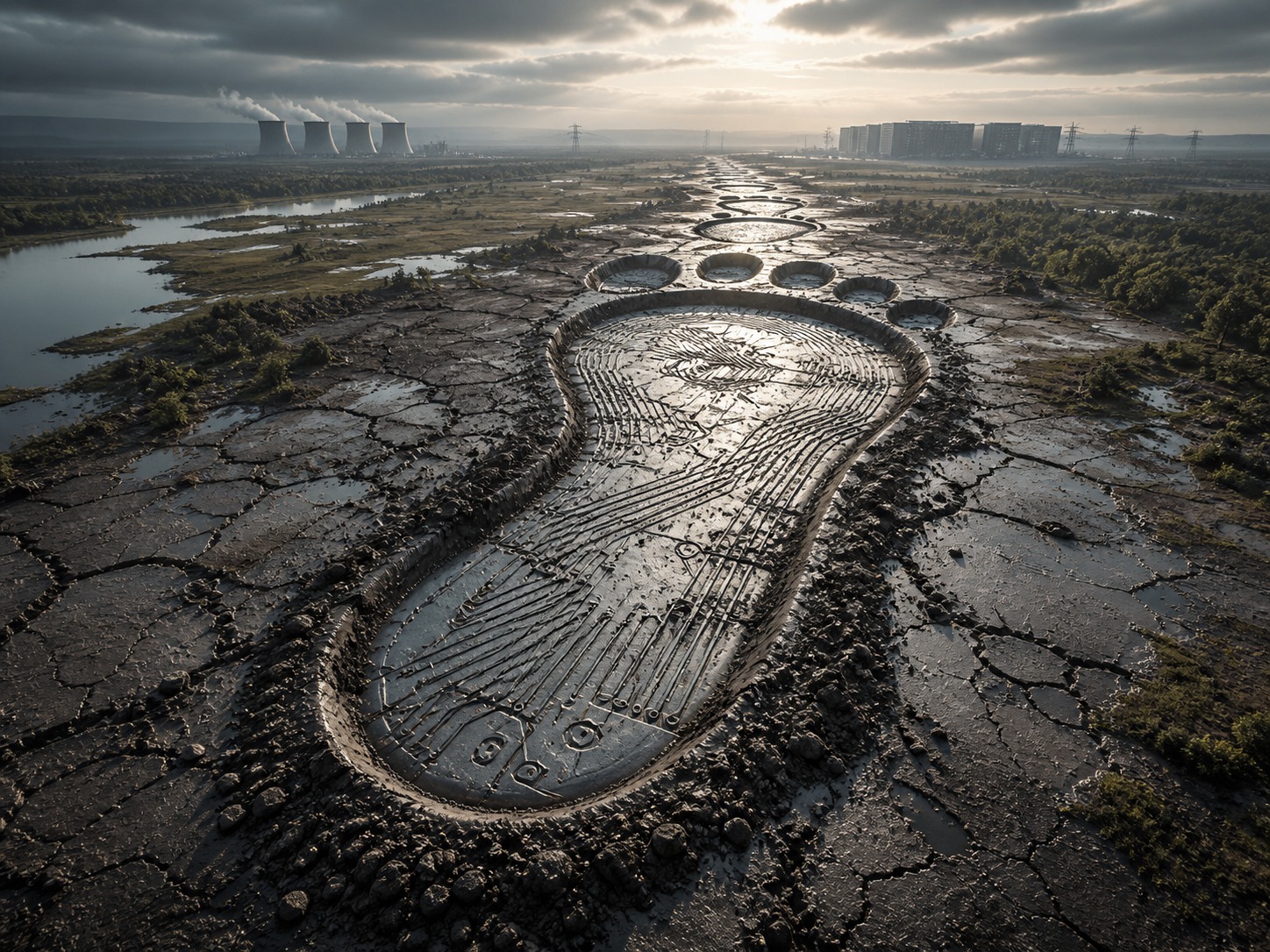
 United Nations University researchers are cautioning governments to look before they leap, by measuring and controlling the hidden environmental costs of the ‘defining technology’ of the 21st century. (Photo: Generated by ChatGPT / UNU-INWEH)
 Unlike the conscious action of picking up a gun, aiming at a target and pressing the trigger, the roller-coaster impacts of tapping away on a keyboard or cellphone screen are largely hidden from public view.
Partly, this is because there is very little noise and no visible clouds of smoke pouring from the rooftops of the new “information factories” springing up across the world.
And yet, the seemingly benign or noble activity of accessing and distributing digital information can have profound impacts on some of the world’s most critical social and environmental resources – notably water, electricity and a climate conducive to human health.
/file/attachments/orphans/tonyAI5datacablestanglePhotoGoogleUNU-INWEH_486195.jpg "Apart from electrical power, data centres can also consume large volumes of water – either directly for cooling purposes, or indirectly to generate steam in coal-fired power stations. (Photo: Google)")
Some of these impacts have been highlighted with startling comparative statistics in a new study by researchers at the United Nations University Institute for Water, Environment and Health in Canada.
Here are some examples:
- ChatGPT now processes about 2.5 billion prompts per day worldwide. Training the GPT-4 (Generative Pre-trained Transformer 4) model alone required up to 70 GWh of electricity over a period of roughly 100 days. According to the UN researchers, this is equivalent to the annual residential electricity consumption of about 460,000 people in Sub-Saharan Africa.
- Training GPT-4 also required about 600 million litres of water, enough to meet the minimum needs of 81,000 people in the same region.
- Based on the projected growth of AI uptake over the next four years, global electricity demand from data centres is likely to double to about 945 TWh – triple the electricity currently used by 650 million people in Pakistan, Bangladesh and Nigeria.
- Put another way, that’s enough to supply residential electricity to all 1.3 billion people in Sub-Saharan Africa for about 5.5 years.
- In terms of water, this translates to 9.3 trillion litres – enough to meet the minimum annual domestic water needs of all residents of Sub-Saharan Africa for a full year.
- Depending on how that electricity is generated, the associated climate gas emissions could reach 400 million tonnes of CO₂e, comparable to the UK’s carbon emissions from all sectors in 2025.
Seen from this perspective, the report raises several questions about the social and environmental justice implications of unbridled AI data centre proliferation.
“When billions of people interact with AI each day, even a few milliwatt-hours of energy per query add up to gigawatt-hours of demand.
“These patterns have clear justice implications. The electricity used and the environmental resources impacted to generate verbose chat responses, AI-crafted images, or high-fidelity videos are resources that may be unavailable to communities that still lack reliable power or clean water.”
/file/attachments/orphans/tonyAI3imaginarywomanpicPhotoChatGPTcopy_729773.jpg "An AI-generated face showing a woman who does not exist. Aside from the hidden environmental impacts, the same technology can be used to impersonate real people, commit fraud, and spread convincing misinformation at scale, undermining trust in digital images and online communication. (Photo: Generated via OpenAI’s ChatGPT)")
The authors acknowledge the role of AI to analyse massive datasets in seconds, translate multiple languages, detect diseases from medical scans, forecast climate trends, and power everything from personalised recommendations to self-driving cars.
“By executing complex operations at speeds and scales far beyond human capacity, AI is more than just a technological tool – it is a transformative force. It is reshaping economies, redefining labour and influencing how societies interact with technology and with the planet. As AI’s influence accelerates, so too does the urgency to understand its full impact: not only the promise it offers, but also the profound challenges it raises,” the report cautions
Professor Kaveh Ramdani, lead investigator for the report and winner of the 2026 Stockholm Water Prize for his research on water bankruptcy and other water issues, suggests that: “The future of artificial intelligence should not be measured only by what machines can do, but by whether humanity can deploy those capabilities within planetary boundaries... This report is a call to make those hidden environmental costs visible before they become unmanageable.”
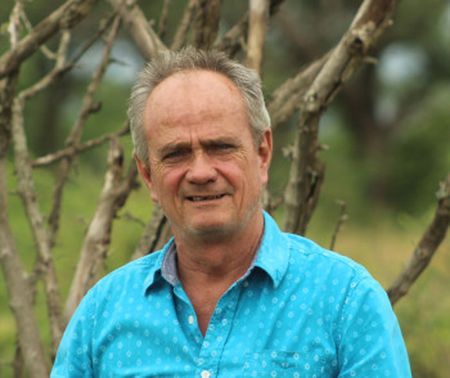
/file/attachments/orphans/tonyAI4kavehramdaniPhotoUNU-INWEH_461118.jpg "Professor Kaveh Ramdani, lead investigator of the new report titled Environmental costs of AI’s energy use. (Photo: UNU-INWEH)")
The researchers cite the example of Ireland, where rapid data centre growth has outpaced its electricity generation capacity. In 2023, data centres accounted for 21% of Ireland’s total metered electricity, compelling the national grid operator to halt new data centre connection approvals until 2028 due to lack of capacity.
Closer to home, a recent Daily Maverick investigation has illustrated the potential for similar problems in South Africa. Plans for a major 400 MW data centre near eManzimtoti could consume 25% of Durban’s current municipal electricity demand. Separate plans for four new data centres in Cape Town are likely to demand 34% of that city’s current electricity supply.
What can be done to ensure a ‘responsible AI future’?
According to the United Nations University report the first of several key steps is to ensure public transparency. It recommends that:
- Communities and civil society should be involved early in data centre siting decisions, with enforceable transparency, consultation, public scrutiny and grievance mechanisms, especially in environmentally stressed regions.
- Governments should also integrate AI infrastructure into energy planning, water governance, and land-use permitting and require standardised environmental footprint reporting.
- Industry and AI developers also need to improve the energy and water use efficiency of data centres through better design.
- Users and deploying organisations should adopt “fit-for-purpose” use – selecting the lightest model and lowest-energy format to meet the task.
- Investors should treat electricity, carbon, water and land footprints as material risks in AI infrastructure portfolios.
/file/attachments/orphans/tonyAI2datacentresbynumberTableStatista2025UNU-INWEHcopy_328668.jpg "Data centre capacity is unevenly distributed worldwide. A small number of countries host the majority of global compute infrastructure, while many regions lag behind. (Table: Statista 2025/UNU-INWEH)")
The report concludes that: “AI offers remarkable potential, but fulfilling this promise responsibly requires systemic change. Every interaction draws on finite resources, and the total environmental footprint depends on how AI systems are designed, how often they are used, and what tasks they perform.”
But putting “responsible” principles into effect timeously is much easier said than done, it seems, at a time when AI is sweeping forward at dizzying speed. DM