



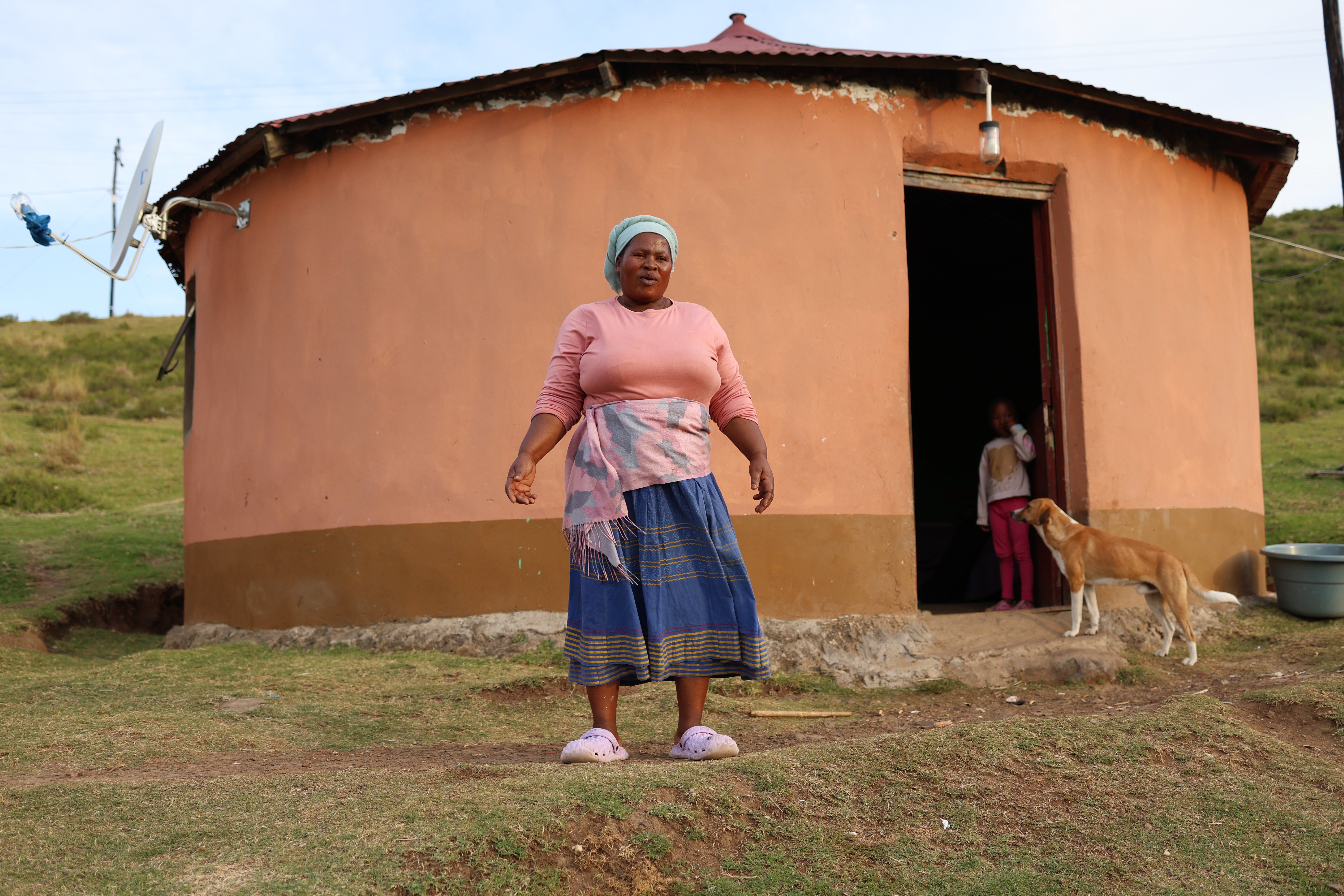
 Ntombekhaya Mduva, with Lilomso (6), overcame challenges in obtaining her birth registration and identity document in the remote rural community of Xhora Mouth with assistance from the Nosintu Gwebindlala Foundation. (Photo: Felix Dlangamandla)
In the deep rural regions of Elliotdale in the Eastern Cape, the struggle for basic documentation can span generations. Without birth certificates and identity documents (IDs), grandparents and young children alike are entirely cut off from the state’s social welfare safety net.
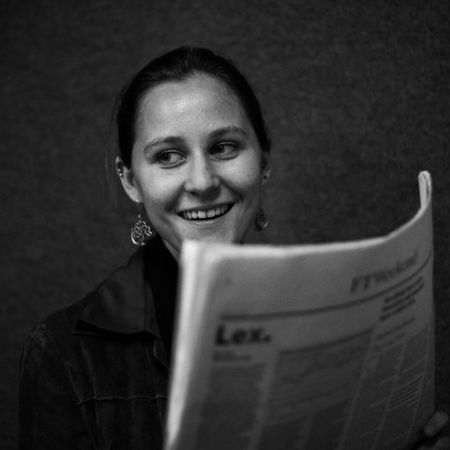
On a mission to bridge this gap for stateless residents is Nosintu Gwebindlala, the founder of the Nosintu Gwebindlala Foundation. The wife of Chief Vuyani Zwelikhanyile Gwebindlala — senior traditional leader of the Jalamba Traditional Council — she leverages her community ties to tackle the crisis, having learned to treat every complex case she takes on as unique.
/file/attachments/orphans/WFD_4287_971039.jpg "Nosintu Gwebindlala, founder of the Nosintu Gwebindlala Foundation. (Photo: Felix Dlangamandla)")
Her role in traditional leadership means she has long served as a problem-solver for the local people, but when she launched her foundation in 2022, she soon realised that one of its main focus areas needed to be the large number of undocumented community members in the area.
“People think that documents are … accessible to all, and from a rural perspective, there are many different issues that lead to people being undocumented,” explained Gwebindlala.
“In some cases it’s historical, generational — a case of the generation before, or two or three generations, never having the documentation — and, unfortunately, those [family members] are no longer there. They’ve all passed on … but the child is here, living.”
The foundation is based in the Xhora Mouth Administrative Area, which encompasses a collection of villages on a remote stretch of the Wild Coast. However, the organisation assists people across Elliotdale and runs a virtual advice office for people seeking help further afield.
/file/dailymaverick/wp-content/uploads/2024/07/Elliotdale.jpg "The remote rural area of Elliotdale. (Photo: Supplied)")
Gwebindlala estimated that they worked on 500 cases of undocumented residents per year, with a success rate of close to 80%.
Barriers to documentation
The Births and Deaths Registration Act requires children to be registered within 30 days of birth. Once this period has elapsed, caregivers seeking birth certificates must go through a more complex late registration of birth process.
A mother cannot register the birth of her child without a valid ID of her own, which is a serious challenge in families where members across multiple generations are undocumented. This is just one of many reasons why people living in the rural areas might miss the 30-day window by a wide margin.
As there is no government clinic or hospital in the Xhora Mouth Administrative Area, mothers face a journey of more than two hours to reach the nearest facility that provides specialised maternity services. On foot, this requires crossing a river and navigating rolling hills; by car, it means arranging transport through a winding network of dirt roads.
/file/attachments/orphans/Tamsin-NGF-EC2_640978.jpg "The remote village of Elliotdale in the Eastern Cape, where rolling hills, scattered homesteads and rugged landscapes reflect both the beauty and challenges of rural life. (Photo: Felix Dlangamandla)")
/file/attachments/orphans/Tamsin-NGF-EC_902579.jpg "The remote village of Elliotdale in the Eastern Cape. (Photo: Felix Dlangamandla)")
Home births are not uncommon, especially if poor weather conditions coincide with labour, meaning some children do not receive the proof of birth forms issued at hospitals, noted Gwebindlala.
“There are issues of access to the [Home Affairs] office [and] the distance that you need to travel. For example, in my area, it’s 50km to get to town.”
In Xhora Mouth, where the unemployment rate has been estimated at more than 90%, paying R50 to R100 per person for transport to the Home Affairs office can be a tough call for caregivers. It might only be once a child approaches the age at which they need to be enrolled in school that parents attempt to submit a late registration of birth application.
There are also households where grandparents raise undocumented children whose parents are absent, deceased or working in other parts of the country, said Gwebindlala. If they do not have a proof of birth form from a hospital or evidence confirming their roles as primary caregivers, efforts to register the child’s birth can be drawn out and frustrating.
/file/attachments/orphans/WFD_4162_207027.jpg "Lihle Mbikwana from the Nosintu Gwebindlala Foundation assists residents of Xhora Mouth address challenges related to birth registration and identity documents. (Photo: Felix Dlangamandla)")
Voice for the voiceless
Where births aren’t registered, caregivers struggle to access vital social assistance programmes like the Child Support Grant. Children face barriers to accessing schools and IDs, and later tertiary education and employment options. Gwebindlala views the problem as an urgent one, describing the resultant social welfare challenges as a “pandemic”.
“I would say we’re the voice of these undocumented citizens, or anyone who is facing any social welfare challenge. We speak on their behalf,” said Gwebindlala.
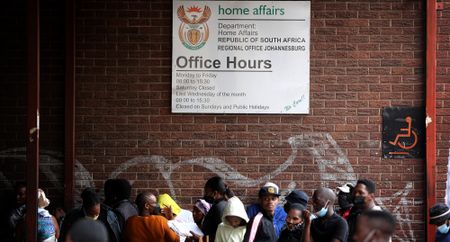
“Home Affairs is always full. There’s officials sitting behind the desk and there’s 100 people waiting to be helped on that day, so they will never get the time to sit down and take an hour with one client.
“That’s where we come in. We will sit and walk with [each person].”
One of the Xhora Mouth residents assisted by the Nosintu Gwebindlala Foundation was Ntombekhaya Mduva, a mother of eight. Mduva had first applied for an ID in 1994 as a young girl. However, a mistake on the Home Affairs system led to her identity being mixed up with that of another person. When that individual later died, it was Mduva who was listed as deceased.
/file/attachments/orphans/WFD_4344_710831.jpg "Ntombekhaya Mduva with Tania ( 3) successfully overcame challenges in obtaining her birth registration and identity document in the remote rural community of Xhora Mouth, Eastern Cape, with assistance from the Nosintu Gwebindlala Foundation. (Photo: Felix Dlangamandla)")
/file/attachments/orphans/WFD_4349_120438.jpg "Ntombekhaya Mduva obtained her birth registration and identity document with assistance from the Nosintu Gwebindlala Foundation. (Photo: Felix Dlangamandla)")
/file/attachments/orphans/WFD_4317_348485.jpg "Without an ID, Ntombekhaya Mduva struggled to access employment in her village. (Photo: Felix Dlangamandla)")
/file/attachments/orphans/6I1A1926_479792.jpg "It was only when the Nosintu Gwebindlala Foundation stepped in to assist Mduva in 2023 that her situation improved. (Photo: Felix Dlangamandla)")
Mduva told Daily Maverick that she travelled to Home Affairs multiple times over the years to try to sort out her paperwork, but failed to obtain a valid ID. Eventually, she gave up, resigning herself to the fact that she would not be able to access birth registration or Child Support Grants for her children.
Without an ID, she struggled to access employment in her village, which left her deeply depressed.
It was only when the foundation stepped in to assist Mduva in 2023 that her situation improved. She recalled how Gwebindlala paid for her taxi fare to visit the Home Affairs office and assisted her through the process of getting her ID. Later, she was able to finalise birth registration for her children.
She noted that having an ID had significantly improved her life. “Now, I can feel like I am a human being after having my documents,” she said.
Gwebindlala explained that the foundation’s interventions varied based on the nature of each case. It could involve advising people on how to acquire supporting documentation, hunting down estranged family members on social media, searching people’s homes for long-lost papers or securing additional support from other community leaders.
Securing documentation for just one person could take months of work, with the foundation covering transport costs to and from the Home Affairs office.
“In the beginning, I used to go to Home Affairs for the whole day, sit there … at the front desk and listen to cases. But the bottom line is to build relationships with those social welfare officers and get to understand what they do — everything that they do,” said Gwebindlala.
“Basically, we walk the journey with them up to the end.” DM
Comments
Scroll down to load comments...