



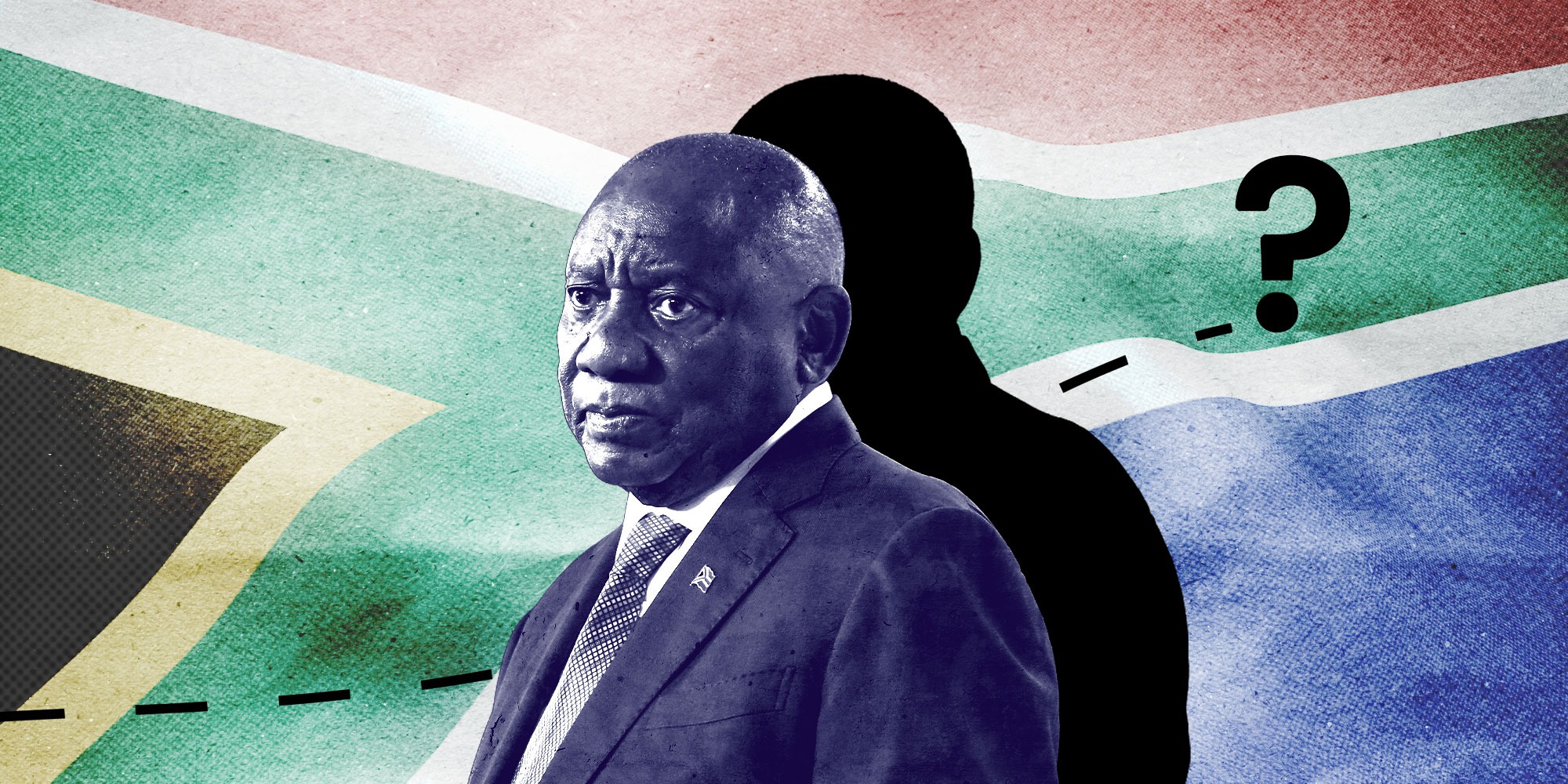
 Illustrative image: President Cyril Ramaphosa. (Photo: Gallo Images / Sharon Seretlo) | South African flag. (Image: Freepik) | (By Daniella Lee Ming Yesca)
While many people enter politics simply for their own self-aggrandisement, the true test of a successful politician is whether they are able to change the trajectory of a society.
Considering South Africa’s situation, that then becomes a test of whether the reforms instituted under President Cyril Ramaphosa will change our trajectory, and particularly help our economy to grow.
It may be premature to say with certainty whether certain reforms might remain, but some do appear to be entrenched and harder to reverse. Others have become almost institutionalised, which means they will probably outlast even significant political change.
At least two reforms appear institutionalised and might be very difficult for any future leader to roll back.
The first is at Eskom, where the current leadership, CEO and board have been able to radically transform the entity. While they’ve had help (the huge increase in rooftop solar generation, for example), the fact is that they’ve been able to relegate load shedding to just a distant memory.
While it is always possible for an institution to be looted in the future, and for government to again mess up its planning, a more fundamental change has happened.
Ten years ago, almost all electricity consumed in South Africa was generated by Eskom. Now, less and less power is. Instead, a significant portion is generated from rooftop solar installations and by independent power producers who then sell it to Eskom.
This change will never be rolled back. The genie is out of the bottle and government has lost its monopoly on electricity generation forever.
Something similar has happened at Transnet, but not quite to the same extent.
A private operator currently runs Pier Two of the Durban Harbour, through which about 46% of our cargo volume moves.
This is a 25-year contract, and while it is conceivable that a future government could cancel the deal, it seems very unlikely. It would also have to be a government of a very radical character to make this decision.
The same is probably true of the decision by Transnet to allow privately owned trains to run on the national railway system. Any decision to reverse that would result in endless court action (although, the MK party says in its manifesto that it does not believe there should be a Constitution… but then, last week, its new spokesperson Sifiso Mahlangu said the party “reaffirms its commitment to constitutionalism and the rule of law”).
And, of course, only someone who is politically insane would reverse the progress made by Prasa in getting passenger trains working again.
Another set of reforms that appears almost entrenched are the changes made by Home Affairs Minister Leon Schreiber.
These include the “Digital Nomad” visa and other changes that are making Home Affairs services much easier to access (people with memories of waiting days at Home Affairs offices that were always “offline” can now go to a normal bank branch for several services).
These changes, too, will not be rolled back, if only because some are mainly technocratic in nature and therefore not ideological.
Operation Vulindlela
But a bigger change has been happening in many areas of government, in that the private sector’s role in our economy has grown dramatically since the start of the pandemic. This has happened almost without political debate.
A major political shift could stop that process from progressing any further, but it might not be able to reverse what has already happened.
Crucially, the major office driving many of these reforms, Operation Vulindlela, is located in the Presidency. A new person in that office could, theoretically, simply disband it.
However, there are important reasons why it might stay, almost no matter who becomes president.
The two most important reforms it has overseen, at Eskom and Transnet, might well result in higher economic growth.
Companies should be much more productive when the power is always on.
Coal miners are no longer held hostage by problems with Transnet’s trains, meaning they’re able to export more of their product and make more money.
If this leads to economic growth and Operation Vulindlela is seen as responsible, then it would be much more difficult for any future president to disband it.
Vulnerable moves
While some of these reforms do appear secure, a brief look at Business Leadership SA’s Reform Tracker will reveal many that are still very vulnerable.
For example, despite widespread anger and frustration at how local government works, there is still no certainty that proper reform will happen. There is currently a Local Government White Paper, but until the proposed changes are adopted, it is always possible for them to be derailed.
The same is also true of the crime and justice cluster of departments.
The Madlanga Commission investigating Nhanhla Mkhwanazi’s claims has yet to make final findings, but the public is already demanding big changes in this area.
However, despite Ramaphosa’s promises and the promises of his and other parties, there’s a chance this may not happen.
A new president could decide they would prefer to keep the SAPS weak and politicised.
And even if Ramaphosa is determined and able to steer through big reforms in the police, the huge variety of interest groups within the SAPS will make this difficult.
They will be helped by the hugely complex nature of the changes that are needed. This may mean that it proves impossible to ever properly reform the SAPS.
The same may be true of other aspects of the criminal justice system.
Previous promises that the National Prosecuting Authority will be reformed have also not yet borne fruit. Its new head, Andy Mothibi, is a man of experience and determination, but nothing will change without extensive political cover.
One of the under-appreciated breaks that Ramaphosa has made with the past has been to appoint independent people to key institutions.
Shamila Batohi at the NPA was just one example, Edward Kieswetter at SARS was another. But Ramaphosa has also ensured that the judges he has appointed to various positions have been independent and seen to be independent.
This was very different to both the Zuma and Mbeki eras, where people such as former Chief Justice Mogoeng Mogoeng, or former NPA head Bulelani Ngcuka, were given important jobs.
While Ramaphosa may hope that this practice continues, it will depend on his successor. It seems likely they will want to merely control these positions and thus will not follow his example.
Economic protection
In the final analysis, the main test of whether a reform is successful might be whether, in fact, it improves the lives of South Africans.
If the economic reforms do lead to more economic growth, they will feel the difference, and those reforms will be protected and become further entrenched.
If they fail, even through no fault of their own (if high oil prices make it impossible to grow the economy, for example), then they will not be protected.
This shows how important economic growth will be in determining whether Ramaphosa has, in fact, changed the trajectory of our country. DM
Comments
Scroll down to load comments...