




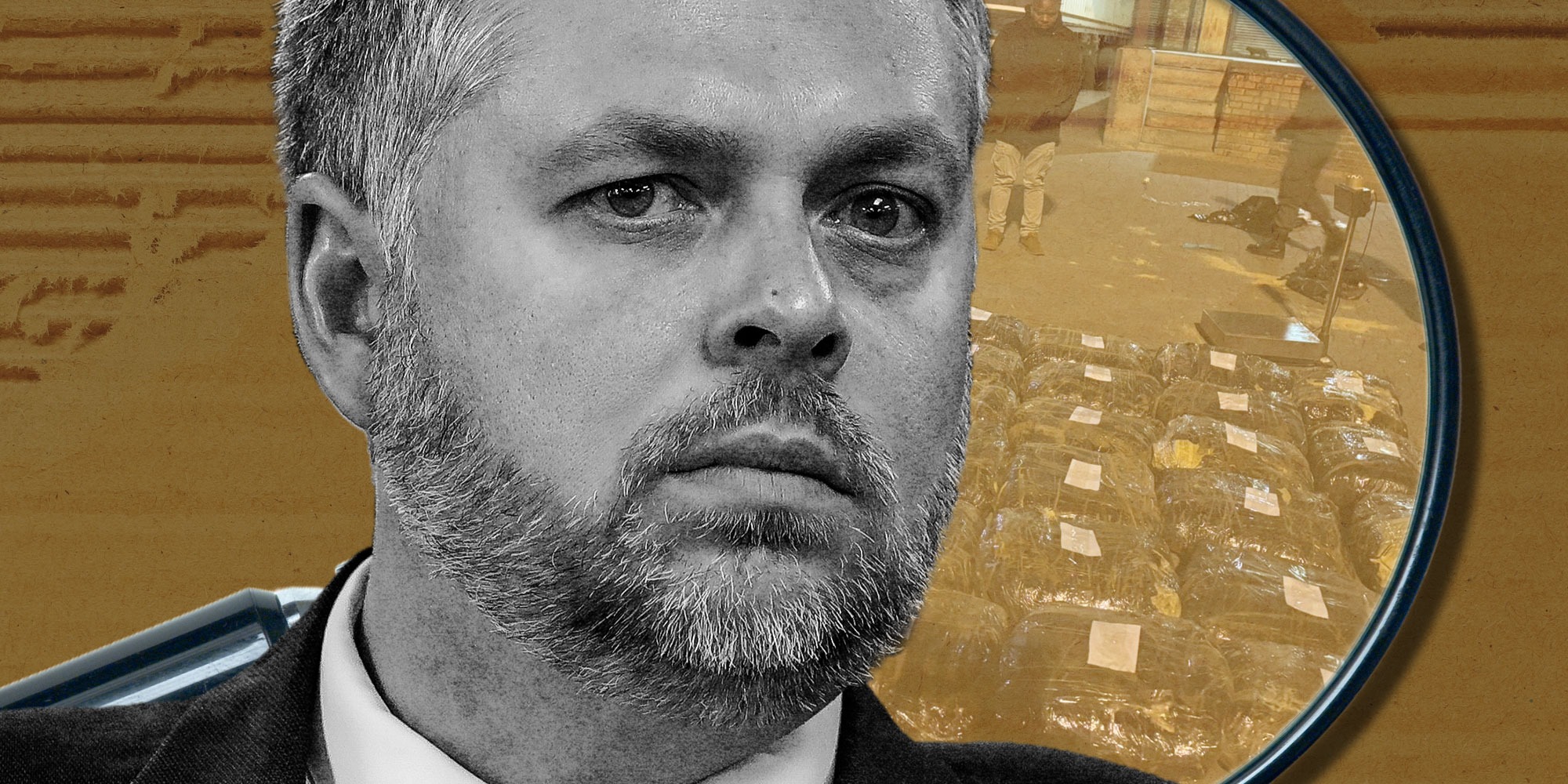
 Illustrative image: Home Affairs Minister Leon Schreiber. (Photo: Gallo Images / Fani Mahuntsi) | Magnifying glass. (Image: Freepik) | The Border Management Authority intercepted a consignment of chemicals used to make Mandrax. (Image: X / @leonschreiber) | (By Daniella Lee Ming Yesca)
 It has been hailed as a massive moment in South Africa’s fight against illicit drugs, and a political party has even claimed bragging rights.
But is it as significant as it has been made out to be? Let’s take a look.
On Wednesday, 27 May 2026, a truck was intercepted at the Beitbridge Border Post while travelling from Malawi to South Africa.
While it was being scanned, an anomaly was picked up. The truck was dismantled over eight hours, leading to the discovery of a hidden compartment. Concealed inside were rectangular bundles containing methaqualone, used to make Mandrax.
Three suspects were arrested. The DA took to social media, saying: “The DA is securing our borders, protecting all our communities.”
The party’s Home Affairs Minister Leon Schreiber also lauded the interception.
The Border Management Authority has just achieved what is likely the single biggest breakthrough against the drug trade in South African history, by intercepting a consignment at Beitbridge valued at nearly R1 billion. (You read that right).
— Leon Schreiber (@Leon_Schreib) May 28, 2026
Yesterday, an intelligence-driven… pic.twitter.com/uRSxLbxj0E
On Thursday, he issued a statement saying: “The Border Management Authority (BMA) has just achieved what is likely the single biggest breakthrough against the drug trade in South African history.”
Schreiber and the BMA said in statements that the methaqualone intercepted last week weighed about “713,000 grams,” in other words, 713kg, and had a street value of around R998.2-million.
That’s just short of R1-billion. It’s not clear how they came to this figure.
Comparing numbers — billion vs millions
During a press conference with the BMA on Friday, Schreiber explained that methaqualone was a precursor chemical used to make Mandrax.
(This suggests the intercepted load was on its way to a clandestine production facility where it would be processed to churn out Mandrax tablets.)
Schreiber said that because the precursor chemical was seized, this meant: “The ultimate value of this interception is likely far more than the billion-rand value assigned to this particular substance.”
But some sources with knowledge of illicit drug investigations told Daily Maverick that the value may be far lower.
They say it all depends on the number of Mandrax tablets that the methaqualone can yield, plus the quality and price per tablet produced.
/file/attachments/orphans/HJYhwBnWgAATcdw_718241.jpg "Authorities in South Africa say a substance used to make Mandrax, worth nearly R1bn, was intercepted at the Beitbridge Port of Entry on 27 May 2026. (Photo: X / @Leonschreiber)")
Eyewitness News also reported that when the three suspects arrested in connection with last week’s bust appeared in court, “the prosecutor [said] that the value of the seized drugs was approximately R34-million, significantly lower than the earlier figure presented by officials.”
The report also said this had “raised questions over how the estimated street value was determined, whether different methods were used by authorities and prosecutors, and whether the substance was subjected to scientific laboratory analysis for confirmation.”
The Madlanga Commission of Inquiry, investigating accusations that a drug cartel has infiltrated South Africa’s criminal justice system and politics, has heard that cocaine is the most expensive drug in the country, while Mandrax fetches the lowest price.
Let’s compare last week’s 713g methaqualone bust, with a claimed value of R1-billion, with a cocaine consignment.
Towards the end of 2021, when police intercepted 600kg of cocaine at Durban harbour, they said the estimated street value was R240-million.
Based on this, it seems the methaqualone bust may be worth less than Schreiber and the BMA have asserted, but that depends on how the figure was calculated.
Previous R1bn crackdowns
Schreiber, in his statement on Thursday, described last week’s interception as “likely the single biggest breakthrough against the drug trade in South African history”.
It is unclear what factors he attached to this.
Schreiber may be saying that the methaqualone alone is valued at around R1-billion, possibly making it the largest precursor chemical interception.
It may also be the single largest amount of methaqualone intercepted at the border.
There have been other kinds of drug busts with a higher value and potentially more concerning international reach than last week’s.
Back in 2011, police announced a R2-billion Mandrax production facility had been uncovered in a Cape Town suburb.
Among various substances and items seized was a powder that could make “tablets with a street value of R112-million”.
Other major drug manufacturing crackdowns have since happened.
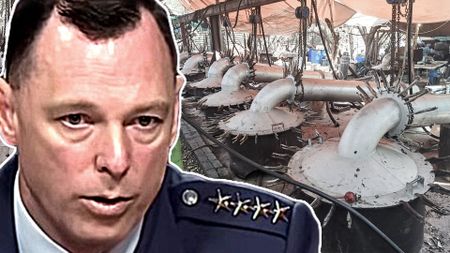
Daily Maverick reported that a narcotics-making facility worth about R2-billion was uncovered at a farm in Limpopo in 2024.
This bust was so significant that it was recently referred to by General Dagvin Anderson, who heads the US’s Africa Command, a combat command responsible for military operations to protect America.
/file/dailymaverick/wp-content/uploads/2025/10/2-1-1.jpg "Four suspects, including the farm owner and two Mexican nationals, were arrested on 19 July 2024 in an intelligence-driven operation by members of the Limpopo Serious Organised Crime Investigation team, assisted by the Limpopo Tactical Response Team at a farm in Groblersdal, where a multimillion-dollar clandestine laboratory was discovered. (Photo: SAPS)")
In mid-May 2026, police in South Africa announced that another drug manufacturing facility, worth about R1-billion, was discovered in Swartruggens, North West.
Those two crackdowns involved crystal methamphetamine, and arrests included suspects from Mexico, fuelling concerns that cartels from that country are increasingly setting up shop in South Africa.
Last week’s methaqualone bust, regardless of its true value or if it’s the biggest narco breakthrough in this country’s history, means some drugs have been diverted from reaching the streets.
It also emphasises that South Africa is a drug manufacturing hub, as well as a narcotics transit country and consumer base.
‘Sophisticated enterprise’
What the methaqualone interception definitely points to is the calibre of criminals operating – or trying to operate – via South Africa.
During Friday’s press conference with Schreiber, BMA Commissioner Michael Masiapato described how last week’s intercepted truck involved an intricate trafficking operation.
“This is a very serious, sophisticated enterprise,” he said.
“This is not [a case of] some chance takers who just [took] some things and threw it into the truck.”
/file/attachments/orphans/HJYhwESWoAUuGxw_191354.jpg "Authorities in South Africa check a substance they say is used to make Mandrax, worth nearly a billion rand, that was intercepted at the Beitbridge Port of Entry on 27 May 2026. (Photo: X / @Leonschreiber)")
Masiapato said the secret compartment in the truck was specially sealed with steel.
“It was an activity to dismantle,” he said.
The South African Police Service (SAPS) canine unit and detectives from the Hawks were called to the scene and retrieved 28 packages containing methaqualone.
An investigation was launched to determine where it was headed and whether the traffickers were part of a transnational syndicate.
Masiapato made it clear that last week’s bust was not an isolated incident.
Daily crackdowns were happening and did not just involve illicit narcotics.
Pre-empting problems
There are various measures in place to bolster security at South Africa’s points of entry.
Schreiber said on Friday that the BMA was installing facial recognition cameras at major airports. This was related to Electronic Travel Authorisation.
A government website describes this travel authorisation as “a digital authorisation that allows prospective travellers from eligible visa-required countries to travel to South Africa for tourism or visitor purposes, without the need for a traditional visitor’s visa.”
Schreiber said that South Africa could now digitally verify and identify the biometrics of foreigners before they entered the country.
He said this went towards “significantly strengthening national security and helping to prevent criminal syndicates from exploiting weaknesses in the immigration system.”
/file/attachments/orphans/HJYhwBmWQAYC-ID_481938.jpg "Authorities in South Africa with the substance they say is used to make Mandrax, intercepted at the Beitbridge Port of Entry on 27 May 2026. (Photo: X / @Leonschreiber)")
A critical part of last week’s methaqualone interception was a scanner that was used on the truck. Scanners are also used on shipping containers to try to pick up whether these contain illicit items.
In a response to parliamentary questions earlier this year, acting national police commissioner Firoz Cachalia explained that SAPS did not conduct container scanning.
“The SAPS does not own or operate container scanning equipment, nor does it have mobile container scanners capable of scanning containers,” he said.
“Where containers, identified through profiling or intelligence, require scanning, such containers are referred to Customs, who have the capability for scanning infrastructure within the port environment.”
Cachalia said the BMA brought together various structures, including SAPS and the South African Revenue Service (SARS).
‘It will never be enough’
Late last year, Daily Maverick asked SARS about its scanning capacity.
The revenue service said it used a combination of fixed and mobile scanners at key seaports to bolster customs inspections.
“These scanners are deployed based on operational needs and risk assessments. Mobile scanning units, including truck-mounted systems, are also used at selected inland sites to inspect cargo transported by road,” SARS said.
“These units help SARS carry out non-intrusive inspections in areas identified as high-risk.
“SARS has two sea freight cargo scanners at Cape Town and Durban, plus Beitbridge, which also considers sea freight shipments in transit to or from Durban.”
It planned to get more scanners, but pointed out: “Regardless of the number, the scanners will never be enough.”
Corruption and collusion
Last week’s methaqualone interception and recent drug busts come against the background of South Africa’s law enforcement implosion that erupted in July last year and is hinged on accusations that a drug cartel has infiltrated the criminal justice system, politics and private sector, including security.
The Madlanga Commission of Inquiry, which is investigating the accusations, recently heard testimony about two mass 2021 cocaine interceptions in KwaZulu-Natal.
Read more: SA’s cocaine shame: How cops ‘bungled’ global trafficking cases
One of those involved the theft of cocaine worth between R200-million and R250-million from the Hawks’ offices in Port Shepstone.
This was widely believed to be an inside job.
A second cocaine interception, worth R286-million, had been stored in a forensic science laboratory – R55-million worth of that haul went missing. DM