




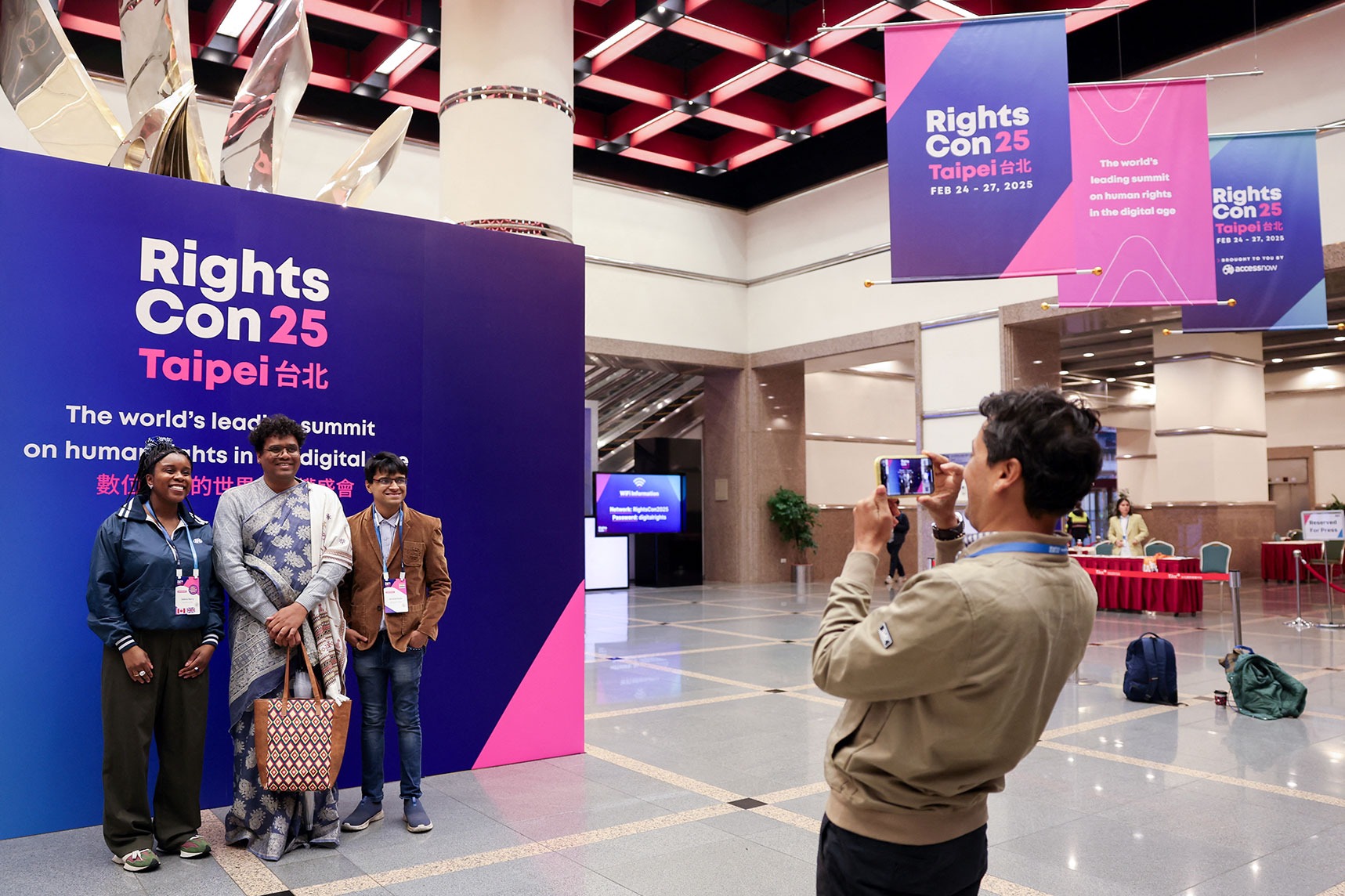
 People pose for photo at RightsCon in Taipei, Taiwan February 24, 2025, the previous RightsCon before the Zambian event. (Photo: REUTERS / Ann Wang)
 Digital rights and media groups have been calling for Zambia to account for its unilateral decision to prevent RightsCon 2026 from proceeding on 5 May in Lusaka, which triggered a frenzied upset that affected a number of other events.
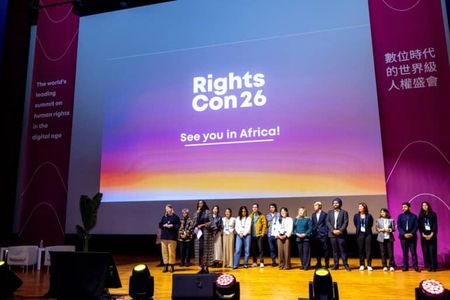
From the get-go, organisers AccessNow pointed specifically to China’s hidden hand, saying that they had been informed that Beijing had objected to the planned in-person presence of Taiwanese delegates, which is a red flag for the People’s Republic of China.
The African Editors Forum (TAEF) was among those who called on Zambia to “give a full and honest account of the circumstances that led to this cancellation, apologise to the organisers and partners, and provide credible guarantees that Zambia remains committed to freedom of expression, assembly, media freedom, digital rights, and open civic debate”.
In an interview, TAEF president Churchill Otieno said the cancellation was “not homegrown” but driven by “external forces leveraging all manner of influence” in the state.
The 11th-hour backtrack by Zambia – without consultation or warning – exposed a stark geopolitical reality: the vulnerability of Global South nations to superpower influence, said the Centre for Law and Democracy’s Toby Mendel, who agreed that the primary driver was China’s “aggressive” stance against Taiwanese participation and conference themes.
/file/attachments/orphans/Toby-Mendel-CentreForLawAndDemocracy_323679.jpg "The Centre for Law and Democracy’s Toby Mendel. (Photo: Supplied)")
‘Diplomatic sensitivities’
This week, for the first time since the controversy erupted, the Zambian government conceded to this journalist that “diplomatic sensitivities that emerged shortly before the event” had played a role, along with previously disclosed reasons of “national values, policy priorities and broader public interest considerations”.
Responding to written queries, Thabo Kawana, permanent secretary in the Zambian Ministry of Information and Media, said the country had fully supported preparations for the conference, but “certain unforeseen developments required additional consultation and alignment”.
Responding to claims of kowtowing to China, Kawana said that “any assertions that Zambia’s decisions are driven by external pressure are mischaracterisations. Zambia is a sovereign state… Our foreign policy remains guided by principles of non-alignment, respect for international relations frameworks and constructive bilateral and multilateral engagement.”
It was important that the event “proceeded under conditions that would ensure stability, inclusiveness and adherence to Zambia’s diplomatic and legal frameworks… The postponement should therefore be viewed as a precautionary and responsible decision, rather than a withdrawal of support.”
It needed to ensure “national stability, policy consistency and strategic long-term interests”. Extensive, detailed communication at the time of the “unfortunate postponement” was not immediately possible “without risking misinterpretation and premature disclosure of sensitive discussions,” Kawana said.
Asked about a missed opportunity for Zambia, he said the country remained committed to “positioning itself as a credible host for international events, including those focused on digital rights and information integrity… The government values platforms like RightsCon and recognises their importance. We remain open to future engagement under conditions that align with Zambia’s national interests and global commitments.”
As outrage spread globally throughout May, senior fellow at the Centre for International Governance and Innovation (CIGI) Anja Kovacs cautioned that it is important to look deeper with a “decolonial lens” to see the economic forces at play, noting that Zambia occupied a “complicated space” even if the Zambian government had the best of intentions. The growing relationship between the two nations had given China more leverage over the Zambian government’s decisions.
“Somehow, in the current political climate, isn’t it essential to take this context into account? If we really want to promote and protect digital rights as a community, isn’t it essential that we hold space for all of this, too?” Kovacs asked.
Seeing the broader context, she considered what had led Zambia to be “pushed into a corner at the last moment”. She speculated that it was “easier to lose a conference of thousands of people, mostly foreigners, rather than lose some funding that they feel they really need to improve life for people in their country”.
According to a CIGI article by programme director Dianna H English, the Zambian government announced a $1.5-billion deal with a Chinese state-owned company to expand the country’s power capacity in April, alongside a development cooperation agreement signed on 24 April. “These are real investments that become even more powerful given shrinking foreign assistance budgets globally, especially the closure of the United States Agency for International Development,” she said.
At the same time, a US bilateral agreement with Zambia stalled, reportedly because the US government was placing conditions that lifesaving HIV health assistance be linked to mining and data access.
“These are exactly the kinds of real, human trade-offs that create the conditions for transnational repression,” warned English.
Mendel said that, besides the deepening influence of China, digital rights are simultaneously squeezed by the US, which actively protects big tech interests from regulation and taxation by other countries. “There’s a huge threat to digital rights advancement coming very specifically from the US… going around and knocking anybody on the head who tries to regulate these platforms.”
The Nigerian-based Paradigm Initiative, which was involved in RightsCon 2026 preparations, is among more than 133 digital rights signatories to a joint statement, noting that it was “appalled” at the Zambian government’s action.
“The decision raised concerns about closing civic space and fostering a culture of self-censorship ahead of the August 2026 elections and is a major setback for Zambia’s digital rights trajectory regionally and globally, signalling a departure from the gains it has secured in leading global processes,” the statement read.
/file/attachments/2992/10IMG_0056-2-scaled_644440.jpg)
Paradigm executive director Gbenga Sesan speculated that the decision boiled down to three core considerations: “Zambia says LGBT issues are not national values, that the One China Policy means no Taiwanese participation or support, and that online participants should be moderated.”
He pointed out that the Digital Rights and Inclusion Forum, which addresses global issues related to internet rights, particularly in the Global South, was hosted in Zambia in 2025, with the involvement and support of the government, and included LBT sessions hosted by various organisations. “But I guess we didn’t pose any threat to China, so that’s more like what triggered the RightsCon suspension,” he said.
The Media Institute of Southern Africa’s regional director, Tabani Moyo, cautioned that this geopolitical shift – where China is gaining an upper hand – “will equally give a stronger hand to those of its allies in terms of pushing back, which might then spill over into internet regulation, including issues of throttling of the net and its shutdown. It’s going to be increasingly sophisticated.”
This included data sharing without judicial oversight, localised throttling to control information flows, and heavy investment in bots and large language models to pollute online spaces.
Moyo speculated further that had Lusaka not acquiesced, China might have resorted to even more severe measures.
China aside, the civic space is shrinking in Zambia
While the hidden hand of China has been widely referenced as the driving force, Sishuwa Sishuwa, a Zambian political historian at the University of Stellenbosch, argued that this was an “excuse”, with domestic politics actually driving the decision.
“The explanation of ‘pressure from China’ fitted in easily with a general anti-China narrative and was accepted uncritically, especially in the West,” Sishuwa said. He pointed out that RightsCon was scheduled to take place while Zambia’s ruling party-dominated parliament was sitting to consider “no fewer than 70 bills, including a series of repressive legislative proposals seeking to arrest human rights”.
“It would have been very awkward and even embarrassing for the government to discuss and pass these anti-human rights laws while the people attending a major human rights conference in the building adjacent to the National Assembly are denouncing such laws,” Sishuwa observed.
/file/attachments/orphans/Sishuwa-Sishuwa_397433.jpg "Sishuwa Sishuwa. (Photo: Supplied)")
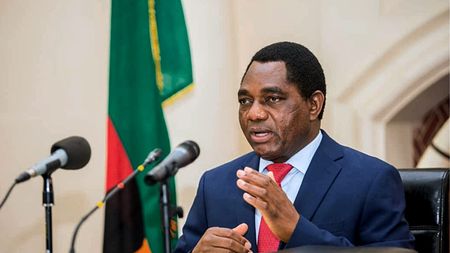
“It is plausible that the main motivation was the government’s apprehension that the event would draw international attention to its systematic efforts to undermine human rights. Such scrutiny would have challenged the government’s narrative of an improved human rights environment since [President Hakainde] Hichilema’s election.
“What the RightsCon organisers experienced in one week has been the experience or daily reality of Zambians under the Hichilema administration. Ironically, by cancelling the summit, the authorities have inadvertently intensified international focus on the shrinking civic and political space in Zambia. For a country seeking a seat on the UN Human Rights Council, these actions demonstrate its unsuitability for such a role. As under the previous administration, human rights in Zambia remain precarious.”
Zambia’s parliament dissolved on 13 May ahead of the general elections in August. DM
Janet Heard is contracted with the Centre for Information Integrity in Africa (CINIA).
