




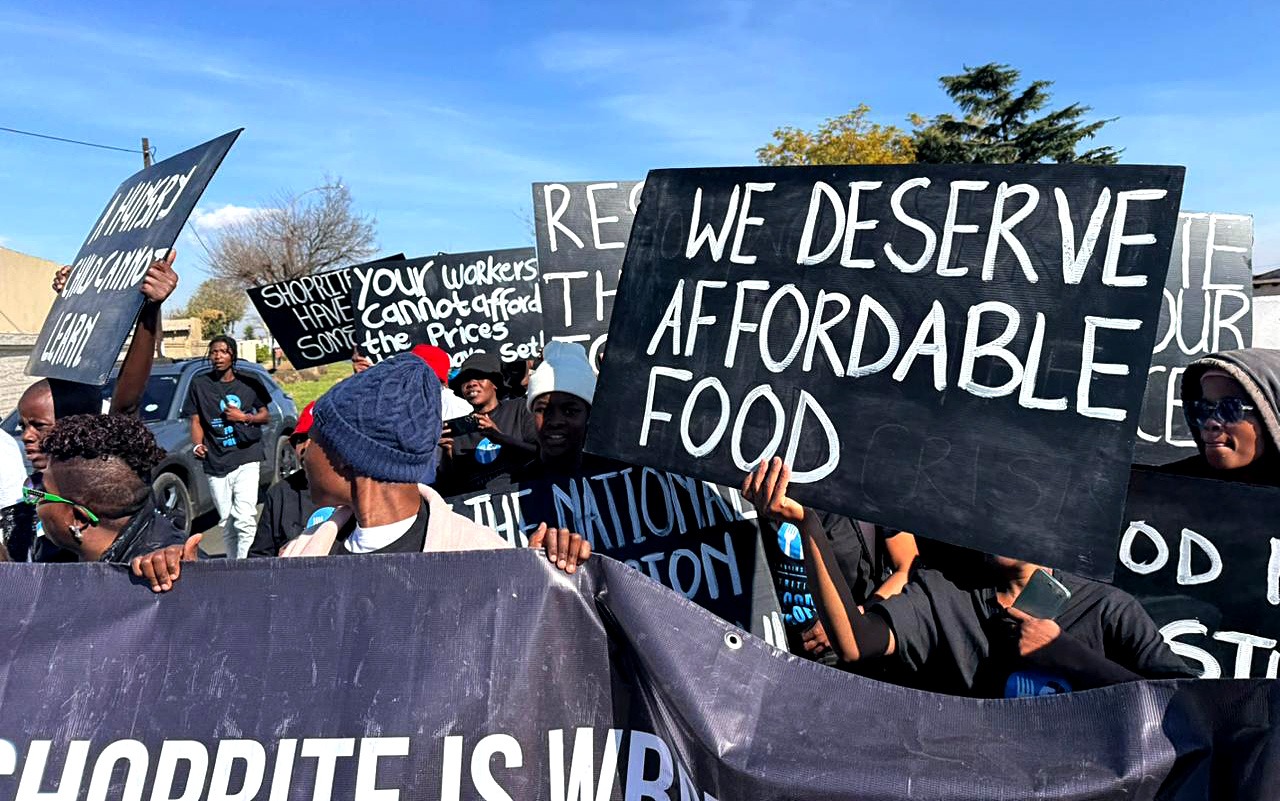
 Union Against Hunger members and supporters march outside a Shoprite store on 27 May 2026, demanding lower essential food prices and a living wage for retail workers. (Photo: Supplied / Union Against Hunger)
 South Africa produces enough food to feed everyone. The majority cannot afford to eat it. That contradiction sat at the centre of Food Justice Week, a series of pickets, dialogues, and community actions organised by the Union Against Hunger (UAH) from 25 to 30 May.
Across the week, Union Against Hunger members and supporters hold panels, discussion opportunities and pickets to consistently make the argument that hunger in South Africa is unacceptable and that we should realise it has identifiable causes, identifiable culprits, and legal remedies that have not been used yet.
At the Union Against Hunger’s Food Justice Week opening media briefing on 26 May, Zwelinzima Vavi, the General Secretary of the South African Federation of Trade Unions (Saftu), cited figures from the Pietermaritzburg Economic Justice and Dignity Group showing that the average household food basket now costs more than R5,400 per month, while a basic nutritious basket costs about R6,600.
The national minimum wage, he said, translates to between R4,800 and R5,800 a month, with electricity and transport consuming 58% of that before food is bought. The child support grant stands at R560 per month, nearly R300 below the food poverty line of R855. And the Social Relief of Distress grant remains at R370.
“This means millions of unemployed people and mothers are expected to survive on grants that are nowhere near the actual cost of food. That is institutionalised hunger,” he said.
/file/attachments/orphans/48_928824.jpg "Speakers at the Union Against Hunger’s media briefing at the Nelson Mandela Foundation in Johannesburg on 26 May 2026, where the union launched its Food Justice Week. From left to right: Nomzamo Zondo, Nzama Mbalati, Sibongile Tshabalala, Sibusiso Zikode, and Zwelinzima Vavi. (Photo: Daniélle Schaafsma)")
Treatment Action Campaign national chairperson Sibongile Tshabalala, speaking as someone living with HIV, described the daily choices these figures produce.
“A mother needs to think: Do I take this R20 and buy a loaf of bread, or do I take this R20 and go to the clinic and get life-saving medication? That is not just a choice, that is a danger to our nation,” she said.
The union argued that the consequences of hunger extend beyond empty plates. Abahlali baseMjondolo President Sibusiso Zikode connected the crisis directly to the social tensions playing out on SA’s streets.
“The anger of the poor and working class can go in many directions. In 2021, it manifested itself in the form of looting. Now it manifests itself in the form of xenophobia. The anger is justified. But it is misdirected,” Zikode said.
“We know our enemy,” Zikode told Daily Maverick. “And we must tell South Africans that the frustration that we all see is understood. But we are not doomed not to know who our enemy is.”

Constitutional promises
“The right to food is a constitutional right. Therefore, our government is undermining the Constitution,” said Lebohang Phanyeko, Head of Campaigns at the Food and Allied Workers Union, at Tuesday’s media briefing.
On 27 May, the Union Against Hunger convened a dialogue at Section27’s offices in Johannesburg with Constitutional Court Justice Jody Kollapen. The gathering brought together lawyers, community members from Soweto and Orange Farm, and civil society representatives, to discuss what the law actually requires on the question of hunger.
The starting point is Section 27 of the Constitution, which provides that everyone has the right to have access to sufficient food and water. The state is required to take reasonable legislative and other measures, within its available resources, to achieve the progressive realisation of that right.
When courts assess whether the government has met this obligation, they apply a reasonableness standard, asking not whether everyone has been fed, but whether the state has taken reasonable measures to progressively realise the right, and whether those measures adequately provide for the most vulnerable.
When it comes to children, however, Section 28 is different. It provides that every child has the right to basic nutrition, shelter, basic healthcare services, and social services, with no qualification around available resources or progressive realisation. It is, in legal terms, immediately realisable.
Reflecting on the broader trajectory of socioeconomic rights since 1994, Kollapen said: “We largely remain an unequal society.” He described the Constitution as having been presented at the time as a promissory note to the future, but that we have reached the point where rights have become commodities – we have to buy our housing, healthcare, safety and food.
/file/attachments/orphans/5_853810.jpeg "Constitutional Court Justice Jody Kollapen, right, and Mark Heywood, co-founder of the Union Against Hunger, left, at the union’s dialogue around the right to food on 27 May 2026. (Photo: Daniélle Schaafsma)")
If a case were to be made in court, Kollapen outlined what he described as a possible direction for pushing beyond reasonableness, arguing that progressive realisation must ultimately mean actually realising the right, not simply demonstrating year-on-year progress.
“It must ultimately lead to having a house,” he said in the context of housing rights, drawing a parallel to food.
It is on Section 28, however, that the union sees its strongest legal ground, precisely because reasonableness does not apply in the same way. Section27 Director Sasha Stevenson was direct about what the immediately realisable standard means.
“Children have a clear right to basic nutrition. It’s not limited by available resources or progressive realisation or any of these ways that we allow the government to slowly make progress.”
Nearly 29% of children under five are stunted due to chronic malnutrition, and an estimated 10,000 children die every year from malnutrition and malnutrition-related diseases, according to Mark Heywood, co-founder of the Union Against Hunger.
“That is 30 children per day in our rich country with its advanced food system,” Heywood said. “Every child who is dying and stunted now is a victim of unlawful government. A failure to carry out legally binding obligations to make sure that every child has basic nutrition.”
Yet during the discussion, it was acknowledged that any legal challenge faces a structural complication. Unlike housing or healthcare, where the state can build clinics and houses, Kollapen said, food production and distribution in SA was dominated by a small number of private corporations.
The state’s ability to discharge its Section 27 obligation, according to Kollapen, cannot be separated from the private sector’s dominance of food production and pricing. He argued that this opened the door to compelling the state to regulate food pricing as part of its own constitutional duty, and that if retailers were to argue that such regulation violated their right to trade under Section 22, the profit data was already there to answer them.
“You’re making profits at twice the level that your counterparts are making in other jurisdictions. The impact on your right is hardly as invasive as you make it out to be.”
/file/attachments/orphans/11_556521.jpeg "Members and supporters of the Union Against Hunger picket outside a Shoprite store on 27 May 2026, as part of the union’s Food Justice Week, centred around World Hunger Day on 28 May. (Photo: Supplied / Union Against Hunger)")
Taking it to big retail’s front door
On Wednesday, UAH members and supporters picketed 28 Shoprite stores across seven provinces and handed managers a formal memorandum addressed to CEO Pieter Engelbrecht and board chairperson Wendy Lucas-Bull. The memorandum called on Shoprite to lower essential food prices by 20% across key staples, including milk, amasi, eggs, bread, fruit and vegetables, rice and cooking oil; to pay all employees a living wage; and to reduce executive salaries.
It noted Shoprite’s R7-billion net profit last year, described as twice the average margin of food retailers internationally, and its more than 3,000 stores serving predominantly poor and working-class communities.
The memorandum also cited a statement attributed to President Cyril Ramaphosa in October 2025, in which he reportedly called on food retailers to reduce prices, saying they were “the ones who drive the high food prices”.
The union said it had requested a meeting with Shoprite’s leadership on several occasions without success. Shoprite has indicated it considers its existing corporate social investment programmes sufficient. The memorandum warned that, absent engagement, pickets and outreach to the company’s investors would continue.
At Tuesday’s media briefing, Vavi set out their view of what that standoff represents.
“The CEO of Shoprite reportedly earns more than R87-million a year while many retail workers cannot afford the food they pack, transport and sell,” he said. “This is not merely inequality. This is organised economic violence.” DM