



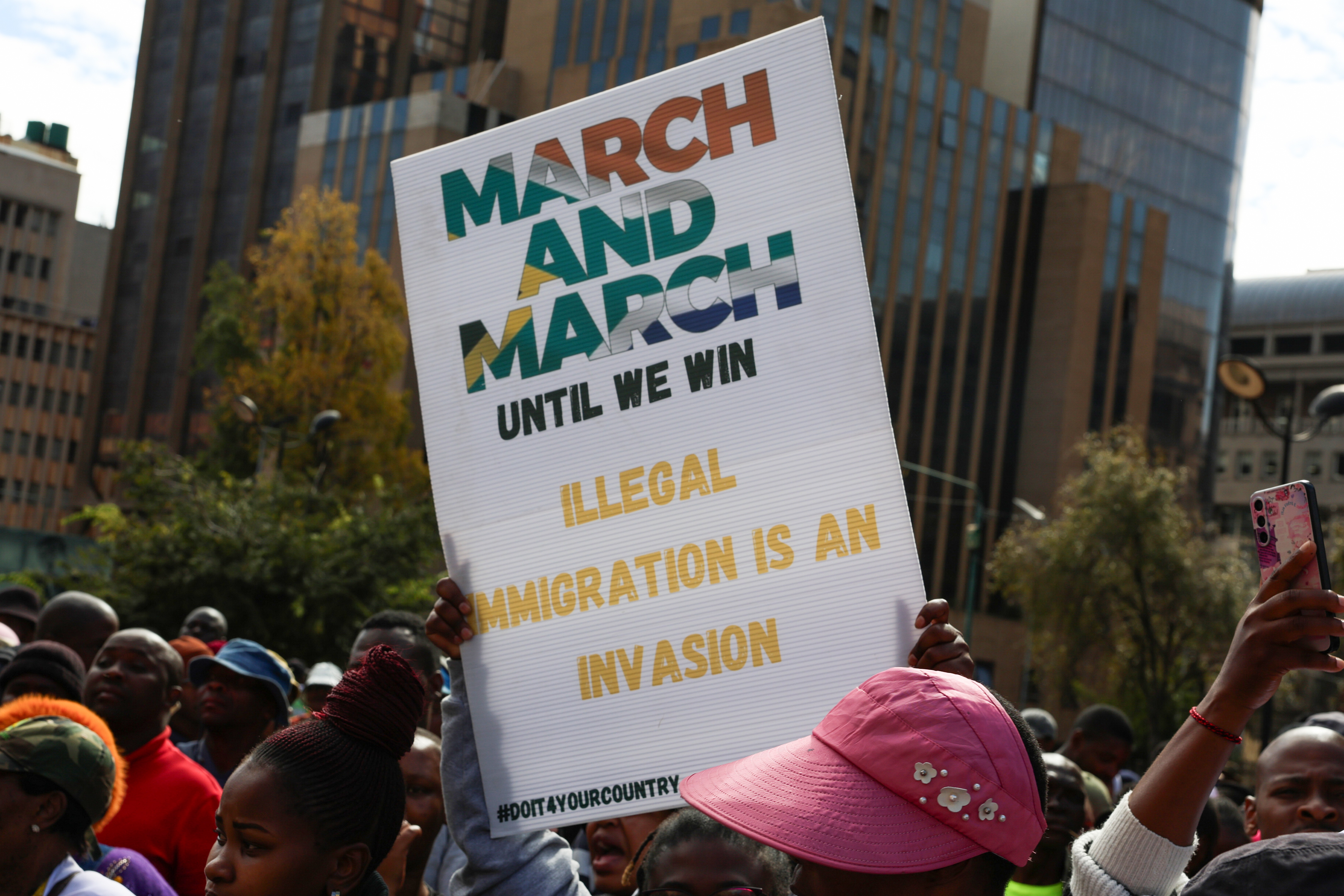
 Marchers protest against illegal immigration in Johannesburg on 29 April 2026. (Photo: Gallo Images/Luba Lesolle)
The rising tide of xenophobia is embarrassing South Africa as African countries are formally complaining about the treatment of their citizens.
Nigerian foreign minister Bianca Odumegwu-Ojukwe called her South African counterpart Ronald Lamola on Monday to discuss her government’s accusations of xenophobic violence against Nigerians in South Africa, including the death of two.
/file/attachments/orphans/GettyImages-2211431108_353975.jpg "Bianca Odumegwu-Ojukwu, Nigerian Minister of State for Foreign Affairs. (Photo: Ernest Ankomah / Getty Images)")
Ghana has also recently formally complained to Pretoria about the alleged mistreatment of its citizens, and Mozambican President Daniel Chapo was also expected to do so in a meeting with President Ramaphosa in Pretoria on Tuesday, according to Maputo sources.
At the weekend, Nigerian foreign minister Odumegwu-Ojukwe announced that her government was planning a special evacuation flight from South Africa for Nigerians who wished to flee the country.
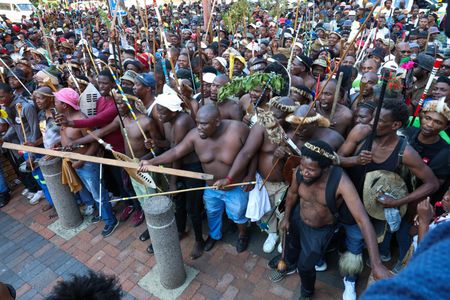
The Nigerian foreign ministry also announced that it had called in the South African acting High Commissioner for a meeting on Monday to discuss the issue. Nigeria has claimed that two of its nationals were killed by South African security forces and has also protested against the surge of March and March demonstrations by South Africans who demand the eviction of foreigners.
/file/attachments/orphans/ED_5442121_596957.jpg "South African Minister of International Relations and Cooperation Ronald Lamola. (Photo: Gallo Images / Frennie Shivambu)")
In their phone call, Lamola and his Nigerian counterpart had “committed to strengthening cooperation, including people-to-people ties and to working together to address the root causes of irregular migration,” according to a statement by the South African Department of International Relations and Cooperation.
Kimiebi Ebienfa, spokesperson of the Nigerian foreign ministry, said that the ministry’s Permanent Secretary Dunoma Umar Ahmed had met acting SA High Commissioner to Nigeria Lesoli Machele on Monday to protest against the xenophobia.
Ahmed repeated the foreign minister’s charges, but added concerns specifically about reported threats against foreign nationals in South Africa by the March and March group led by Jacinta Ngobese-Zuma, and other groups such as Operation Dudula. He also requested full cooperation by South Africa with Nigeria in the investigations into the death of the two Nigerians.
He also called for the speedy implementation of an MoU on an Early Warning Mechanism on xenophobia (which had been signed in 2019)
Ahmed also said his government was aware of a protest by a small group of Nigerians at the SA High Commission in Abuja on Friday, and called on Nigerians not to take the law into their own hands.
He said Machele had informed him that the SA government did not support the protests in South Africa against foreigners and that the issue would be addressed.
/file/attachments/orphans/GettyImages-2211439477_805783.jpg "Samuel Ablakwa, Minister for Foreign Affairs of the Republic of Ghana. (Photo: Ernest Ankomah / Getty Images)")
This was to be the second episode in a fortnight of a West African government formally complaining to Pretoria about xenophobic attacks on its nationals. Last month, Ghana’s foreign minister Samuel Ablakwa called in South Africa’s acting High Commissioner Thando Dalamba to protest about reports of xenophobia directed against Ghanaians. He and Lamola also discussed the complaints in a phone call on 22 April.
/file/attachments/orphans/osm-Ghana_103710.jpg "South Africa’s acting High Commissioner in Ghana Thando Dalamba. (Photo: DTIC / Wikipedia)")
In an Instagram post over the weekend, Nigeria’s Odumegwu-Ojukwe said, “There is heightened anxiety over the series of anti-foreigner protests, also targeted at Nigerians in select cities in the Republic of South Africa in recent weeks.”
She said the Nigerian president had called for “more effective control of the situation by relevant host security services. ”
“The images pervading both mainstream and social media depicting violence, carnage and targeted xenophobic killings of foreign nationals and demonstrations characterised by xenophobic rhetoric, hate speeches and incendiary anti-migrant statements by the arrowheads of such rallies, have generated worldwide condemnation.”
Odumegwu-Ojukwe said protests held in Pretoria and Johannesburg, between 27-29 April were largely peaceful and were accompanied by heavily armed police, who used tear gas to deter protesters.
“There is no recorded killing of any Nigerian or destruction of Nigerian-owned properties during this particular protest,” she wrote.
‘Condemnable and unacceptable’
“However, two Nigerian nationals have been reported dead in separate incidents involving security personnel – Amamiro Chidierbere Emmanuel died on 25 April 2026 as a result of injuries sustained from brutal beatings by military personnel of the South African National Defence Force on 20 April 2026 in Port Elizabeth.
“Nnaemeka Matthew Andrew also died following an alleged interaction with members of the Tshwane Metro Police, and his body [was] discovered at the Pretoria Central Mortuary on 20th April 2026.
“This is utterly condemnable and unacceptable.”
The Nigerian High Commission, she said, was closely following investigations into the incidents and that “Nigeria demands justice”.
Daily Maverick approached both the SANDF and the Tshwane Metro Police Department for comment on the allegations by Nigeria against their officers. Neither had replied by the time of going to press.
Meanwhile, the office of Mozambican President Daniel Chapo announced on Monday that he would meet Ramaphosa in South Africa on Tuesday in response to an invitation from the South African President “to strengthen bilateral cooperation, with an emphasis on the security and protection of citizens”.
A Maputo source said this referred specifically to the protection of Mozambican nationals in South Africa who had also been the target of xenophobic hostility.
‘Extremely disturbing attacks’
On 22 April, Ghanaian foreign minister Ablakwa posted on X that he had had a phone call with Lamola about “the trending videos about Ghanaians coming under extremely disturbing xenophobic attacks in South Africa.
“The South African foreign minister has expressed his empathy with the victims and promised full-scale investigations into the depressing incidents.”
Ablakwa said Ghana’s High Commission in Pretoria had located the main victim in the viral video. “He is doing very well. No Ghanaian life has been lost.” He promised Ghanaians in South Africa that his government was determined to protect them.
“May these regrettable incidents never quench our Pan-African love and solidarity for each other. The overwhelming majority of Africans are united and share an unbreakable bond — we shall not be divided by the hatred of a few fringe elements.”
The videos show a man, whom Ablakwa refers to as Emmanuel Asamoah, being grilled by a hostile crowd of South Africans, which allegedly included a Patriotic Alliance member, and ordered to go home. The crowd forced him to record a video message urging all of his fellow Ghanaians to also go home.
On 23 April, Ablakwa posted that he had summoned SA’s acting High Commissioner to Ghana, Dalamba, to convey Ghana’s “strong condemnation of the continuous xenophobic attacks on Ghanaians and other Africans living in South Africa.
“We are urging South African authorities to take decisive action in protecting the human rights and dignity of our nationals and all Africans. Ghana equally expects that the promised investigations be expedited and all perpetrators punished to serve as adequate deterrence.”
On 25 April, Ablakwa posted that Ghana was removing Asamoah from South Africa even though, as he told Nigerian media, Asamoah was legally in the country. Ablakwa also commended Pretoria for its “reassuring response”, citing in particular a statement by acting police minister Firoz Cachalia who said he “strongly condemns the recent xenophobic acts of violence and intimidation directed at Ghanaian nationals and other foreign nationals within the Republic of South Africa”.
Cachalia said these acts were “not only unlawful”, but also contradicted the constitutional values of dignity, equality and human rights.
“South Africa is a constitutional state governed by the rule of law. No individual or group has the authority to take the law into their own hands, irrespective of grievances or frustrations,” said Cachalia. DM
Comments
Scroll down to load comments...