




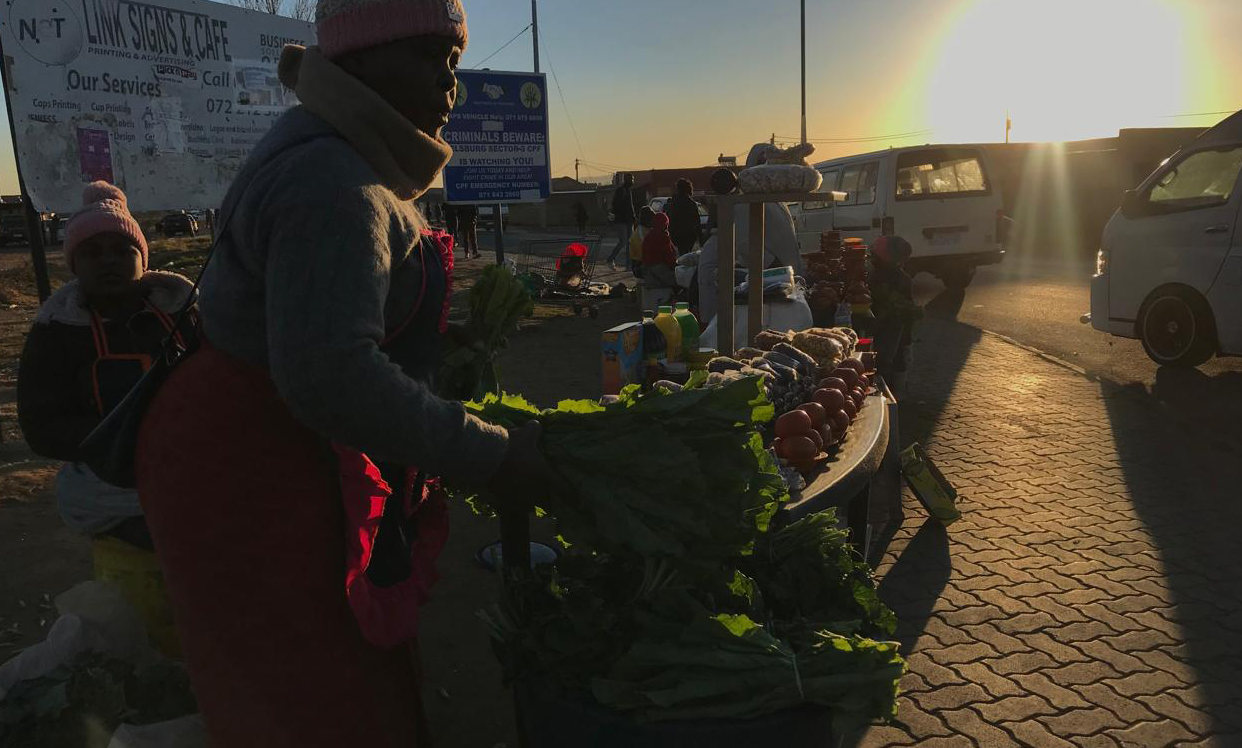
 Informal vendors selling vegetables in Buhle Park, Johannesburg. (Photo: Felix Dlangamandla)
Everyone has the right to sufficient food, guaranteed by the South African Constitution. But more than half of South Africans are food insecure, because their incomes are too low and food prices are too high – and the number of people going hungry is rising, even as World Hunger Day 2026 approaches.
Statistics quantify the scale of the food crisis. The United Nations estimates that the proportion of undernourished people in South Africa trebled, from 3.3% to 10%, between 2006 and 2024. Almost 11 million South Africans live below the food poverty line of R855 per person per month, surviving on R28 or less per day. More than one in 4 children under five (28.8%) have stunted growth. The Department of Health records a shocking 1,000 child deaths owing to malnutrition every year.
But statistics don’t explain why people are hungry. Unemployment and the poverty it creates are obviously major drivers. A related issue was discussed at a recent symposium in Johannesburg: high prices that make food unaffordable. The impact of the closure of the Strait of Hormuz on global fuel, fertiliser and food prices is a reminder of why urgent action is needed. The symposium brought together researchers, civil society activists and government officials to analyse why food prices are high, rising and unstable, and to brainstorm solutions to making nutritious food affordable for all.
The food affordability gap
Because most South Africans buy rather than grow their food, access to food depends on two things: incomes (how much money they have) and prices (how much money they need). The gap between individual or household income and the cost of a nutritious diet is the “food affordability gap”. Interventions to improve access to food can address either side of this gap: incomes can be raised, or food prices can be lowered, or both.
Why food prices are so high
/file/attachments/orphans/6I1A1257_908379.jpg "By building a more equitable food system – including making space for small enterprises (SMEs) in farming, agro-processing, distribution and retailing – the government can improve food affordability. (Photo: Felix Dlangamandla)")
Most food moves through long supply chains, from production to processing to distribution, both wholesale and retail. At each stage, firms add costs and profit margins or markups, which shape the final prices paid by consumers. In South Africa, food prices are also affected by shocks to the food system, both domestic (for example drought, load shedding, foot and mouth disease) and global (Covid-19, wars in Ukraine and the Middle East, tariffs). These shocks are transmitted through the supply chain, pushing up consumer prices. Moreover, prices do not always fall when costs decline. For example, in 2025, maize producers and maize-meal retailers in South Africa captured excessively high margins, by failing to pass cost reductions on to consumers.
Market structures also matter. South Africa displays high levels of corporate concentration across the food system, with a few large firms controlling how food moves, how prices are set and who captures value. For instance, the “big five” supermarket chains dominate the formal retail sector. Large firms can bring benefits of scale and efficiency, but they also hold enormous power in the food system. This attracts risks such as cartels colluding to profiteer, as with the bread price-fixing scandal in the early 2000s.
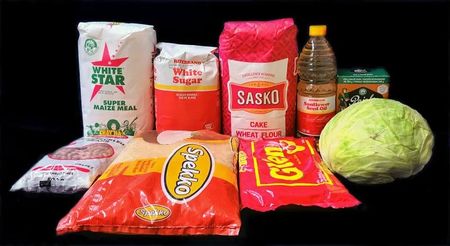
Price monitoring reveals that the cost of a basic food basket has increased by 33% since 2021 – maize meal and cooking oil increased by close to 50% – and is consistently higher than the national minimum wage or the Child Support Grant. Some basic food items are zero-rated for VAT, but this is not sufficient to offset the income-reducing effects of inflation, which has risen faster for zero-rated than non-zero-rated foods, suggesting opportunistic behaviour by corporates.
Animal-sourced foods are the most expensive food group in South Africa, followed by vegetables and fruits. Starchy staples, oils and fats are the cheapest but the least healthy. People in poverty can afford only poor diets, setting up a vicious cycle of intergenerational transmission of malnutrition that requires systemic, coordinated interventions to address.
What should be done?
During his annual State of the Nation Address in February 2026, President Ramaphosa announced: “This year, we will embark on a mission to end child stunting by 2030.” Making progress towards this ambitious target will require interventions across both the income and food prices dimensions of the food affordability gap.
Strategies to raise income
/file/dailymaverick/wp-content/uploads/2025/05/MC-Tuesday-Ed-1Nov_4-1.jpg "Food insecurity spikes in the week before social grant payments every month, as those depending on these grants run out of money for food. (Photo: Deon Ferreira)")
Social grants are a key government policy for addressing food insecurity, but they are insufficient for recipients to afford a healthy diet. Food insecurity spikes in the week before social grant payments every month, as those depending on these grants run out of money for food. The Child Support Grant (R560) and the Social Relief of Distress grant (R370) should immediately be raised to the food poverty line (R855), then to the cost of a nutritious food basket (currently R965 for a child). All grants should be pegged to inflation to retain their purchasing power as food prices rise.
The first 1,000 days of life, from conception to two years, are critical for lifelong physical and cognitive development. To address maternal malnutrition, low-birthweight babies and early childhood malnutrition, the government should introduce a Maternal Support Grant to allow pregnant women to purchase more nutritious foods. Considering the high exclusion rate from the Social Relief of Distress grant, there is a strong case for the government to introduce a Universal Basic Income grant for the unemployed and the working poor.
Strategies to reduce food prices
/file/dailymaverick/wp-content/uploads/2023/06/11421237.jpg "The UK government has just asked supermarkets to freeze prices of essential foods in response to their cost-of-living crisis. (Photo: Andy Rain / EPA-EFE)")
Nutritious foods compete for the money in people’s pockets against alternatives that are cheaper, more convenient, highly processed (longer shelf-life, less preparation), more addictive (sugar, salt, fat) and unhealthier.
Access to nutritious foods must be facilitated by interventions to make them more affordable, as advocated by Grow Great’s 10 Best Buys Campaign, and promoted through education campaigns.
The UK government has just asked supermarkets to freeze prices of essential foods in response to their cost-of-living crisis. The government of Mexico adopted a more direct approach, requiring supermarkets to provide a basket of 24 basic food items at a capped maximum price. President Ramaphosa wrote in October 2025: “The ‘Big Five’ retail companies can and must play a far greater role in making nutritious food more affordable for South African households.”
Improving food affordability requires the government’s taking steps to build a more equitable food system. This includes curtailing market power through tougher enforcement of competition regulations, more transparency in pricing behaviour of dominant actors and opening spaces for small and medium enterprises (SMEs) in farming, agro-processing, distribution and retailing.
The food symposium highlighted the need for longer-term structural reforms, such as:
- Investing in existing municipal markets and new local food markets;
- Creating regulatory and physical space as well as infrastructure for informal food trading;
- Reducing dependence on imported agricultural inputs;
- Accelerating land reform; and
- Establishing food reserves.
Whether the food system is “broken”, as some argue, or is functioning well but only to the benefit of a minority, it clearly is not meeting the needs of a growing majority who simply cannot afford to buy enough food.
The symposium concluded that a variety of coordinated interventions is needed. These must both increase the incomes of those in poverty and also keep food prices as low and stable as possible. Symposium participants agreed that there is much that can be done and needs to be done, to make food affordable. With the right commitment, it is possible to deliver on the President’s promise to end child stunting. It is possible to achieve the constitutional right to food for all, and eradicate hunger. DM
Andrew Bennie is Senior Researcher in Climate Policy and Food Systems at the Insititute for Economic Justice (IEJ) and research associate of the Department of Sociology at Wits University.
Mark Volmink is a Postdoctoral Fellow at the DSTI-NRF Centre of Excellence in Food Security at the University of the Western Cape. My research focuses on the Water-Energy-Food nexus, food security, and sustainable livelihoods in poor communities.
Oscar Sithole is a PhD student at the University of Pretoria and grantee of the DSTI-NRF Centre of Excellence in Food Security at the University of Pretoria.
Stephen Devereux holds the DSTI-NRF Research Chair in Social Protection for Food Security, affiliated to the Centre of Excellence in Food Security, at the University of the Western Cape.
Marc Wegerif is a Principal Investigator with the DSTI-NRF Centre of Excellence in Food Security and Associate Professor and Development Studies Programme Coordinator at the University of Pretoria.
Yondela Mahlathi, is a Researcher in Climate Policy and Food Systems at the IEJ.
Comments
Scroll down to load comments...