





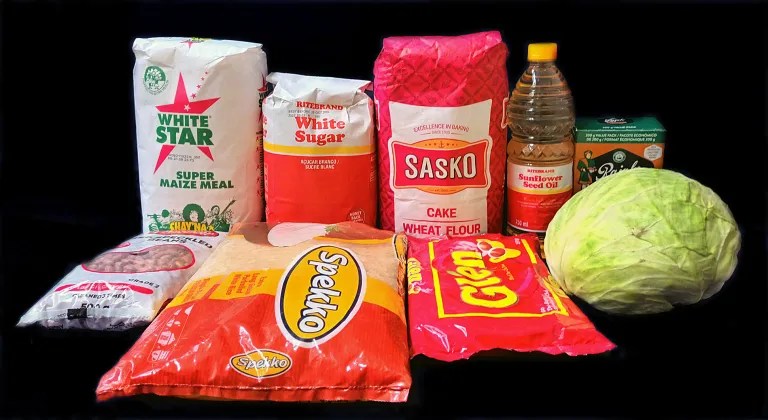
 Between March to April, the food basket of 14 basic items increased by R16 to R423.86. May is forecast to see another fuel increase, resulting in cost of living increases in South Africa. (By: Naledi Sikhakhane)
Maverick Citizen has been tracking the prices of 14 basic food items that can be bought with the R370 Social Relief of Distress (SRD) grant. Between March and April, the food basket increased by R16 to R423.86, mainly due to rice and cabbage, costing R10 and R5 more respectively. The food basket is R53 more expensive than the R370 SRD grant, making it unaffordable for grant recipients.
Pietermaritzburg Economic Justice and Dignity’s Household Affordability Index tracks 44 basic food items. In April, the household food basket cost R5,452.09, and has increased by R123.66 since March.
The basic nutritional basket with a household of seven members, on the other hand, amounts to R6,618.99.
As they note, 74.8% of black South Africans live below the upper-bound poverty line, which is R2,486 a month. This makes the basic food basket and the basic nutritional basket far out of reach for most people.
Bhungane Zibi (58) is a freelance journalist and SRD grant recipient from Mthatha. He recently started a Facebook page ‘Living the R370 life’ to dispel myths about how the grant is misused and to destigmatise social assistance.
Due to bank charges, he does not get the full amount every month.
“It fluctuates. It could be R8 one month or R12 or even R14 the next. I spend most of the grant on maize meal, electricity, sugar, cooking oil and a condiment that makes pap easier to eat. Then veggies. The rest is spent on soap, vaseline, toothpaste, depending on which of them is more urgently required.”
He buys everything on special or at reduced prices. He only buys cabbage and/or carrots: the cheapest and longest lasting vegetables.
/file/attachments/orphans/Food-prices-March-April-2026_465598.jpg)
Six months ago Zibi began running out of money halfway through the month. Luckily, he has been getting help from family members, as well as small amounts of money from “piece jobs” that he did. This month, he was down to his last R60 by the 9th of April.
“I am grateful for the grant. Unfortunately it’s now progressively falling short of providing for even the basic foodstuffs for the whole month. If it’s this hard for a single guy like me who lives alone, I can’t imagine how it must be for those with kids and other responsibilities.”
Fuel increase impact
Of the grain farmers’ input costs in SA, fertiliser accounts for roughly 35% and fuel accounts for about 13%. Which means roughly half of the input costs are exposed to the challenges posed by the ongoing crisis in the Middle East.
SA is starting the 2026-27 winter crop season at a challenging time, and with the higher input costs for farmers, Western Cape farmers will be affected first, according to agricultural economist, Wandile Sihlobo.
/file/dailymaverick/wp-content/uploads/2025/06/iStock-623194968.jpg "The Cost of Living report by the Competition Commission found that the farm value of white maize fell from R22.16 in May 2025 to R14.49 per 2.5kg in December 2025. Producer prices for maize meal did not fall by the same extent, and retail prices remained high. The producer-to-retail 'spread' was 37% in November 2025. The spread is the percentage difference between the producer price and the retail price.
<br>(Photo: iStock)")
(Photo: iStock)
“According to the latest ‘official statistics’, food price inflation was on a favourable trajectory, coming in at only 3.6% in March 2026 – that was just before the war started having its impact. However, the release of statistics have not yet caught up with lived realities since the Iran conflict started, and we will only have better insights when these data come out next month,” said Dr Dieter von Fintel, development economist and professor of economics at Stellenbosch university.
“We do, however, have a clue from other events, especially because the start of the Ukraine war remains fresh in our memory. Inflation rocketed because of supply chain disruptions and escalating fertiliser costs.”
“But this time round we have that situation plus a blockade of a dominant oil trade route – this will most certainly have an impact on food prices because food producers use diesel, and moving the food from farm to plate needs petrol and diesel – it is an important input cost into all parts of the food system. Just as happened after the Ukraine war, this will likely have a noticeable impact on food insecurity especially among the poorest households,” said Von Fintel.
In April, petrol rose R3.06 a litre, while inland diesel rose R7.51 a litre. The general fuel levy was reduced by R3 per litre from April 1 to May 5 2026 by the Department of Petroleum and Mineral Resources and Treasury.
After 5 May, it is estimated that South Africans will face another rise in fuel costs, despite the government intervening again with R3 relief per litre of petrol, and R3.93 for diesel until 2 June, 2026.
“Prices were starting to go up already before the ongoing US-Iran war. Cooking oil and condiments for example. I’m expecting general food inflation to become more pronounced next month, when the fuel increases start kicking in,” Zibi explained.
“These prices are unprecedented. Most people look at the impact this has on their own transport costs. But that is only an immediate cost. Evidence for South Africa shows that a 10% increase in the oil price contributes to about 0.2-0.5 percentage point increase in overall inflation,” explained Von Fintel.
“A back-of-the-envelope calculation would suggest that the current inflation rate of about 3% could spike to 4.5% based on these figures. That means we are back to the rapid rise in the costs of living we witnessed in the wake of the Ukraine crisis. It is not obvious that a reversal is in plain sight.”
Report: ‘rocket and feather’ pricing
The Cost of Living (COL) report released in March by the Competition Commission showed that from 2020 to January 2026, electricity prices rose by about 85% and water prices by about 68%, which is above overall inflation by 30% over the same period.
High electricity prices influence people’s ability to cook, and store food safely.
“I see the price of electricity has jumped again. For R20 now you only get 7.40 kWh. About three or four months ago it was 8.10,” Zibi told Daily Maverick.
The COL Report also looks at the gap between what producers receive and what consumers pay for selected foods, including canned pilchards, eggs, individually quick frozen (IQF) chicken, sunflower oil and maize meal. The “spread” is the percentage difference between the producer price and the retail price. The Commission analyses spreads to see how prices change as they move through the value chain – whether widening or narrowing.
“A widening spread can suggest opportunistic ‘rocket and feather’ pricing, where processors or retailers raise prices quickly when costs rise, but reduce them slowly when costs fall,” said the COL report.
The outlook for essential food prices remains mixed, according to the report.
Canned pilchard and brown bread narrowed, but with other staples, retail prices stayed high even when upstream costs were stable or falling. This can be seen in eggs, IQF chicken, sunflower oil and maize meal. The report said that this means that low-income households may not benefit quickly from lower input costs.
/file/dailymaverick/wp-content/uploads/BM-Ed-LandLease-option-1.jpg "South Africa’s inequality, high unemployment, spatial inefficiencies and infrastructural challenges all combine to restrict access to nutritious and culturally appropriate food. (Photo: Waldo Swiegers / Bloomberg via Getty Images)")
“The outlook is ‘mixed’ and perhaps not as ‘clear-cut’ as one would like to understand. It is therefore not obvious whether input prices – like oil and fertiliser – will be the only drivers of retail prices. The gap is never one-to-one, but it is also hard to predict how individual retailers will respond.”
“Before the war, The Bureau for Food and Agricultural Policy (BFAP) projected overall food inflation of 4.5% for 2026, but only 2.9% for its ‘thrifty food basket’ – representative of the foods consumed by low-income households – in other words, sometimes the gap between input prices and food prices works to the benefit of poorer households, though sometimes it is the opposite,” said Von Fintel.
Targeting nutritional food baskets
With opportunistic “rocket and feather” pricing, how could South Africa ensure a nutritional basket of food is affordable for the poorest households?
“Indirectly, but important nonetheless: The current attempts to bring relief through reductions in the fuel levy are a direct way to ensure the overall containment of inflation, including food prices. It helps both producers and consumers in a time of crisis.
“Targeting food directly: school feeding programmes remain an important mechanism to ensure that the youth have at least one plate of food on the table daily. Continued support for this goes a long way to ensuring that a large part of our population is shielded from hunger. The onus is also on programme manners to work within constrained budgets to ensure that the food on those plates is not only ‘enough’, but also ‘nutritious’.
/file/dailymaverick/wp-content/uploads/2025/01/ED_229873.jpg "Subsistence and small to medium-scale farmers are using intuition and indigenous knowledge to farm sustainably. (Photo: Sharon Seretlo / Gallo Images)")
“Targeting the youth is important, but one omission is that the youngest children – those not yet in school – do not have this benefit, and arguably are at the most critical period of their development. Finding mechanisms to bring feeding programmes into Early Childhood Development Centres, as well as reaching pregnant mothers (potentially through antenatal primary healthcare facilities) remains a way to protect individuals in the most critical life phases.
“Home production of food may become more important. There is evidence to show that food security is better in rural areas where subsistence farmers can meet some of their needs through rain-fed agriculture. However, this solution is also threatened by the looming El Niño in the coming season,” concluded Von Fintel. DM
Comments
Scroll down to load comments...