



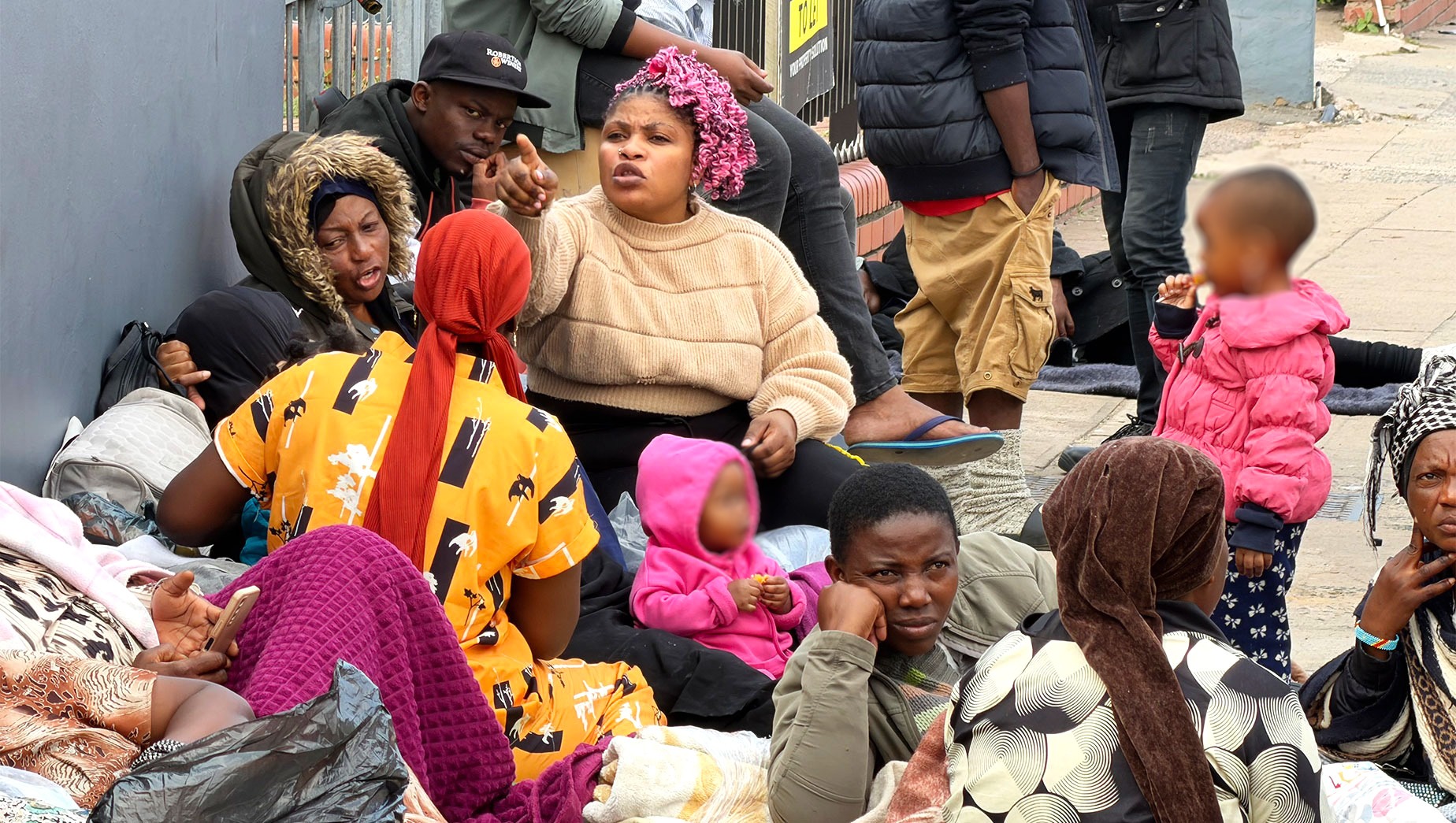
 On a dirty pavement outside Durban’s Home Affairs Refugee Reception Centre, a huddle of terrified people is waiting for 30 June, an ominous deadline that anti-illegal immigration groups have set for undocumented foreigners to leave South Africa. (Photo: Supplied)
 On a dirty pavement outside Durban’s Home Affairs Refugee Reception Centre, a huddle of terrified people is waiting for June 30, an ominous deadline that anti-illegal immigration groups have set for undocumented foreigners to leave South Africa.
The threat now hangs over the city after more than a week of xenophobic violence, public assaults and inflamed social media mobilisation.
Beyond the fear and chaos, the question more people are asking is: who is organising and financing a movement that analysts warn could push South Africa towards another July 2021?
/file/attachments/orphans/Xeno-10_982547.jpg "On Che Guevara Road outside Durban’s Home Affairs Refugee Reception Centre, a huddle of terrified people say they are legal foreigners with papers to prove it, but are too scared to leave the makeshift roadside camp because of fears that thugs marauding through the city will attack them. (Photo: Supplied)")
The traumatised group of about 60 people encamped outside the Home Affairs centre on Che Guevara Road over the weekend cuts a stark contrast to the strutting bravado of the aggressive anti-foreigner demonstrators who terrorised parts of Durban.
Both groups represent the state’s failure to deal with xenophobia.
The Che Guevara Road refugees say they are legal foreigners with papers to prove it, but are too scared to leave the makeshift roadside camp because of fears that thugs marauding through the city will attack them.
In the past week, their migratory story played out as they sought refuge at the Durban Central Police station, the Diakonia Centre (an inner-city hub for social and non-government agencies), and, finally, on the pavement in Che Guevara Road.
Their lives were turned upside down after a mob of xenophobes demanding their repatriation got the attention of eThekwini Mayor Cyril Xaba, who sent them to be verified at Home Affairs.
Victimisation
There, the city said, officials checked the papers of 457 foreign nationals, and only two people were found to be without proper documentation.
For Bishop Raphael Bahebwe, the number is a cruel validation of the victimisation foreigners suffer. Last week was a terrifying bang that ended in a bureaucratic whimper.
They were hauled out of their homes and workplaces by armed vigilantes, slapped around, beaten and interrogated.
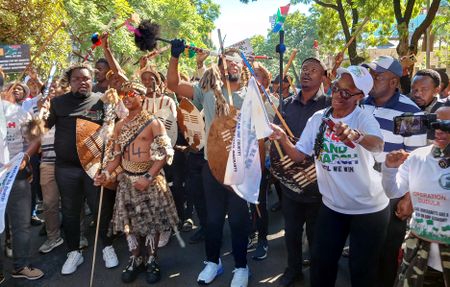
Their workplaces were invaded and shut down, sometimes in the presence of the police, in incidents filmed and shared on social media.
Instead of demanding that the law be upheld, the provincial government and the eThekwini administration met March and March, an organisation that appears to lead an informal coalition of demonstrators.
“I said to the police, ‘ Why don’t you just take your uniform and give it to March and March and Dudula?” Bahebwe told DM.
“They are the new South African police because the police don’t do their jobs.”
“Who are Dudula and March and March?
“Who is Ngizwe Mchunu?”
Mchunu is a controversial radio personality and self-proclaimed Zulu chauvinist at the forefront of demonstrations against foreigners.
Bahebwe asked: “How is it that people can pull us out of our homes and our places of work?
“How do they even know who a foreigner is?
“Earlier this year, they confronted a policeman from Limpopo in Durban.”
Bahebwe, a refugee from the Democratic Republic of the Congo, is a permanent resident in South Africa. For him, the xenophobic demonstrations are witch hunts, giving cover to criminals and extortionists.
In response to the xenophobia, foreigners of various nationalities have banded together to help one another.
“The authorities must tell us what to do now, “ Bahebwe said.
“Victims of xenophobic attacks went to the police station individually when this first started happening the week before last.
“They told the police, ‘We are legal, you must protect us.’
“But the police never gave anyone case numbers. We were chased from the police station to Diakonia, and then here.”
It has been a week of trauma, rubber bullets and tear gas.
Burundian refugee Jeanne Nahimana, in South Africa since 2003, spoke to Daily Maverick from her pavement bed at the weekend. Her only comfort over the past three days has been donations from Gift of the Givers.
“I had to leave my home in town this week. We are scared. We go to the toilet in the street. There is no water, and some people are sick.”
‘We don’t know who’s going to come and beat us’
Rebecca Furaha, from the DRC, left her job in Estcourt this week, immediately after politicians there started threatening foreigners.
“I was afraid, so I came to my family in Durban. We are still afraid. We don’t know who is going to come and beat us.”
Bahebwe says in the absence of a resolute response from the state, the foreigners are powerless to do anything but sit together on the pavement.
“If they want to kill us, they must come here and do it on this government property. Maybe we will get protection here. We don’t want confrontation.
“We are not sure what is going to happen on June 30.”
Anti-illegal immigration demonstrators, including March and March members, have set that as a deadline for undocumented foreigners to leave South Africa.
Jean Butoki, a Burundian refugee, says he has been targeted by March and March members on social media, who have put his photo online, demanding he be deported.
“I want to leave South Africa, and if I can get help to leave, I will go.
“I want to take my family to safety, but I don’t know where. I can’t go back to Burundi, my life is also in danger there. Our lives are in the hands of God. Most of us can’t go to work now to support our families.
“If people can attack you in front of the TV cameras and the authorities without consequence, what will they do if they find you alone?”
/file/attachments/orphans/Xeno-9_421852.jpg "Refugee spokesperson Bishop Raphael Bahebwe at the Home Affairs Durban Refugee Reception Centre on Che Guevara Road, where about 100 victims of xenophobic violence camped on the pavement after waves of attacks in the city last week. (Photo: Supplied)")
Bahebwe and others have expressed appreciation to some politicians and civic leaders who have publicly condemned xenophobia, including Economic Freedom Front leader Julius Malema.
In a Sky News interview last week, Malema described the xenophobes as “criminals and extortionists”.
In Durban, Bahebwe said organisations like the shack dwellers movement Abahlali base Mjondolo had publicly expressed support for foreigners being hounded by mobs.
“Abahlali has been helping us. Not all South Africans hate us.”
Butoki says the violence is meant to stir up public sentiment to put pressure on the South African government to act against foreigners.
But, he says, citing a United Nations report, it is irrational.
According to the UNHCR (the UN Refugee Agency), in 2025, South Africa hosted more than 167,000 refugees and asylum-seekers in a “fragile” environment of rising xenophobia, misinformation and socioeconomic pressures.
‘Who’s stoking the violence?’
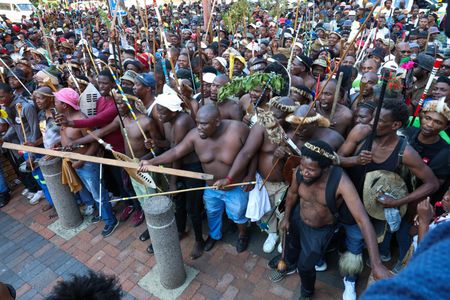
Political analyst Sandile Swana says xenophobia is not linked to rising joblessness or challenging economic conditions.
He believes the source of the violence demands inquiry.
“It is black-on-black violence, and Afrophobia that positions South African politics to the right. Black-on-black violence is not new, and neither is Afrophobia. There has never been any empirical evidence that the country is overrun by foreigners. So what mobilises a poor man in Alexandra to attack a foreigner, thinking that will improve his life?”
Swana said the face of the anti-foreign movement was March and March’s Jacinta Zuma, Ngizwe Mchunu and actor Nkosikhona Ndabandaba (who goes by the name Phakel’umthakathi).
“Unfortunately, this has taken on a fearful Zulu character. It is easy to channel tribalism, but I am less impressed by threats of more violence and more interested in who is behind this. It is well-organised and resourced. Who pays for these people to fly around the country, hold rallies, and bus people to demonstrations?
Siphumelele Zondi is a multimedia & journalism lecturer at the Durban University of Technology with a Master’s in cultural studies and digital media from Sussex University.
He believes the anti-foreign movement is dangerous.
‘Aggressive social media drive’
“My hunch is that there is someone behind the project. The people leading these demonstrations, Jacinta Ngobese-Zuma, Ngizwe Mchunu, and Phakel’umthakathi, have massive social media followings and are using that online popularity to incite.
“This is stirring up resentment towards foreigners. The narrative, not supported by fact, is that foreigners are driving up crime, stealing jobs, clogging the healthcare system and putting a drain on the fiscus.
“That anger is amplified by an aggressive social media drive. That angry algorithm is spiralling. It is online anger harvesting. And, it has an ethnic layer. The more visuals are shared online, the bigger the story gets, even when the story may not be intrinsically that big.
“But the result is the people who are sharing grow in stature and are feted by politicians and authorities as if they have a constituency, when we don’t really know if they have. It’s not difficult to raise a mob.”
Zondi added, “Whoever is behind this wants to create anarchy. The question is, who is funding this? These people are criss-crossing the country and organising buses. There is this ominous June 30 deadline. Will it be a repeat of July 2021? We can’t take this lightly. July 2021 started with a social media campaign.”
Growing hostility
The Consortium for Refugees and Migrants in South Africa, representing more than 30 organisations, released a weekend statement condemning the growing climate of hostility towards refugees and migrants and expressing concern at “deeply disturbing intimidation and violence”.
“Equally alarming and unacceptable are reports and visual evidence suggesting the excessive use of force by members of law enforcement agencies against refugees and migrants.”
The consortium said inflammatory rhetoric, misinformation and unlawful mobilisation fuelled xenophobic tensions and risked more violence, displacement and intimidation.
“No individual or group has the authority to target, harass, assault, intimidate, or forcibly remove another person on the basis of nationality, migration status, race, or ethnicity. The actions witnessed represent a dangerous erosion of constitutional democracy and pose a serious threat to social cohesion, public safety and the rule of law.”
Xenophobia, the consortium warned, could easily get out of control.
According to Human Rights Watch, 62 people were killed in xenophobic violence in 2008 and 12 people in 2019.
Attempts to contact Jacinta Ngobese-Zuma were unsuccessful, but she was quoted in a News24 story over the weekend relating to a demonstration in the Cape where she is reported to have told marchers:
“We are the rainbow nation… and then everyone saw this harmony as an invitation. They took advantage of our Ubuntu. Ubuntu is suspended until further notice
“We don’t want a situation where foreign nationals are always painted as the victims, and we are the villains. It’s our country, and we’re tired of explaining that there is no xenophobia in the country.” DM
Comments
Scroll down to load comments...