




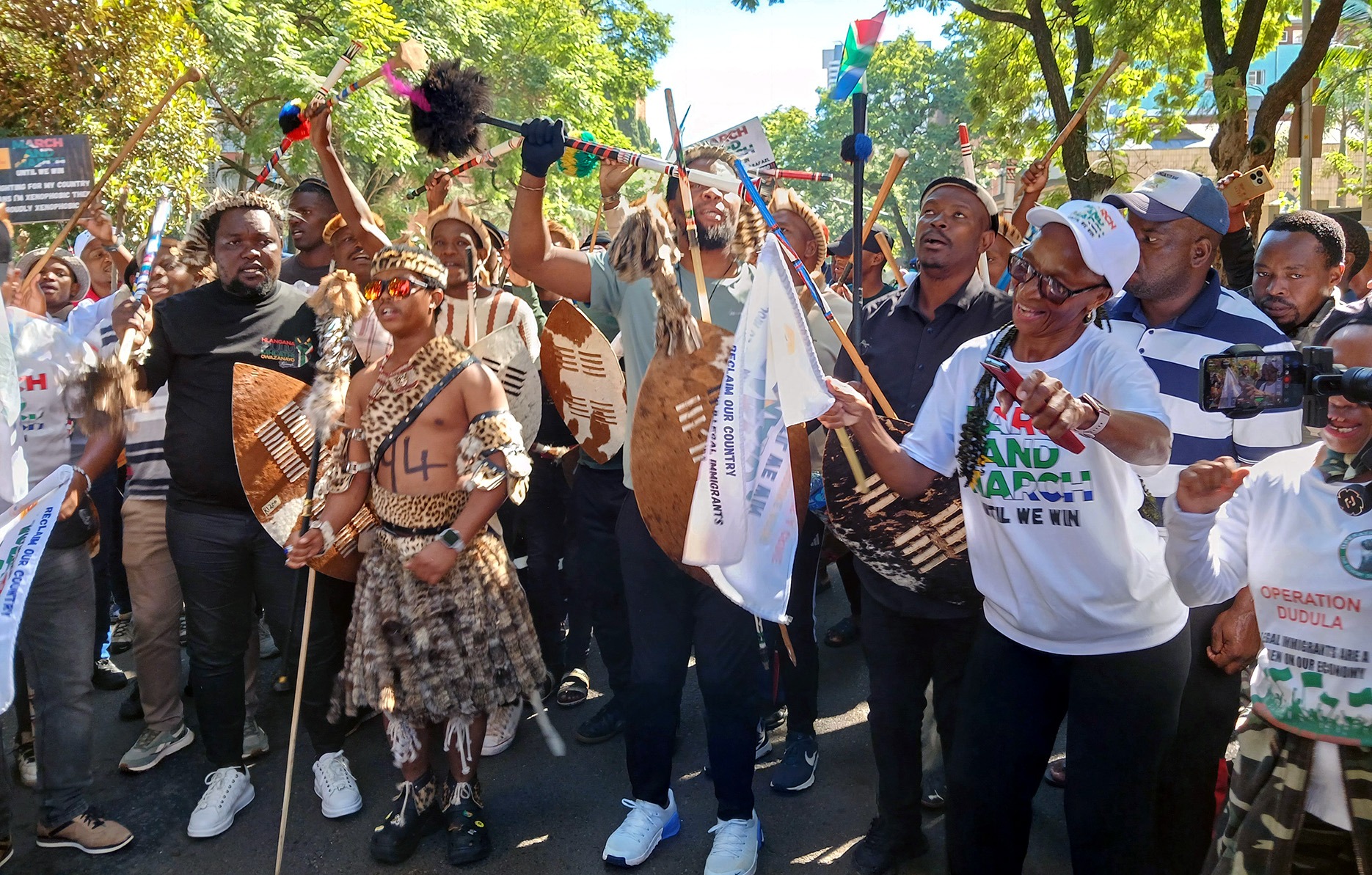
 A demonstration led by anti-immigrant group March and March in Pretoria on Tuesday. (Photo: Bheki C. Simelane)
Anti-foreigner group March and March, which first gained prominence in KwaZulu-Natal, staged demonstrations in Tshwane and Johannesburg on Tuesday and Wednesday this week, calling for “illegal” foreigners to leave the country and for the government to take stronger action on migration.
In both cities, the group, supported by other organisations such as Operation Dudula, which started in Johannesburg, repeated its call for the government to “fix Home Affairs and get rid of all illegal immigrants”.
Both groups are adamant that they are opposed to “illegal” immigration, but their messaging makes broad generalisations about foreigners that blame them for the country’s challenges and include false information regarding their rights, while their demonstrations often include violence and intimidation. The groups largely target migrants from Africa and South Asia.
March and March’s move into Gauteng is a sign of the role anti-foreigner sentiment could play in the local government elections, which must be held between November 2026 and January 2027.
Political vacuum
According to the Inclusive Society Institute’s GovDem Survey, distrust of African immigrants climbed from 62.6% in 2021 to 73.1% in 2025.
A 2023 study by the University of Johannesburg’s Mondli Hlatshwayo noted that anti-immigrant sentiment was tethered to perceived economic threats, with foreigners blamed for shrinking jobs and dwindling opportunities.
Professor Loren Landau, from Oxford University and the University of the Witwatersrand’s African Centre for Migration and Society, said, “Throw a hotly contested and uncertain local government election around the corner and South Africa is a tinder box.
“As none of the parties [has] a concrete plan that speaks to people over their concerns, anti-outsider rhetoric is how they seek to connect. From township corners to national politics, leaders – elected, self-appointed and otherwise – are playing this card to self-aggrandise.”
/file/attachments/orphans/20260428_105947_665089.jpg "A March and March supporter displays a poster during this week’s demonstration in Tshwane. (Photo: Bheki C. Simelane)")
Landau said that while anti-foreigner sentiment usually emerged ahead of elections, this year felt particularly acute, given the massive insecurity people felt over jobs, water and electricity.
“That the President would spend 10 minutes on Freedom Day speaking about immigration suggests that for some, apartheid oppression has been replaced by immigration competition,” Landau said.
During his Freedom Day address on Monday, President Cyril Ramaphosa said concerns over migration should not descend into xenophobia.
When asked if the anti-foreigner sentiments would have an impact on the local government elections, Landau said, “Absolutely, if nothing else, the ability to misdirect the citizenry’s attention away from corruption, poor planning and an absence of vision means South Africans will elect candidates who are less qualified, less principled and less able to deliver for the people.”
Landau said that a leader elected on this ticket only had the option of doubling down when harsh and hateful immigration restrictions failed to resolve the country’s economic malaise.
Mike Ndlovu, from Kopanang Africa Against Xenophobia (Kaax), also expressed concern over the countrywide rise in anti-foreigner sentiment.
“There is certainly a qualitative drift towards right-wing populism and actually even elements of fascism developing in the politics in the country.”
Challenging constitutional rights
March and March supporters gathered at Burgers Park in Tshwane on Tuesday before marching to the Union Buildings as part of their ongoing efforts to persuade the government to implement tougher immigration systems and laws.
The group’s leader, Jacinta Ngobese-Zuma, told Daily Maverick on Tuesday that since it began in 2025, she believed there had been some progress on their demands, citing the White Paper on Immigration.
March and March largely rose to prominence following its protests at Addington Primary School in Durban, where it falsely claimed that migrant children were being prioritised over South African citizens. Police had to intervene and escort learners from the school, while Ngobese-Zuma was criminally charged with inciting public violence.
“We did have a meeting with the Department of Education, and we did raise the issue of South African children not getting spaces in schools, yet children of foreign nationals get spaces in schools,” Ngobese-Zuma said this week.
The Constitution entitles all children, regardless of whether they are migrants or not, to the right to education. They cannot be discriminated against based on their nationality.
/file/attachments/orphans/ED_606570_965802.jpg "March and March supporters during the protest march to Mary Fitzgerald Square in Johannesburg on 29 April 2026. (Photo: Gallo Images/Luba Lesolle)")
Ngobese-Zuma said that March and March also had a meeting with the Health Ministry, claiming that the group had proposed implementing a system to check biometrics to access health centres.
She suggested this would mean only South African citizens or documented foreigners could access health centres. Legally, foreigners, regardless of their status, are entitled to public health services. In 2025, a court ordered Operation Dudula to stop blocking migrants from accessing clinics.
“The biggest problem that we have is that the president of the country is assuming a posture of someone who is apologetic about enforcing the laws of his own country. What kind of president doesn’t know how to make a proper call against something that is illegal in the country?” she said of Ramaphosa.
Asked in Johannesburg on Wednesday how March and March was funded, Ngobese-Zuma said the movement was dependent on donations.
“We get our funding from concerned South Africans, but we also have a social media page where our supporters can contribute. They contribute financially, but some contribute in kind,” Ngobese-Zuma told Daily Maverick.
/file/attachments/2991/20260429_141352_950763.jpg "March and March leader Jacinta Ngobese-Zuma addresses supporters in Johannesburg on Wednesday. (Photo: Bheki C. Simelane)")
Businesses closed
During the demonstrations in both Tshwane and Johannesburg, many stores closed their doors before the March and March supporters passed. The group’s activities in Durban, as well as KuGompo, have previously turned violent.
Organisers on Tuesday and Wednesday warned supporters against engaging in violence, while reiterating that they needed to stay unified. Marchers, however, threatened store owners who didn’t close their doors.
Influencer Nkosiikhona Ndabandaba, known as Phakelumthakathi, blamed store owners for closing their doors during the demonstration.
“We stated that the marches would be peaceful, but they have closed their businesses. This means that there is something unlawful,” he said. “Why would they close their businesses if there was nothing untoward?”
/file/attachments/orphans/20260428_113331_843000.jpg "Influencer Nkosiikhona Ndabandaba, known as Phakelumthakathi, at March and March’s Tshwane demonstration on Tuesday. (Photo: Bheki Simelane)")
Enter ActionSA
Herman Mashaba’s ActionSA is largely campaigning on immigration issues. He received a warm welcome at the protest in Johannesburg on Wednesday, where demonstrators marched from Mary Fitzgerald Square to Beyers Naude Square. Mashaba pledged his support for the work of March and March.
“As a country, we have reached a stage where these foreigners have shown total disrespect to us,” he said at Beyers Naude Square in Newtown.
“The only way I believe we are going to save this country are actions like this. We are gatvol as a country. We can’t take it any longer,” Mashaba added.
“Imagine if we lose this country, where are we going to go to?”
March and March and other groups that took part in the demonstrations have not officially endorsed ActionSA ahead of the elections.
In contrast to Mashaba’s reception, Gauteng Premier Panyaza Lesufi, from the ANC, was booed when he accepted March and March’s memorandum at Beyers Naude Square.
/file/attachments/2991/20260429_132917_917207.jpg "ActionSA leader Herman Mashaba at the March and March demonstration in Johannesburg on Wednesday, 29 April 2026. (Photo: Bheki C. Simelane)")
Rising frustration and blame
Supporters of groups like March and March, and Operation Dudula, often blame foreigners for issues such as unemployment and crime.
Tshwane resident Joyce Rathete, who attended the march in that city, claimed, “My son, who was born in 1988, worked for the SA Navy.
“Now I have to support him because of illegal foreign nationals from whom he bought drugs.”
According to Rathete, her son lost his job in the Navy because of his nyaope addiction. She said nyaope was brought into the country by foreign nationals.
“He was not fired. He would get paid and buy nyaope, and eventually he stopped working because of the addiction,” she said.
An unemployed teacher, who said she was speaking on behalf of unemployed teachers, said they were in support of March and March’s efforts.
“We have an immigration crisis in South Africa,” she said, addressing demonstrators. “Can they please remove foreign teachers from the education system? Teaching is not a scarce skill.” DM
Comments
Scroll down to load comments...