



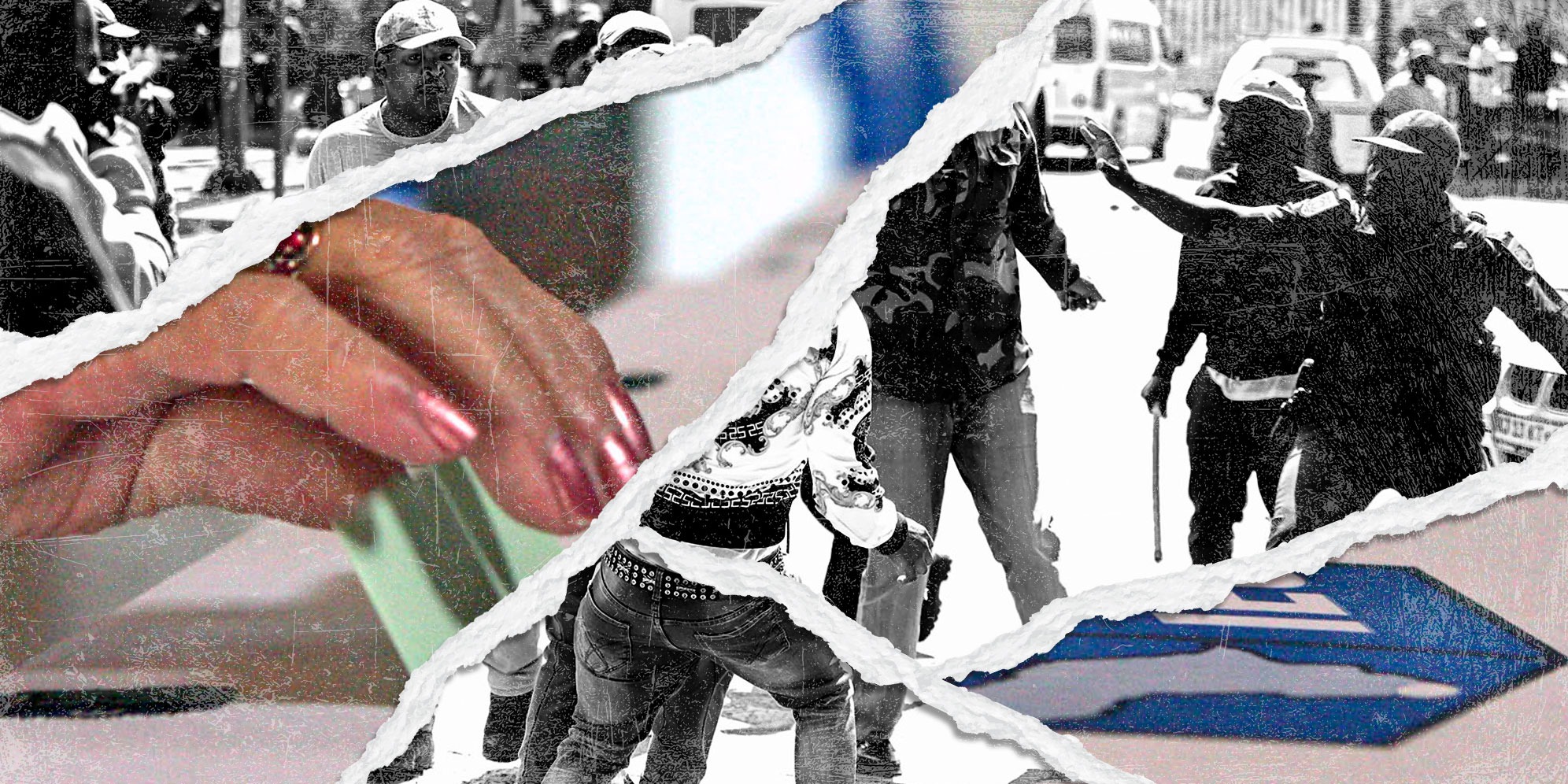
 Illustrative Image: Members of Operation Dudula clash with suspected foreign nationals and police in Atteridgeville on 1 September 2022. (Photo: Deaan Vivier / Gallo Images / Beeld) | A person voting. (Photo: Charl Devenish / Gallo Images | (By Daniella Lee Ming Yesca)
 /file/dailymaverick/wp-content/uploads/2025/10/label-analysis-2.jpg)
Over the last few months, the March and March movement has held regular protests in the Durban CBD. Last week, a group of foreign nationals, saying they feared for their lives, camped outside the Durban Central Police Station.
Their leaders said they felt it was the one place where they would be safe.
But police refused to allow them to stay and used physical force to disperse them. This led to anguish, with women pleading for help.
They then went to the Diakonia Centre, saying they wanted to speak to officials at the Office of the United Nations High Commissioner for Refugees.
On Thursday, several people from March and March and MK arrived at the Diakonia Centre, telling television reporters they were there to see what was happening.
As if by magic, a large crowd gathered, waving South African flags and chanting anti-immigrant slogans.
Inside the Diakonia property were the foreign nationals, and outside was a growing group of people who seemed to want to use physical force against the foreign nationals. Many of the foreign nationals were recording this on their phones.
In between them was a determined and well-resourced group of police officers. They have experience in keeping these groups apart after March and March enacted a similar scene at Durban’s Addington Primary School in January.
Eventually, the eThekwini mayor, Cyril Xaba, arrived. He announced buses were arriving to take the foreign nationals to Home Affairs offices to have their legal status checked.
It was a rare moment of political maturity from an elected official in dealing with an incredibly difficult issue.
Police guarded the group as they were shepherded into the buses, thus removing the focal point from MK and March and March.
On Friday morning, it emerged that the vast majority of this group were in South Africa legally. This would appear to blow a hole in March and March’s claim that they are not xenophobic but merely want people here illegally to leave.
‘By-law compliance’
Meanwhile, in Joburg last week, the mayor, Dada Morero, joined police in what was described as an operation to check “by-law compliance”.
But the main headlines that emerged were about people who officials said were working illegally. Which means that rather than checking “by-law infringement” people were being asked to produce legal documents about their immigration status.
A cynic might suggest Morero was only there to try and gain some momentum ahead of what turned out to be a chaotic and frankly awful State of the City Address on Wednesday.
/file/attachments/orphans/ED_609695_747398.jpg "Joburg Mayor Dada Morero delivers the State of the City Address at St Mary's Cathedral on 20 May. (Photo: Fani Mahuntsi / Gallo Images)")
Considering that various political parties have been quick to show their support for March and March in the last few months, this does raise questions about how far politicians will go on this issue.
ActionSA leader Herman Mashaba was arguably the first mainstream SA politician to explicitly weaponise illegal immigration as a campaign issue. He and his members have joined some of the March and March protests, a sign perhaps of a changing political identity for ActionSA.
/file/attachments/2991/20260429_141352_950763.jpg "March and March leader Jacinta Ngobese-Zuma addresses supporters in Johannesburg on 29 April. (Photo: Bheki C. Simelane)")
MK has been much more overt, and its leaders and members, many wearing MK regalia, have regularly joined March and March protests.
The fact that March and March first held events in Durban, and then appeared to have resources to hold events in other places, raises suspicions that its relationship with MK is closer than originally appeared.
Looking for votes
Clearly, there are votes to be garnered on this issue.
For some residents, such as those who protested in Ekurhuleni on Friday, the issues of illegal immigration and crime are wholly intertwined.
Others are angry at their living conditions and are looking for someone to blame. While some may support the ANC and some MK or the IFP, this is one issue they can all agree on.
Even the DA, with a largely middle-class constituency, once flirted with this issue before deciding to avoid it.
Only the EFF, with its explicitly pan-African agenda, appears resolute in its opposition to xenophobia.
At the heart of this debate is the ANC, where internal divisions appear to be split along generational lines. Older members, shaped by their time in exile during the Struggle, routinely condemn anti-foreigner hostility. This position is epitomised by former President Thabo Mbeki, who frequently maintains that Africa’s vital support in dismantling apartheid should never be met with local prejudice.
President Cyril Ramaphosa has consistently condemned anti-foreigner sentiment, saying that asking people for their papers to prove they are here legally was exactly what the apartheid government did to black people.
But for younger ANC leaders, the lure of this issue may be impossible to ignore.
Take Morero’s position.
He has his back to the wall. Eskom has publicly threatened to disconnect parts of Johannesburg, the finance minister has condemned the management of Joburg, the Auditor-General will not accept Morero’s interpretation of the City’s financial statements, the JSE has suspended trading in the city’s bonds, and potholes are growing bigger and deeper while water and electricity problems grow worse.
/file/dailymaverick/wp-content/uploads/ferial-potholes-1-main-option-2.jpg "A pothole in a Johannesburg road. (Photo: Unsplash / Marc Olivier)")
Morero is desperate for a scapegoat, and foreign nationals fit the bill.
Many other ANC leaders in similar situations will be desperate to find common ground with communities who feel they’ve been betrayed by the party.
Protests around this issue generate huge media coverage, perfect for a leader desperate to get some attention. All they have to do is arrive on the scene and claim to be marching “with the people”.
Inherent risks
The risks inherent in this anti-immigrant mobilisation are twofold.
First, the nature of the community response is shifting; unlike the migrant groups in Durban who turned to the police for protection, more established trader networks are likely to fight back. These networks are tightly knit, utilising WhatsApp groups and cross-border economic ties to mobilise quickly.
A dangerous precedent was set in Gqeberha in 2021 when Somali traders retaliated against minibus taxi operators, illustrating a high risk of prolonged, localised conflict — an outcome that may serve the strategic interests of certain political agitators.
Second, any attempt to forcefully displace these communities ignores how deeply foreign nationals have become integrated into South Africa’s economy.
As the academic Tanya Zack has shown, the amount of trade flowing through the Joburg CBD alone amounts to billions of rands. This involves people from different nationalities moving goods in and out of the inner city.
Disturbing that flow would have a huge impact on the economy of Gauteng and affect millions of South Africans.
Perhaps the risk that is most hidden is that while politicians may seek to use this issue to further their interests, it will be a distraction from our real problems.
Our local elections should be about governance, service delivery and improving the lives of millions of people.
Instead, some politicians will seek to distract us and turn people against each other for their own short-term gain. DM