



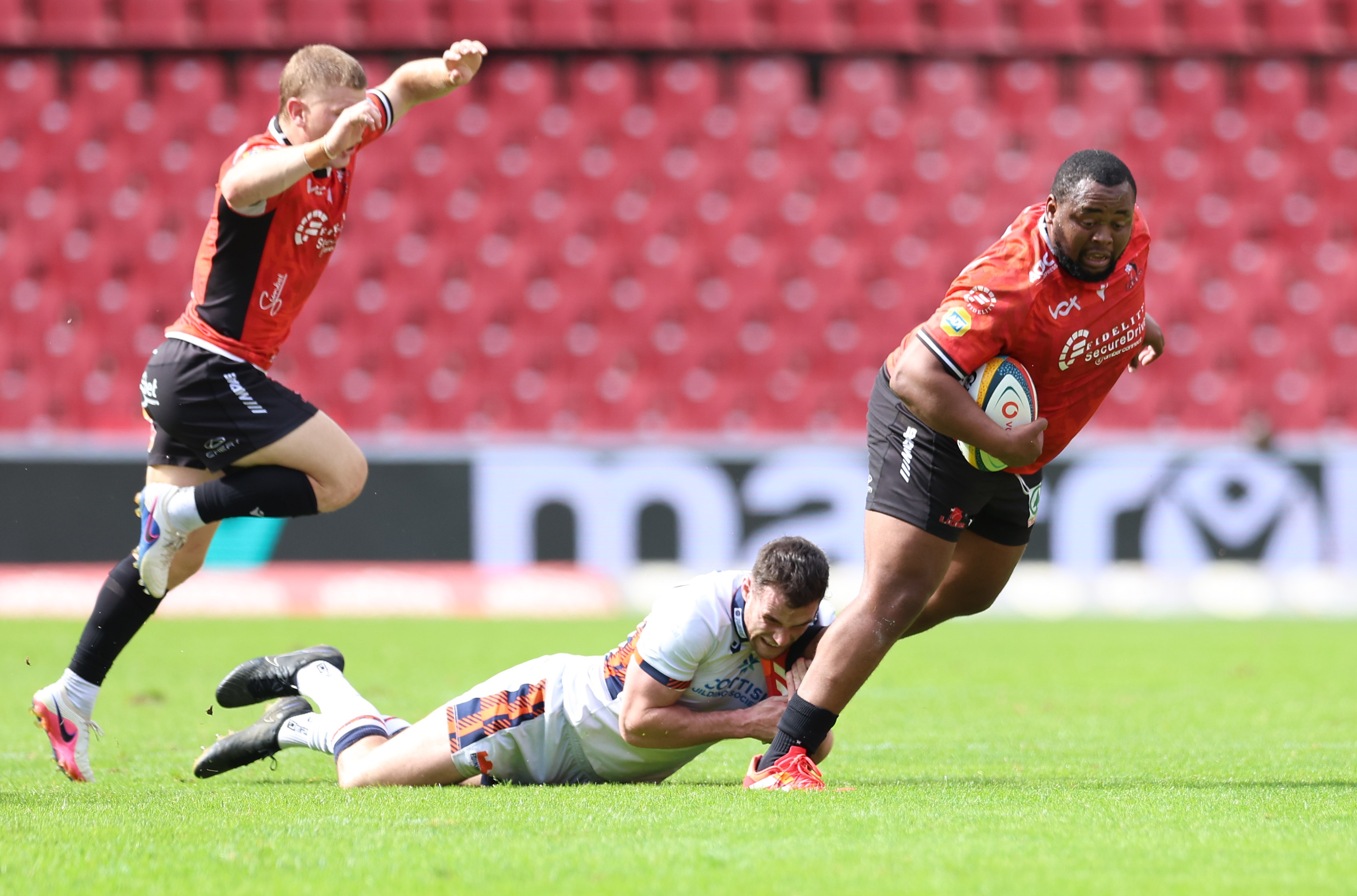
 Asenathi Ntlabakanye of the Lions is tackled by Matt Currie of Edinburgh during a United Rugby Championship match at Ellis Park on 21 March 2026. (Photo: Gallo Images/Getty Images)
The old saying “the law is an ass” was never more apt than in the doping case involving giant prop Asenathi Ntlabakanye, who has been banned from playing rugby for 18 months.
In case you’re not up to speed, the brief recap is this: Ntlabakanye was prescribed medications by an endocrinologist to deal with his struggle with weight loss.
With the specialist knowing Ntlabakanye was a professional Test-level rugby player, it was not unreasonable of Ntlabakanye to assume the medications did not fall foul of anti-doping’s strict and lengthy list of banned substances.
To his credit, Ntlabakanye did not leave it there. He took the prescription back to the Lions medical staff, specifically team doctor Rob Collins, as per team protocols, for a second opinion.
According to Ntlabakanye’s defence at his doping tribunal, the Lions doctor greenlighted the use of the medications and they were administered to the player weekly from the Lions medical centre.
/file/dailymaverick/wp-content/uploads/2025/07/TL_2135609.jpg "Lions prop Asenathi Ntlabakanye during the United Rugby Championship against Zebre at Ellis Park. (Photo: Gordon Arons/Gallo Images)")
Two separate banned substances
Unfortunately, two separate medications of the three he was prescribed contained two separate banned substances.
In anti-doping terminology, a “specified” substance is regarded as more likely to have an innocent explanation, whereas a “non-specified” substance is in a stricter category because it is performance-enhancing.
In Ntlabakanye’s case, the first medication contained a hormone and metabolic regulator called anastrozole, which is a “specified” substance. The second contained the prohibited “non-specified” anabolic steroid DHEA.
In other words, two medical professionals gave a professional rugby player the all-clear to take two medications that contained banned substances. Both doctors declined to testify at the hearing.
It’s no wonder that Ntlabakanye is considering a personal negligence lawsuit against at least one of the doctors because, at its core, this was a case of medical safeguards breaking down.
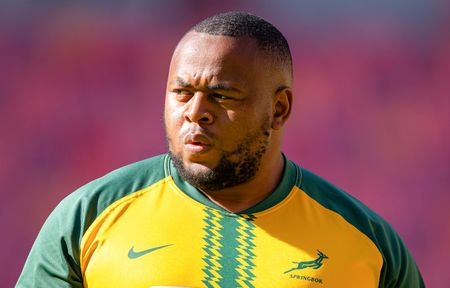
At routine dope testing in May 2025, Ntlabakanye’s urine sample tested positive for anastrozole. Although it’s on the banned list, as a “specified” substance it does not warrant a mandatory suspension.
But Ntlabakanye also declared the use of a prohibited anabolic steroid, DHEA, himself when he was asked to list any medications he was taking.
/file/dailymaverick/wp-content/uploads/2025/07/2221809426-1.jpg "Asenathi Ntlabakanye made his Test debut against Italy on 11 July 2025. (Photo: Ashley Vlotman / Gallo Images / Getty Images)")
Outcome of ‘declaring’
DHEA did not show up in his sample, but declaring it on a form was the same, as far as the anti-doping code is concerned. And so, on 9 September last year, the genial prop was formally charged with a doping violation.
The case played out in February this year and, at the end of it, Ntlabakanye was handed an 18-month suspension, which rules him out of the Rugby World Cup 2027.
It also means that, conservatively, he could lose out on R5-million in earnings during that time.
Daily Maverick understands that the Lions intend to honour Ntlabakanye’s club contract because the failure of medical safeguards played a role in the debacle, so he will not be destitute.
But his career appears to be in tatters and the case has raised the issue of whether the anti-doping code is too punitive and infringes on athletes’ constitutional rights.
Strict liability
The World Anti-Doping Agency (Wada) anti-doping code places an almost impossible burden on athletes to clear their names under the rule of “strict liability”.
The principle of strict liability for doping infractions is the cornerstone of the code. It means liability even without fault.
In doping cases, a charge and suspension does not depend on any guilty intent by the athlete. Suspension is automatic once the sample is proved to contain a prohibited substance.
In anti-doping terminology, a “specified” substance is regarded as more likely to have an innocent explanation, whereas a “non-specified” substance is in a stricter category because it is performance-enhancing.
Under the Wada code, an athlete bears the burden of proof to establish any issue with the testing procedure, sample collection or source of the substance.
Even then, Wada offers a chance to reduce the period of ineligibility only under exceptional circumstances. An athlete must show either no fault or negligence (which eliminates the ban) or no significant fault or negligence (which reduces it).
In the Ntlabakanye case, as in many others, the outcome is an inevitable suspension even if the members of the doping tribunal have sympathy for the defendant’s plight.
/file/dailymaverick/wp-content/uploads/2025/08/TL_2348892.jpg "Ntlabakanye, playing for the Lions, is brought down by the Deaon Fourie and Salmaan Moerat of the Stormers. (Photo: Sydney Seshibedi/ Gallo Images)")
Intent and negligence
The South African Institute for Drug-Free Sport (Saids) sought a four-year ban, claiming among other things that there was “intent” by Ntlabakanye to cheat.
Saids took a particularly stringent line, claiming that Ntlabakanye was “negligent” given that he did not directly ask the two doctors involved whether the medication contained banned substances.
Saids also said that Ntlabakanye did not check the contents of the medication independently. After going through two medical professionals, was he supposed to google it as well?
Given that he only received an 18-month suspension, the independent tribunal that heard the case dismissed “direct intent”. It found that there was simply no evidence
that Ntlabakanye knew he was committing a violation.
The panel also found that there was no “indirect intent” on Ntlabakanye’s part, which is when the maximum sanction would have moved from a four-year ban to two years.
But under strict liability, the burden was still on Ntlabakanye to prove that there was no negligence on his part.
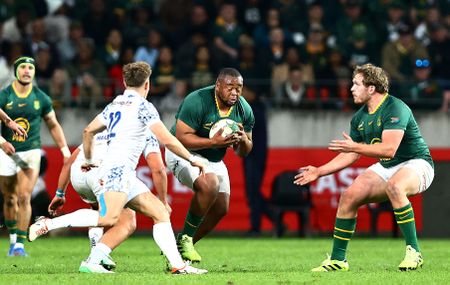
He argued that clearing the medications via the accepted medical channels proved he was not negligent.
The panel viewed things differently, believing he could have asked more direct questions and even requested a “therapeutic use exemption”. This exemption allows athletes to declare they intend to take medications containing banned substances for specific medical conditions.
The panel rejected the argument that there was no negligence on Ntlabakanye’s part. But it did accept there was “no significant negligence”, which reduced the potential suspension to a 12-24-month range.
It was clear that it was a mistake on the part of the medical team, and the reduction from four years to 18 months in the absence of intent was granted.
For Ntlabakanye to come away without any suspension at all was almost impossible under the rules of strict liability because a non-specified substance is involved.
Because the DHEA was also prescribed and he admitted to using it, even though he didn’t know it was a banned substance, the minimum ban would have been a year.
Essentially, in the Ntlabakanye case, but this could apply to several others globally, the tribunal was not trying to find a cheat.
It was applying a code. And the code – as currently written – is, in this instance, very much an ass. DM
This story first appeared in our weekly DM168 newspaper, available countrywide for R35.
/file/attachments/2992/DM-220526_771918.jpg)
Comments
Scroll down to load comments...