



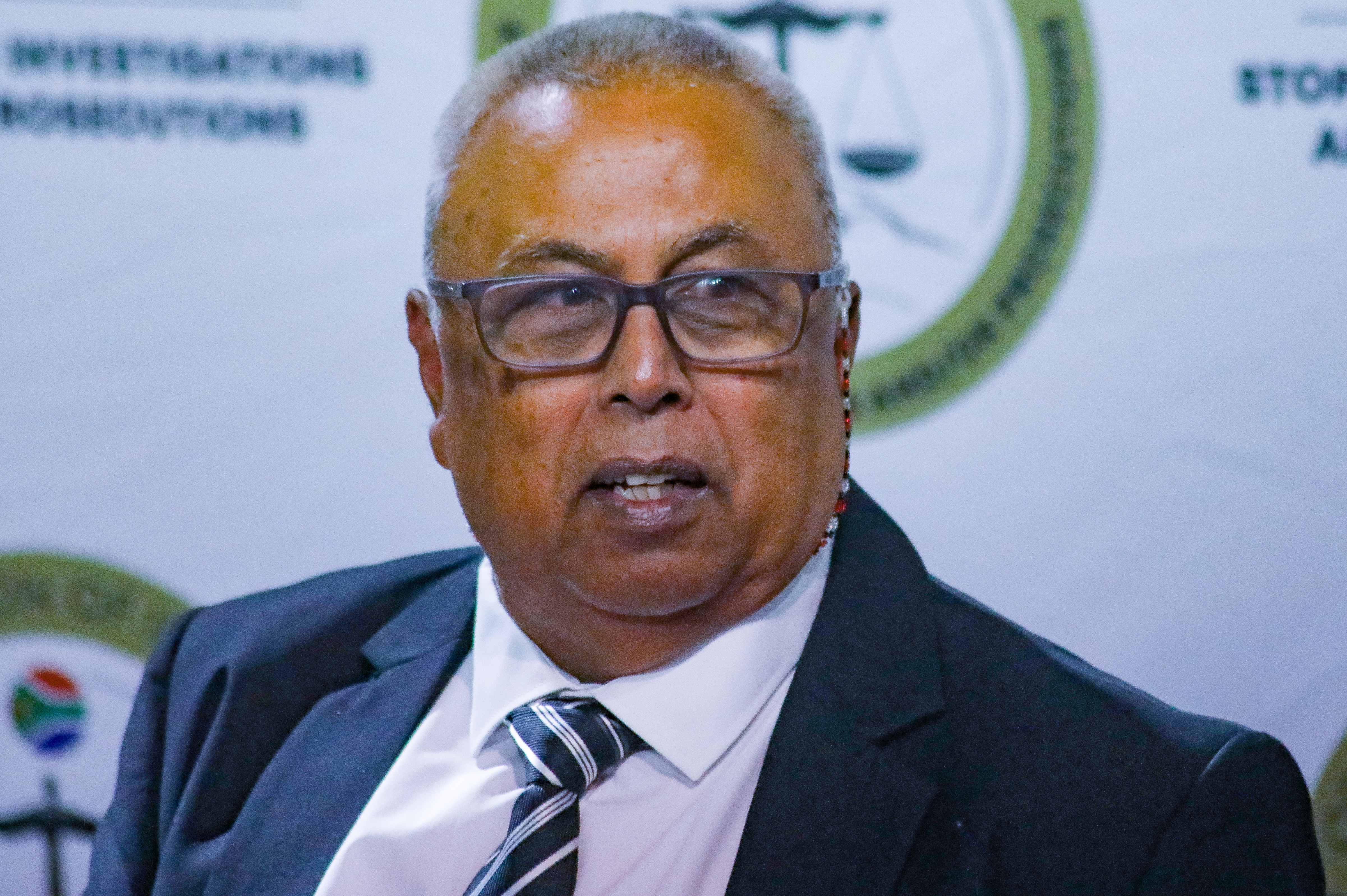
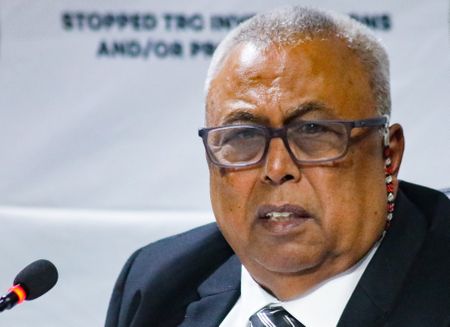
 General Raymond Lalla testifies before the Khampepe Commission on 10 April. (Photo: Fani Mahuntsi / Gallo Images)
Former Crime Intelligence head General Ray Lalla on Thursday told the Khampepe Inquiry into delayed Truth and Reconciliation Commission (TRC) prosecutions that he had to hand over an illegal 2003 recording of high-ranking officials to avoid being seen as a “conspirator” in a plot against then President Thabo Mbeki. Lalla secretly taped a Priority Crimes Litigation Unit (PCLU) meeting before giving the audio to the then Police Commissioner, Jackie Selebi.
Defending his actions, Lalla said, “In my situation, I am the head of intelligence. Hypothetically and in hindsight, I should have informed them [they were being recorded]. But if you come and tell me that you want to arrest the head of state, you make me a conspirator.”
Underlying intelligence in South Africa at the time, said Lalla, had been that the country might be plunged into “internecine strife” should apartheid-era leaders and generals be held to account after the TRC hearings. At the same time, there were calls for ANC leaders to be charged.
Consequences
One of the consequences of the leak to Selebi by Lalla was a moratorium on post-TRC prosecutions by the then justice minister, Brigitte Mabandla, in 2004.
The PCLU head, advocate Anton Ackermann, had been poised to prosecute the apartheid-era minister of law and order, Adriaan Vlok, and police commissioner Johan van der Merwe, when Mabandla instructed the then acting National Director of Public Prosecutions (NDPP), Dr Silas Ramaite, to halt all TRC prosecutions.
/file/dailymaverick/wp-content/uploads/2023/01/000062934-1.jpg "Adriaan Vlok greets members of the SA Defence Force in 1985. (Photo: Unknown)")
This halt was ordered pending a “recommendation” from the Amnesty Task Team (ATT), an interdepartmental body established under the Mbeki administration in 2004 to manage unfinished post-TRC business.
The commission heard on Thursday that in a secret internal memorandum to Mabandla in December 2004, Ramaite stated that the claim by Selebi and “certain Cabinet ministers” that ANC arrests were imminent was “unfounded”.
The memo also informed the minister that the divisional police commissioner, Johannes de Beer, had advised the PCLU that no assistance would be provided for high-profile cases without a written instruction from the President.
This was a bridge too far for the PCLU as well as the National Prosecuting Authority (NPA) head Bulelani Ngcuka, and later his successor, advocate Vusi Pikoli, regarding the independence of the NPA to make prosecutorial decisions.
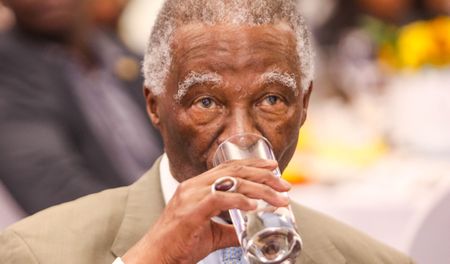
/file/attachments/orphans/ED_5936831_998564.jpg "Former president Thabo Mbeki. (Photo: Sharon Seretlo / Gallo Images)")
A fish out of water
Lalla told the commission that he had been requested by his then boss, Commissioner Tim Williams, to represent the SA Police Service at the ATT along with other members.
“I felt like a fish out of water. They were discussing the legal dispensation for these cases; they were trying to explore what was expected of them.” He confirmed that he had reported back to Selebi and other high-ranking officials in the SAPS hierarchy.
What tripped the switch was a warning from Ackermann in 2003: old-guard investigators remaining in the system were pushing to prosecute Mbeki and 36 others, including Selebi. The ANC had previously been granted amnesty, but that protection vanished after the high court overturned the decision on review.
Lalla told the inquiry, “We needed to protect our institution and the government of the day. I am not saying, however, that he [Ackermann] had wanted to arrest the President, but I had to protect the integrity of the state.”
Precautions
Selebi remained convinced that the PCLU and the NPA were targeting ANC leadership, even after Ngcuka held a press conference denying the rumours and stating that no arrests or prosecutions were imminent.
Selebi’s suspicions had been fuelled by what he selectively heard on the illegal recording provided by Lalla. Defending his habit of taping meetings, Lalla testified that because many officials over the years had private stances that directly contradicted their public statements, he recorded conversations as a “precaution”.
“I did what I had to do to protect myself and the institution. Yes, I recorded it,” he admitted in response to a question as to why he secretly recorded the meeting.
The 2003 meeting with Ackermann and his deputies, advocates Chris Macadam and Torie Pretorius, took place in a room at SAPS headquarters that had been wired, Lalla informed the panel.
“I gave the instruction [to wire the room] long before I went into the room. There is not a switch you can turn on. The whole conversation was recorded,” said Lalla.
/file/attachments/orphans/000075743_558735.jpg "Police Commissioner Jackie Selebi on 8 June 2007. (Photo: Leon Botha / Beeld)")
Selebi’s agenda
Advocate Howard Varney, representing the Calata Group and other families of victims of apartheid atrocities, argued that the recording was provided by Lalla to Selebi not to prevent misunderstanding between the NPA and the SAPS, as Lalla had stated, but rather “to assist Selebi’s alleged agenda to shut down post-TRC prosecutions”.
The Calata Group also challenged Lalla’s assertion that neither the Department of Justice nor the NDPP had brought a TRC docket or specific inquiry to his attention.
A June 2003 letter from Macadam specifically requesting assistance with TRC-related matters, including allegations relating to Winnie Madikizela-Mandela and the 1989 Motherwell car bomb, which was set by security police in an attempt to cover up previous crimes, and killed three policemen and an informer.
Lalla said the industrial-scale incineration of evidence from the apartheid era had made it impossible, in some cases, to find any evidence to secure convictions.
He asked, we gave
Lalla claimed that during his initial contact with Selebi, they spoke about “biological warfare” when the topic of the 2003 meeting with the PCLU had “come up in discussion”.
“[Selebi] said he had another interpretation of what took place in that meeting with the PCLU. I then told him I had a recording. He asked for it, and we gave it to him,” said Lalla.
The commission chair, retired judge Sisi Khampepe, put it to Lalla: “Recording is one thing, handing it over is another. Why did you hand it to Selebi?”
/file/dailymaverick/wp-content/uploads/2024/02/ED_473560.jpg "Retired Constitutional Court Justice Sisi Khampepe. (Photo: OJ Koloti / Gallo Images)")
“He is my accounting officer, and these challenges we experienced quite a lot, where senior officers are told this is how we are doing it, and in other forums, this is what we are being told. He asked for it … we gave it to him,” he replied.
Asked whether he had been aware that Selebi had been one of the 37 ANC members on the alleged list, Lalla claimed not to have had knowledge of this. He denied ever obstructing or delaying any prosecutions during his term of office from 1995 to 2011. DM
Comments
Scroll down to load comments...