



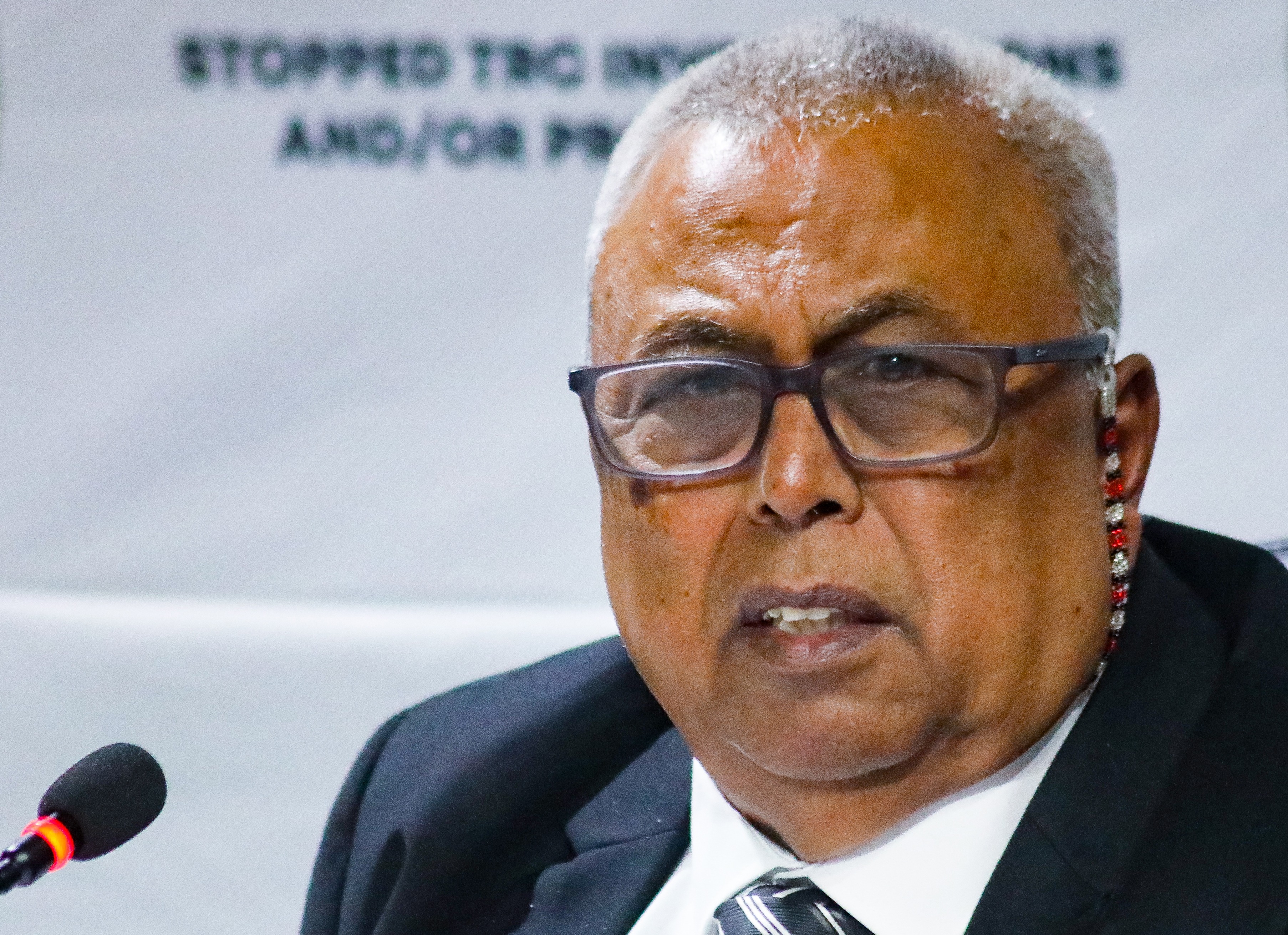
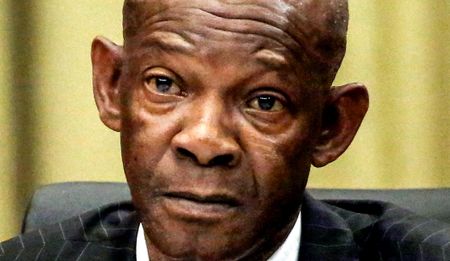
 General Raymond Lalla testifies at the Truth and Reconciliation Commission (TRC) inquiry in Johannesburg on 10 April 2026. (Photo: Gallo Images / Fani Mahuntsi)
The old habit was hard to shake the day former SAPS Crime Intelligence head Raymond Lalla secretly recorded a confidential 2004 meeting with Priority Crimes Litigation Unit head, advocate Anton Ackermann, about Truth and Reconciliation Commission (TRC) prosecutions and later leaked it to then national police commissioner Jackie Selebi.
Lalla, who testified at the Khampepe Commission of Inquiry into delayed Truth and Reconciliation Commission prosecutions on Friday, 10 April 2026, was a member of the Natal Military Command of the ANC and arrested and tortured in Bethlehem in 1990 alongside the late Cabinet minister Pravin Gordhan.
Both men were connected to the ANC’s secret “Operation Vula”, and Lalla told the inquiry his mission back in the early 1990s “was very clear” – “To limit and to ensure that we respect the accord that was being put in place, the Nkomati Accord, and we are able to ensure that there is no disruptions to the talks about talks”, he told the panel.
That is how far back Lalla’s involvement in shaping democratic South Africa tracks, way back to the days of a Convention for a Democratic South Africa (Codesa, 1991-1993), when armed right-wing white supremacists burst into the Kempton Park venue.
/file/attachments/orphans/ED_603420_955825.jpg "General Raymond Lalla testifies at the Truth and Reconciliation Commission Inquiry at Sci-Bono Discovery Centre on 10 April 2026 in Johannesburg. (Photo: Gallo Images/Fani Mahuntsi)")
Lalla was appointed head of Crime Intelligence in 2001 during president Thabo Mbeki’s term of office and represented the SAPS on an “Amnesty Task Team” set up by Mbeki, which resulted in alleged executive creep over independent National Prosecuting Authority (NPA) matters.
This allegedly caused friction between the NPA, SAPS and other law enforcement agencies, derailing TRC prosecutions for more than three decades, and weakening the NPA for longer.
Old habits die hard
The intelligence veteran has been accused by Ackermann of secretly videotaping the confidential meeting between him, advocate Torie Pretorius, Senior Deputy Director of Public Prosecutions, and advocate Chris Macadam, former Director of Public Prosecutions, where Ackermann had voiced his “disgust” over the refusal of the Directorate for Special Operations (DSO) to take on TRC-related cases or to offer resources.
“I deliberately recorded it. I did not tell him, I saw no reason in telling him. It is in my office, I am the head of Crime Intelligence, so I want to keep proper recordings of what goes on,” Lalla told the panel.
At first, he had kept the recording private, but about a year later, Selebi had called to chat about “another matter regarding foreign law enforcement”, said Lalla.
“I said to him, you know what, I do not want to go into details about what I said, but I said I did record the meeting, here is the recording. [Selebi] is my accounting officer and he should know the truth, and I gave him the recording, well, somebody in my staff gave him the recording,” said Lalla.

Selebi, in turn, sent the recording to inaugural NPA head Bulelani Ngcuka. Ackermann, a key witness in this probe, previously testified that Selebi had somehow been convinced that he [Ackermann] had claimed he had “a compelling case” against Mbeki and other senior ANC leaders, which had been untrue.
“There was no case against the president or any other prominent ANC members who had been refused amnesty,” Ackermann emphatically told commissioners when he testified.
/file/attachments/orphans/0000119117_774828.jpg "Former South African police chief Jackie Selebi leaves the South Gauteng High Court surrounded by police, in Johannesburg, on 2 July 2010. Selebi was found guilty on charges of corruption. (Photo: Gallo Images/Foto24/Felix Dlangamandla)")
Ackermann viewed Lalla’s recordings as part of a campaign to sideline him as he was applying pressure for TRC-related prosecutions, especially the charging of former National Party Cabinet Minister Adriaan Vlok and Police Commissioner Johan van der Merwe over the poisoning of Reverend Frank Chikane.
Ackermann said he had been “furious” during the meeting that Lalla had recorded.
The commission has heard there was pushback against Ackermann as he was viewed by many in the ANC as an “apartheid-era” prosecutor. He was despised and “not to be trusted”.
On the other hand, former apartheid-era prosecutors were also not too enamoured with Ackermann’s determination to prosecute human rights violations. Ackermann prosecuted apartheid assassins Eugene de Kock and Ferdi Barnard, the Civil Cooperation Bureau operative who assassinated academic David Webster in Johannesburg in 1989.
This did not convince the ANC of his bona fides, and it appears that it was then that the fog of war entered the game.
Lalla told commissioners, “I did not have any malice or any intention of wanting to stop the prosecution. I think this was just an isolated incident, and the only person who can explain his behaviour is advocate Ackermann.”
Spooks on the loose
It appears from the evidence presented to the commission that the narrative, first circulated in the early 2000s, that Ackermann was gunning for 37 senior ANC leaders, had been concocted by former security police members.
It was after a call from Jan Wagenaar, lawyer for implicated apartheid-era generals, that the rumour was fashioned into “fact” and Selebi became hell-bent on providing no assistance to TRC cases.
It was also after Wagenaar’s contact with the government that former minister of justice and constitutional development Bridget Mabandla called then acting DPP Dr Silias Ramaite to inform him that a “moratorium” had been placed on all TRC prosecutions.
Reconciliation before justice
According to the submission by the family of Fort Calata – one of the Cradock Four activists murdered by security police in 1985 – members of the Amnesty Task Team had agreed that the paramount objective at the time had been “the national interest” and “reconciliation”.
This had resulted in justice denied for the victims of atrocities.
The families allege that audio captures task team members “cross-examining” NPA prosecutors rather than facilitating the legal process to charge apartheid-era criminals.
Lalla was part of senior ANC leadership structures involved in early negotiations with the former apartheid state officials after the unbanning of liberation movements and the release of leaders, including Nelson Mandela.
Lalla’s long walk to Khampepe
Lalla’s history stretches back to his schooldays in Merebank, Durban, when he joined the ANC underground and was trained in “multiple countries, both in [the] military and intelligence”.
Lalla also co-chaired, with a member of the former South African Defence Force, a Codesa meeting of former “independent” homeland or “bantustan” police and military units.
“The purpose was to try and create a scenario for the new South Africa, whereby we had a common approach in basically neutralising speculations, suspicions and violence and taking the country forward,” he said.
After his appointment to Crime Intelligence, his main task had been to transform the old security police apparatus and remnants of “internal security” into a cohesive Crime Intelligence division. In January 2008, he left to become head of detective services, a post he held until 2011.
The lost recordings
Lalla told the commission that he did not have any oversight of TRC documents and denied ever having influenced anyone or tried to stop the prosecution of TRC matters.
Asked by advocate Motlalepule Rantho (for SAPS) whether there had been any requests for copies of the clandestine recording, he replied that the original was missing.
The recording had definitely been received by Selebi, he said, but he could not recall who in his office at the time had effected the handover. He said he had “tried to check” but that “people have left, people have gone, people have died, and that is the challenge”.
He said he had not come across the recording again. DM
Comments
Scroll down to load comments...