




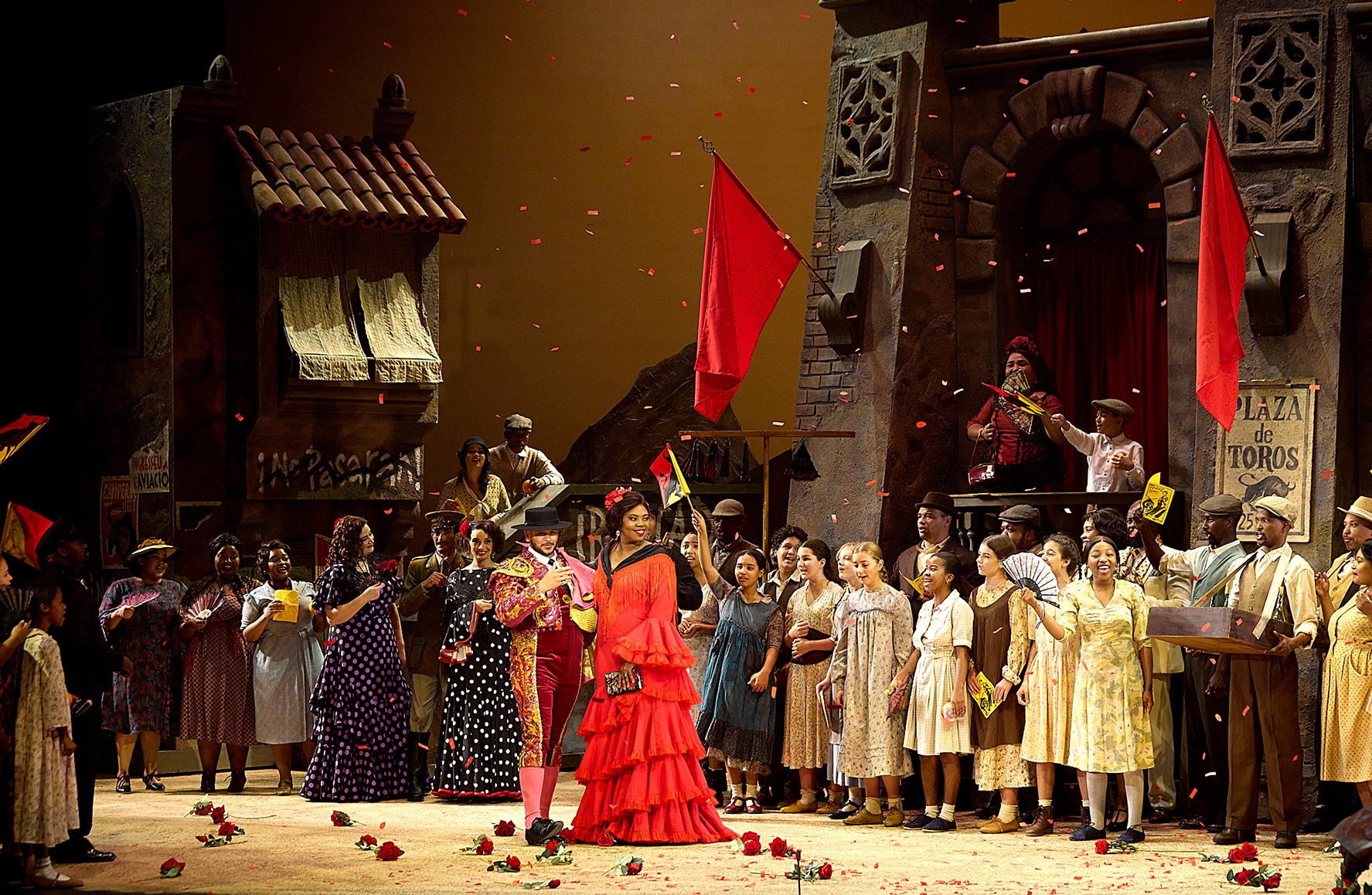
 Carmen and her toreador outside the bullfighting arena in Cape Town Opera's Carmen. (Photo: Oscar O’Ryan)
 She’s saucy, she’s sexy, and she is free. He, meanwhile, has mommy issues, would rather report to army barracks than give her what she craves. It’s the recipe for a real potboiler, the outcome foreshadowed again and again, through music, lyrics and even a blatant tarot card reading, and yet when it happens, just moments before the final curtain, you will feel a shudder of emotions – gasps, even – rippling through the auditorium.
It’s all there in mezze-soprano Nonhlanhla Yende’s eyes and shoulder shrugs, her hands-on-hips impatience and her knowing, self-assured, easy swagger. She commands the stage with those eyes, lets us know what she’s thinking, lets us know – without a shadow of a doubt – that she’s in charge.
And, like her larger-than-life presence, it’s there in her voice – she absolutely consumes the stage, seduces every sentient creature within hearing range with her sultry, captivating, endlessly elegant singing. Her power is, however, also what seals her fate; her commitment to personal sovereignty, her belief in absolute freedom, her will to do with her body as she desires – these are intolerable in a world dominated by men.
/file/attachments/orphans/CarmenandherbestiesoutsidethebullfightingarenainCapeTownOperasCarmen_DanielRutlandManners_607975.jpg "Carmen and her besties outside the bullfighting arena in Cape Town Opera's Carmen. (Photo: Oscar O’Ryan)")
Cape Town Opera’s latest production is a supercharged feminist rendering of the blisteringly hot tale of a free-spirited Andalusian Romani woman, and despite its tragic ending, Carmen still feels like a triumph for womanhood, a slap in the face of toxic patriarchy.
Not that Carmen herself is by any stretch of the imagination an angel, but – my God! – what a fiery femme fatale she is, an honest-to-god feminist icon who lives and dies by her own rules, does what she chooses with her body, and would rather invite death than exist according to the demands of anything as pitiful as a man.
Yende has a voluptuous voice and killer stage presence, and despite the stubbornness and eccentricities of her character, it’s the tenderness and wayward charm of her performance that lingers.
It’s in the way she uses a pair of metal mugs as makeshift castanets and performs a defiant dance of seduction. And it’s in the way she stares across the stage at the end of her “Habanera” aria, landing her gaze on Don José, the slightly silly man-boy whose initial disinterest in her becomes a kind of provocation to seduce and destroy him.
It’s everywhere, in fact, including in the way she chops and changes her lovers to suit a prevailing mood, the way she looks danger in the face and refuses to back away. Even in her dying moments, her instinct is not to scream or cry or struggle, but to get out her bright red lipstick.
By the time all this transpires, the opera’s two hardest working singers – Yende’s Carmen and Lukhanyo Moyake’s Don José – have used their voices to squeeze every drop of passion and honest, unsentimental emotion into the final, devastating duet. And it’s the strangest thing: seeing death operate not as a tool to conquer or vanquish the heroine, but to reaffirm her as one of opera’s most enduring, beloved icons. Her death, after all, is what has immortalised her, deepened the profundity of her refusal to live by anyone else’s rules.
Which of course is also a metaphor for other themes embedded into this production which has as its milieu an early-1930s Spain, where rebellion is in the air and there’s overt antagonism between the state’s soldiers and the people who populate Seville, many of them working class and ready for a regime-change revolution.
/file/attachments/orphans/LoveinthemountainsCarmenandhertoreadorinCapeTownOperasCarmen_DanielRutlandManners_743709.jpg "Love in the mountains – Carmen and her toreador in Carmen. (Photo: Oscar O’Ryan)")
/file/attachments/orphans/NonhlanhlaYendesCarmenandLukhanyoMoyakesDonJoseinCapeTownOperasCarmen_DanielRutlandManners_872903.jpg "Nonhlanhla Yende’s Carmen and Lukhanyo Moyake’s Don José in Carmen. (Photo: Oscar O’Ryan)")
This production, directed by Steven Stead (hot off The Rocky Horror Show, with its vague parallels – the flirtatious antihero dies at the end in that musical, too), kind of sneaks up on you.
It starts out all very muted, lots of browns and greys denoting a somewhat decaying barrio in an industrial part of town. Though there are few hints of colour, there’s graffiti on the walls, big letters demanding “LIBERTY OR DEATH” and a couple of communist hammer-and-sickle emblems signalling that we’re looking at a world on the cusp of change.
Obvious, too, is the blatant misogyny and sexual aggression of the soldiers, supposedly hanging around to keep the law, but in truth they’re waiting – along with the rest of the men – to catch a glimpse of the factory women who will file into the town square. But, when the sweet, innocent Micaëla appears on stage, dressed in blue and all alone, she is roundly harassed by several of the soldiers, a bunch of slobs, really, who have no real business other than counting down the minutes until the changing of the guard.
It’s when the working women from the factory appear, though, that things really begin to hot up, and more colours begin to punctuate the sepia palette. Not only do they sing about the sultriness of the heat and the cigarette smoke, there’s an undercurrent of lust that starts to stir, too.
None of that collective lust can, however, compare with what comes next: Carmen – voluptuous, self-aware, flirtatious to a fault – moving across the stage with vampish swagger. When she wets her legs and arms at the edge of a fountain, she’s does it as much to cool down as to get a rise out of the men. And, in this production, the women are drawn to her, too.
Next thing, she’s singing one of opera’s most enduring, endearing, earwormy songs, her swaying “Habanera” rhythm one that Bizet lifted almost verbatim from the Parisian cabaret scene and which sets in motion the opera’s infatuation with Afro-Cuban sensuality – hips engaged, we’re ready for a fast and furious war of the sexes.
But first there’s a more literal and immediate rumble among the women, and – from the midst of the brawl – Carmen and the woman she’s feuded with, a bloody “X” carved unceremoniously into her cheek, physical proof that this Bohemian minx is not to be trifled with.
And thus drama and tension is built around the fury and guile of an unconventional gitana, her faux surrender to the soldiers, her arrest, her mischievous plan to seduce Don José, and the chaos of her escape which sees Act I culminate in a wagon full of Seville oranges being scattered across the stage.
/file/attachments/orphans/ActIculminatesinawagonfullofSevilleorangesbeingscatteredacrossthestage_DanielRutlandManners_421933.jpg "Act I culminates in a wagon full of Seville oranges being scattered across the stage. (Photo: Oscar O’Ryan)")
/file/attachments/orphans/Carmenistroublebutsheisalsolifeanddesireandsheisabrilliantsplashofcolourinasepiaworld_DanielRutlandManners_481738.jpg "Carmen is trouble, but she is also life and desire – and she is a brilliant splash of colour in a sepia world. (Photo: Oscar O’Ryan)")
The message is clear: Carmen is trouble, but she is also life and desire – and she is a brilliant splash of colour in a sepia world. By the time the curtain descends for the first time, you are hooked in every imaginable way.
As much as there is a lot of – and, at times, a bit too much – visual information on stage, you could happily watch this show with your eyes closed and feel the metaphoric fires burning across the stage.
Not only is the chorus electrifying, but each of the individual roles is a casting coup, starting with Yende’s force-of-nature Carmen: while on the one hand it’s enormously entertaining to watch her beguile and then just as quickly dismiss the men who enter her orbit, the singer is also beautifully adept at comedy, great at sharing secret moments directly with the audience.
It’s as if we’re in cahoots with her, are right there by her side even when she’s up to no good. Even more remarkable is the ease with which her rich, honeyed voice spills out of her – the result is a slippery, enchanting creature who is as charming to watch as she is beautiful to listen to.
Which makes it easier to understand why Moyake’s Don José is so thoroughly bewitched by her. It’s nevertheless to his great credit that, by the end of it all you not only feel the terrible pain of his emotional break, but are able to muster some sympathy for him as his voice so eloquently captures the awful frustration of being obsessively in love with someone who is not only completely unobtainable, but who has turned his life upside down. Yes, he has himself to blame, but he is only human, only a man.
As Escamillo, the egotistical toreador, Conroy Scott has all the requisite larger-than-life boastful arrogance, arriving at the Act II taverna not only with an entourage of fans but with such ridiculously inflated “big dick” energy that he is to some extent a male counterpart to Carmen.
Parading his own bluster, he sweeps everyone (including Carmen) off their feet, and proceeds to sing (most exquisitely) his own praises, climbing on the furniture in a kind of preview of what he gets up to in the bullring – and, no doubt, also in the bedroom.
Wondrous, too, is soprano Vuvu Mpofu, who brings such earnestness and complete honesty to Micaëla, the wide-eyed, unwitting innocent who loses Don José to the more calculating Carmen. While Micaëla is in many ways written as a foil for Carmen’s heady sexual liberation, Mpofu turns up the charm and does so with such vocal purity that it’s impossible not to sympathise with her as well.
Keep an eye on smaller character roles, too. Whether it’s Brittany Smith, who plays Frasquita, one of Carmen’s besties, seated back-to-front on a chair in a kind of parody of exaggerated manspreading, or the way Lusibalwethu Sesanti’s innkeeper looks after her customers, there’s not a part that isn’t fully inhabited and given honest expression.
It is a massive production, with not only a large cast of named characters, but also two choruses (including a lively, excellent children’s chorus who bring tremendous energy to the stage) plus extras among the ensemble and a troupe of dancers who add sizzle and, thanks to Naoline Quinzin’s choreography, even a bit of acrobatic fervour to Carmen’s emblematic Bohemian song, “Chanson bohème”.
And then there is the Cape Town Philharmonic Orchestra, with the rather magnificent Tim Murray conducting. Not only is the music fabulously performed, but there’s some mysterious force between the singers on stage and these particular players in the pit, a spark of connection that you absolutely feel in the performance.
/file/attachments/orphans/Someofthemorevoluminouscrowd-sceneactionisrenderedslightlyclaustrophobic_DanielRutlandManners_356557.jpg "Some of the more voluminous crowd-scene action is rendered slightly claustrophobic. (Photo: Oscar O’Ryan)")
Less satisfying, I think, are the sets, which aim for naturalism but come over as slightly cumbersome, too literal, even a bit cartoonish. The problem with opting for realistic scenery is that it raises expectations; I imagine a less convoluted, more expressionistic visual device would have done the trick.
It might also have freed up more space for the performers – it seems a bit weird that some of the more voluminous crowd-scene action is rendered slightly claustrophobic, the bulkier sets inexplicably very downstage.
But that’s ultimately a minor quibble considering that it’s the music, the voices and the underlying truth of the story that audiences come to experience.
We’re there to be enchanted by the quixotic beauty of the music and then be slaughtered emotionally.
In those final moments before the impulse to kill Carmen completely consumes Don José, the agonies of love at its most savage fill Moyake’s every note. The emotions soar as the audience anticipates the inevitable, hoping against hope that some miracle might save the heroine.
But this is opera. Don José murders her because he is unable to stop loving her. Carmen, by contrast, dies because she refuses to love him in return. The irony pierces your soul, the exquisiteness of their final duet – a duel to the death, really – breaks your heart.
It is in many ways the most perfect ending, immortalising a genuinely complex, truly uncontainable character and, in the case of this rock-solid, rollicking production, leaving the audience with no choice but to rise to their feet.
On its opening night, the energetic ovation continued for many minutes, the passion on that stage and down in the orchestra pit absolutely palpable. An absolute triumph. DM
Carmen is showing at Artscape’s Opera theatre in Cape Town on 21, 23, 27, 29 and 31 May.