



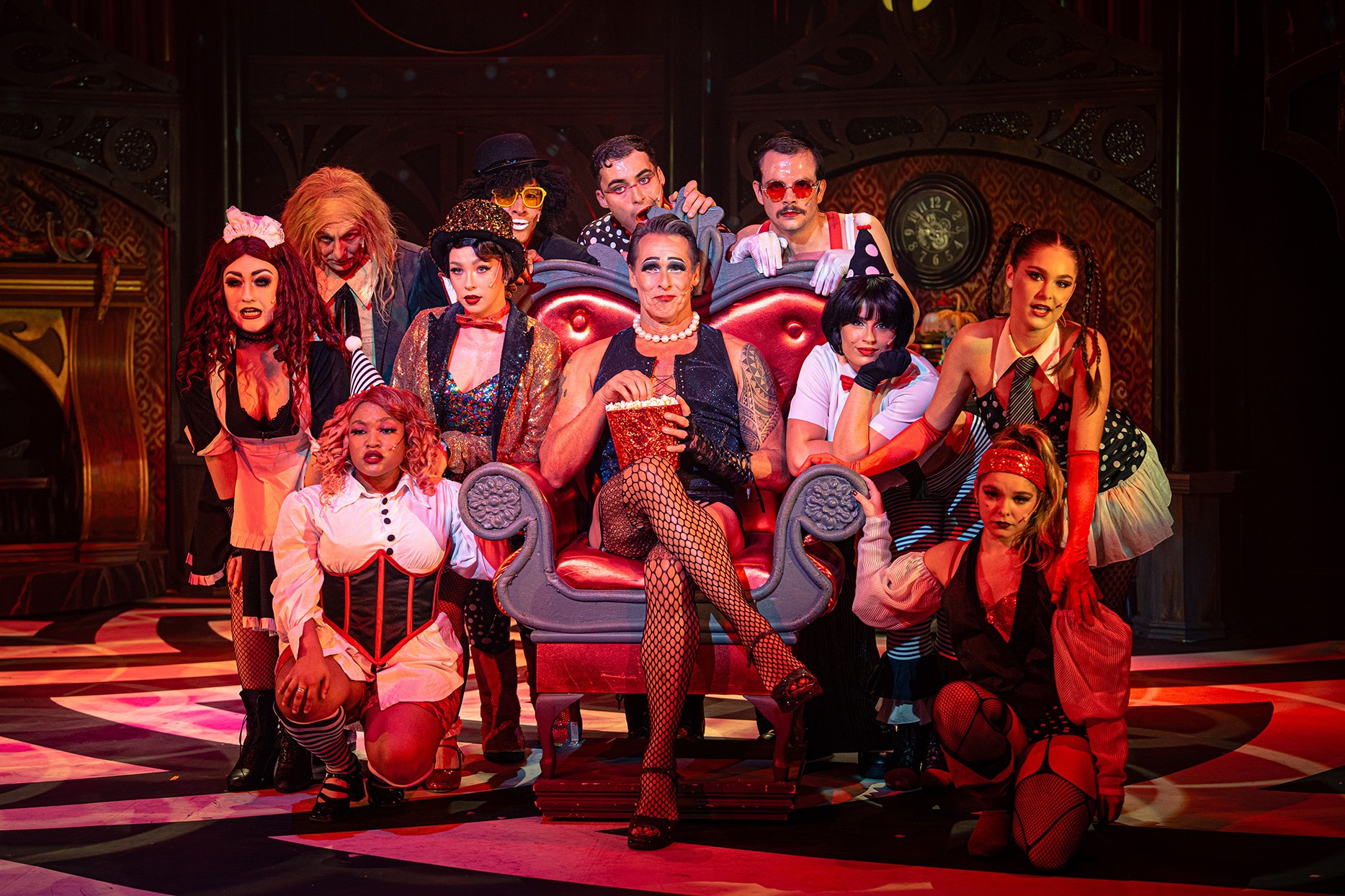
 Craig Urbani and the cast of The Rocky Horror Show. (Photo: Daniel Rutland Manners)
Raunchy, ridiculous, unrivalled.
That’s The Rocky Horror Show in a nutshell. But how then to also explain the weirdly empowering enchantment that happens at the intersection of its fetishising of corsets, fishnet stockings and stilettos, its ceaseless foregrounding of camp in the true sense of the word and its journey from funhouse fringe-theatre experiment to cult-status musical classic?
Never mind its wayward sexual shenanigans that run from multi-partner couplings and off-the-leash desire to fashioning your own living, breathing, weightlifting sex doll, interspecies cuddle-puddle orgies and even intimations of alien incest.
To quote Tony Award-winning director Sam Pinkleton, whose revival of Rocky is currently previewing on Broadway: “It’s made out of everything that I love, which is weirdos and trash and a kind of strange earnestness.”
It’s a show, he says, that “can be ridiculous and trashy and messy and queer and also dead-serious and so big-hearted”.
It also features a gory killing pre-empted by an exalted rock ’n’ roll number and executed by an extraterrestrial, sexually omnivorous mad scientist who first chases after his victim with a chainsaw. Never mind the fact that the rampaging killer is among musical theatre’s most beloved characters.
All of these elements are being exploited and indulged to the max in a production of the show that’s opened at Cape Town’s Theatre on the Bay. Given the opening-night response, it’s destined to be a months-long sellout success, which includes a season in Joburg.
/file/attachments/orphans/CraigUrbaniasFrank-N-Furter_DanielRutlandManners_961523.jpg "Craig Urbani as Frank-N-Furter. (Photo: Daniel Rutland Manners)")
It’s about as dippy and phantasmagorically unhinged as you could hope to get in a musical that is also blessed with across-the-board delectable songs, some pulse-quickening, others genuinely tender.
The energy of it all is bracing, the comedy depraved and it’s wall-to-wall with opportunities not only for the cast to have the time of their lives, but for the audience to be taken – kicking, screaming, howling with laughter and quite likely more than a little turned on – on a wild countercultural ride.
Its outrageous spoof format hinges on its exaggeration of the tropes and clichés and cheap, trashy aesthetic of certain kinds of B-grade movies – the late-night schlock cinema that Richard O’Brien, the show’s creator, was obsessed with as a teenager growing up in New Zealand. O’Brien, who turned 84 last month, was also into rock music and committed to making people laugh, arguing that comedy is a far more challenging endeavour than tragedy.
Rocky Horror is of course grounded in Mary Shelley’s Gothic novel, Frankenstein, or the Modern Prometheus, but O’Brien managed to demythologise the idea of a man-made monster crafted from salvaged human bits and pieces by turning just about every character into some kind of freak or weirdo with which he could have an inordinate amount of fun while skewering mainstream convention.
With its portentous dialogue, nonsense technology, loopy songs and characters who refuse to stay on the straight and narrow, it’s a show that is constantly winking at the audience, ensuring that we’re in on the joke, sharing in the joy of a wayward story with an utterly bonkers plot, and also in the tawdriness, the melodramatic salaciousness of unconventional lust and desire.
The show has become, as O’Brien said in an interview in 2025, a “rainbow event”, a “kind of sanctuary” in a world where “the authoritarian, far right, anti-gay, anti-rainbow brigade” have become so “loud and obnoxious”.
As much as Rocky Horror has an overarchingly queer sensibility, it is vehemently not into labels. Everyone – insiders, outsiders, straights and weirdos – is made to feel at home, even if not entirely comfortable.
In fact, it establishes the vanilla sensibilities of its plain-Jane and ordinary-Joe engaged couple – Brad Majors and Janet Weiss – not so that they can be targets for liberal mockery, but because their deflowering is really the show’s metaphorical heart. They’re served up as sacrificial virgins and have their cherries popped by their hedonistic host as an incitement to have their eyes opened, their horizons expanded and their limited world-view broadened.
/file/attachments/orphans/RobertEversonandLeaBlerkasBradMajorsandJanetWeiss_DanielRutlandManners_918537.jpg "Robert Everson and Léa Blerk as Brad Majors and Janet Weiss. (Photo: Daniel Rutland Manners)")
Playing the straight-laced Brad with as much sweet innocence as he can muster, Robert Everson leans into the comical narrow-mindedness of a Middle American dope who pretends to have all the answers and refuses to be flustered, even when he’s being stripped half-naked in a room full of strangers.
Meanwhile, Léa Blerk as Janet is a blend of wide-eyed innocence and willing curiosity. Once she gives in to temptation, has her angel wings metaphorically plucked, though, Blerk allows Janet’s inner feminist to gently come bubbling to the surface.
These two innocent virgins are, of course, thrown off guard once they’re welcomed into the spooky castle populated by a plethora of radical hooligans, starting with the Beetlejuice-impersonating Riff Raff, the butler-cum-servant-with-a-chip-on-his shoulder.
Riff Raff is a riot, played by Schoeman Smit, who gives his whack-a-doodle character a shifty countenance, uncomfortable posture and all-round erratic disposition that make him riveting to watch. As Magenta is Jasmine Minter, taking on a double role as the movie theatre usher, who is perkily bright-eyed and gorgeous even when she’s cleaning lost knickers and used condoms from the cinema floor.
Alongside the pair is Columbia played by Anna Olivier, who brings an infectious openheartedness to the part, the peaks and troughs of her emotional spectrum responsible for a sizeable number of laughs.
Then there’s Zak Hendrikz as Eddie, the doomed rock ’n’ roll delivery boy who struts and cavorts as he dishes out Hot Patootie like its a full-scale concert. Later, in an appalling wig and in a wheelchair, Hendrikz transforms into Eddie’s energetic opposite, returning as Dr Scott, the scientist with a questionable German pedigree.
Even the ensemble of minions, who might be there to serve as a kind of freakish backdrop to the main action, invariably dish up all sorts of fun, each of them bringing not only verve and colour to the stage, but imbuing their roles with distinct bits of characterisation.
/file/attachments/orphans/ThecastofTheRockyHorrorPictureShow_DanielRutlandManners_704458.jpg "The cast of The Rocky Horror Show. (Photo: Daniel Rutland Manners)")
In this production even the weather – very changeable and slightly screwball – becomes its own character. In fact, the show’s highly strung Narrator-cum-Criminologist played by a purse-lipped Natasha Sutherland must fight the intrusively loud lightning and battle the hoots of ominous owls, among the various cartoonish sound effects that come barrelling off the stage. Sutherland has unshackled her character from its Vincent Price-inspired origins, becoming a kind of strict librarian with a sibilance that she uses to delightful effect.
Will Young, who has opened the show as a stand-in for an injured actor, plays Rocky, the bronzed beefcake who shares a brain with Eddie and is consequently a grown man with the mind of child. Young marshals instinctive “aw-shucks” sweetness and a ripped body into a loveable goofball who, quite understandably, gets his creator all hot and horny.
Playing Rocky’s untameable, corset-clad creator is a frankly impeccable Craig Urbani, who fills those stilettos like he was born for the role. It’s such a commanding, passionate, loving performance, and Urbani – with his nimble baritone voice and insatiable creativity – absolutely owns the stage. His Frank-N-Furter is both a strapping hunk and an über-weirdo whose egomaniacal eccentricities span a vast personality continuum, from cute to mischievous, menacing to charming, often all within a single unpredictable moment.
/file/attachments/orphans/CraigUrbaniasDrFrank-N-FurterinRockyHorror_DanielRutlandManners_213317.jpg "Craig Urbani as Dr Frank-N-Furter in Rocky Horror. (Photo: Daniel Rutland Manners)")
Urbani’s played the satyromaniacal mad scientist before, and yet he doesn’t so much reprise the role as reinvent it in startling ways, finding nuance and subtext that will take even the most ardent Rocky fans by surprise. Like Luke Evans, currently performing the role in Pinkleton’s New York production, there’s no wig, which adds to the adventure of witnessing all of Urbani’s marvellously expressive face reveal the inner workings of Frank’s tricksy, tricksterish personality.
From the way he pouts and flexes his lips, to the manner in which he uses his eyes to provide clues as to precisely where on his emotional roller coaster ride he currently finds himself, he beautifully captures the boundlessness of a character whose tastes, proclivities and mood chop and change with the weather.
Then there’s the way he moves across the stage in those huge heels, each step revealing another clue to his ruptured schizophrenia, every hand gesture, high kick and sideways glance another glimpse of his fascinating derangement. It’s that edge, a sense that he might snap at any moment – cry crocodile tears, commit murder or fall in love – that makes both the character and Urbani’s realisation of him so tantalising.
Director Steven Stead has done a fine job of refuelling a beloved show, making it feel fresh and alive, and keeping it moving at a rock ’n’ roll pace, while providing just the right connective tissue so that its more nuanced moments and subtle jokes have room to land. Pathos and bathos are intimate bedfellows here, and Stead understands the intricacy of that relationship, leans into the uproarious romp while occasionally tugging at more touching, tender heartstrings.
He and his design team have also done a crafty job of fashioning a world that combines the vague trashiness of a B-grade movie set with costumes that lean into the show’s sex appeal and props that have no intention whatsoever of making realistic sense.
/file/attachments/orphans/ThecastofTheRockyHorrorPictureShowatTheatreontheBay_DanielRutlandManners_958878.jpg "The cast of The Rocky Horror Show at Theatre on the Bay. (Photo: Daniel Rutland Manners)")
Choreographers Duane Alexander and Naoline Quinzin have done a considerable job of spicing up every routine, be it with hip thrusts, head tilts or intricate finger gestures, so that there is in fact nothing routine about any of it – even The Time Warp, that proverbial singalong dance-floor treasure, has been reinvigorated.
Witnessing all of this dynamism within the relatively compact Theatre on the Bay greatly heightens the impact of the show; not only does Urbani’s Frank seem that much larger, but the intimate setting brings the audience close enough to the action that you can almost feel the electric sparks between the performers.
It is a very hot show – not merely because the action is genuinely titillating, but because there are few things sexier than watching a group of talented artists having the time of their lives together.
In a way, the entire musical is a kind of metaphor for the experience of going to live theatre, of entering a dream and participating in a fantasy. This particular fantasy is outlandishly wild, fuelled as much by wet dreams as it is by horror-film nightmares.
When the dream is over, though, the story’s deflowered hero and heroine must presumably return to the lie of the American Dream with its fake white picket fence philosophy and patriarchal power structures. And, like Brad and Janet, we in the audience must return to a reality where the real monsters happen to be the crazy palookas in power.
Nevertheless, while the show might not literally transport you to the planet of Transexual in the galaxy of Transylvania, it will help you escape to another dimension for its duration. It is a rocket ship of pure, unadulterated fun – precisely what we Earthlings are crying out for right now. DM
The Rocky Horror Show is playing at Theatre on the Bay until 31 May, whereafter it will move to Johannesburg.
Comments
Scroll down to load comments...