



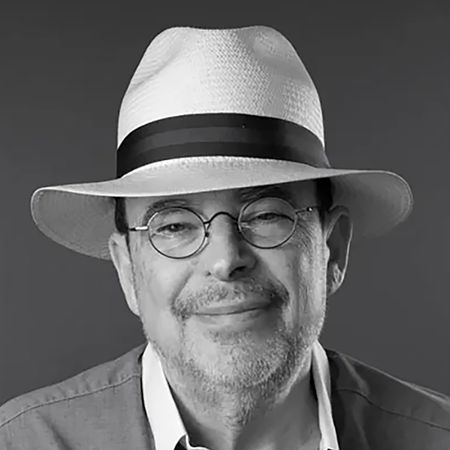
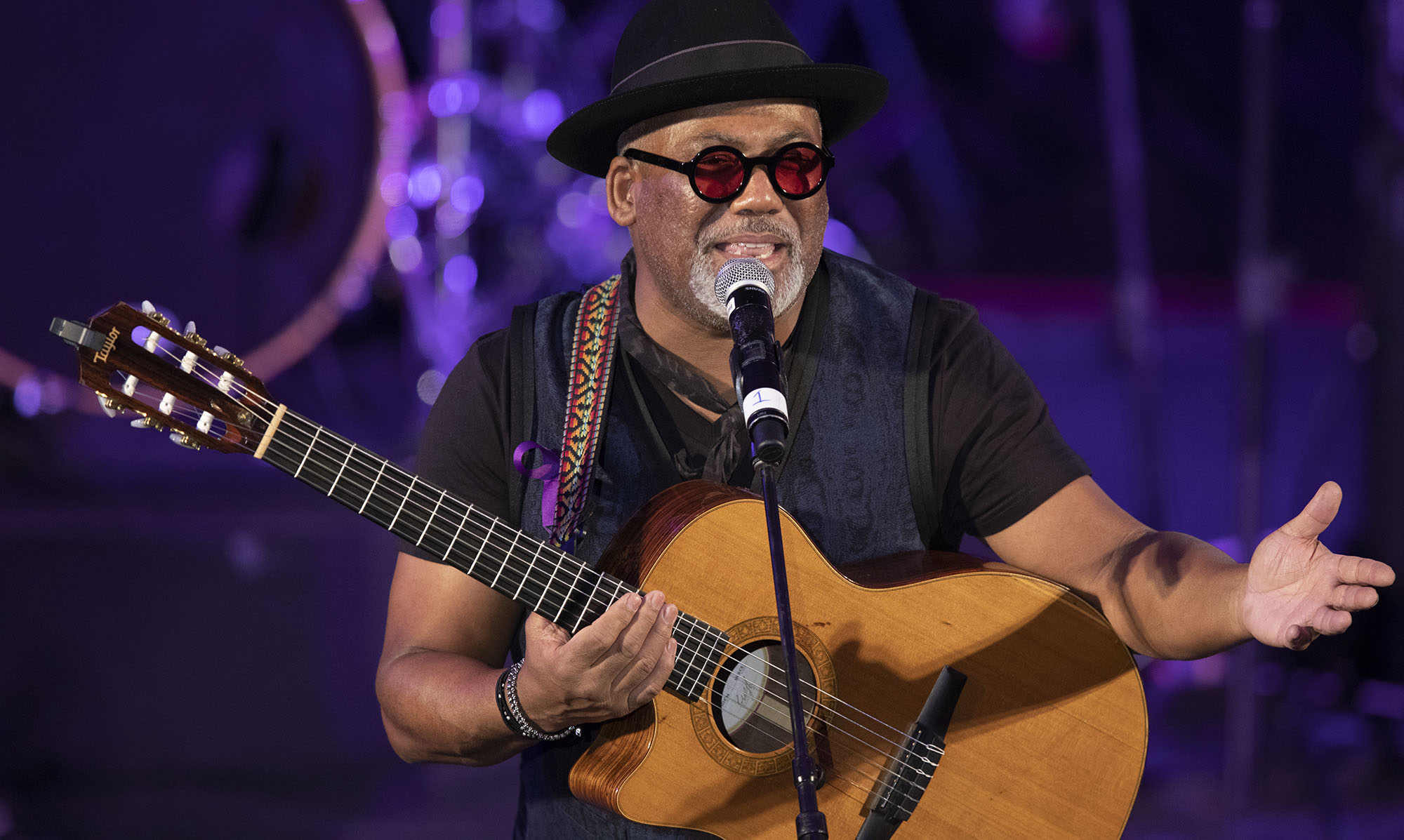
 Jonathan Butler, pictured during the memorial service for Archbishop Emeritus Desmond Tutu in Cape Town on 29 December 2021, was awarded the Order of Ikhamanga in Silver. (Photo: Leila Dougan)
The National Orders Investiture Ceremony took place at the Sefako Makgatho Presidential Guesthouse in Pretoria on Tuesday, 19 May. The President conferred the Order of Ikhamanga, the Order of the Baobab, the Order of Luthuli, the Order of Mapungubwe and the Order of the Companions of OR Tambo on 38 recipients.
The Order of Ikhamanga was established in 2003. Previously, awardees in the arts, culture, the media and sports were included in the already established Order of the Baobab. For those who are not botanists specialising in indigenous South African flora, ikhamanga is isiXhosa (similarly in other Nguni languages) for the magnificent Strelitzia reginae flower.
Over the years, the Ikhamanga honours list has included a healthy roster of leading individuals in the arts, culture, the media and sports, and this year’s list is particularly noteworthy.
In the arts, and honoured with the prestigious Order of Ikhamanga in Gold, was the best-selling and Grammy award-winning flautist Wouter Kellerman, who has combined classical traditions with contemporary music styles. Kellerman’s impact has been global as well as local, and he delights music lovers of all ages.
/file/dailymaverick/wp-content/uploads/2025/02/ED_479634.jpg "Wouter Kellerman at the 29th annual South African Music Awards at Pretoria’s SunBet Arena on 18 November 2023 (Photo: Oupa Bopape / Gallo Images )")
Jonathan Butler, a global star whose recordings and performances inhabit the intersections between jazz, soul, R&B, and gospel, was awarded the Order of Ikhamanga in Silver.
Also honoured with the Order of Ikhamanga in Silver was Oscar “Oskido” Mdlongwa, recognised for creating opportunities for young musicians, as an extension of his success as a DJ, record producer, entrepreneur and kwaito pioneer.
Another global musical presence is South African composer Trevor Jones, who too received the Order of Ikhamanga in Silver. He composed soundtracks for major cinematic hits, including Mississippi Burning, The Last of the Mohicans, Notting Hill, and Excalibur, which have put him in a select league of internationally renowned film composers.
Awarded an Order of Ikhamanga in Bronze was Sam Mhangwani, the veteran playwright and theatrical entrepreneur from an era when African theatre was largely banned from mainline venues, but who toured his productions throughout the country. His best-known work, Unfaithful Woman, was staged continuously for decades.
Other Ikhamanga recipients included Springbok coach Johan “Rassie” Erasmus for his leadership of international championship rugby teams; Andiswa Precious Gebashe for her leadership in working with the often-marginalised deaf community, including efforts ensuring the community is represented in the arts, media, and education; and boxer Norman Hlabane for his winning bouts and inspiring other young men to train and enter the ring.
/file/attachments/orphans/22479519881_862131.jpg "Springbok coach Rassie Erasmus, (Photo: Charles McQuillan / Getty Images)")
Prof Deuteronomy Bhekinkosi Zeblon Ntuli was honoured for his contributions in translating English-language materials into isiZulu, including Long Walk to Freedom and Kahlil Gibran’s The Prophet, retitled as Mphulopethi. Performance artist and arts educator Gavin James Krastin also received the Order of Ikhamanga.
Posthumous recipients
There was a roster of posthumous Ikhamanga awardees, whose influence lives on, including Khabi Mngoma, Molefe Pheto, Queeneth Ndaba, Todd Matshikiza, Johnny Dyani and Daleen Matthee.
Mngoma was a great friend to this writer and his wife over the decades. He founded and conducted choirs in Soweto and had their performances recorded. He founded the Soweto Youth Orchestra, and he taught music and helped run the Orlando YMCA and Dorkay House. Later in life, he established the University of Zululand’s music department.
Watching him weave into city traffic on his motor scooter with a violin case strapped to his back was an unforgettable experience. (And he was the father of a great singer, the late Sibongile Khumalo.)
Todd Matshikiza’s name is forever linked to South Africa’s best-known musical theatre work, King Kong, as its composer. The show includes the showstopper Back of the Moon, first sung by a young Miriam Makeba. Beyond that show, Matshikiza composed choral-orchestral pieces that seamlessly wove traditional African, classical, and jazz textures. A man of many talents, he also wrote for Drum magazine during its golden era, while his son, John, went on to become an internationally renowned actor.
/file/dailymaverick/wp-content/uploads/2024/09/002-Todd-Matshikiza-1.jpg "Todd Matshikiza, composer, music critic and Drum magazine writer. (Photo: Jurgen Schadeberg / www.jurgenschadeberg.com)")
Molefe “Finn” Pheto was a key figure in the rise of black consciousness culture as a leader of the Mihloti African Theatre, a group prominent in the late 1960s and 1970s. Its projects and its performances had a significant impact on the thinking of young black South Africans. Like so many of the country’s other cultural figures, Pheto went into exile during the 1970s.
Johnny Dyani was a leading instrumentalist/vocalist in the group, the Blue Notes, South Africa’s pioneering racially integrated ensemble, before the group scattered as it went into exile. Among jazz fans, Dyani’s fame reached well beyond South Africa.
/file/attachments/orphans/images11_578608.jpg "Johnny Dyani. (Photo: Facebook)")
Queeneth Ndaba was an administrator of Dorkay House in downtown Johannesburg — the legendary and integrated space that was a home base for actors, writers, and musicians that allowed them to practise their craft in the midst of some of the worst days of apartheid. (Dorkay House awaits being properly preserved as an important national cultural monument.)
Jeremiah “Kippie” Morolong Moeketsi was a leader in the development of South African jazz and its integration into the genre internationally. He helped shape South Africa’s jazz style with that instantly recognisable South African improvisational style. The jazz club (and now an event space) Kippies in Newtown was named in his honour, and his statue stands in front of the site.
Then there was a posthumous award to Oliver Kgadime Matsepe for his contributions to modern South African storytelling. His citation noted his attention to a desire for symbolic experience as well as his work being reflective of ongoing events in human relations.
Author Dalene Matthee’s memorable writing in Afrikaans (and translated into English for wider audiences) brought the texture and imagery of South Africa to global audiences. The author of more than a dozen books, she is best known for her four Forest books set in the Knysna Forest — Circles in a Forest, Fiela’s Child, The Mulberry Forest and Dreamforest. Fiela’s Child — depicting the impact of the country’s racial laws on an orphan child — has been made into a feature film twice.
/file/attachments/orphans/Dalene-Matthee_965218.jpg "Dalene Matthee.
<br>(Photo: Writers Write / Wikipedia)")
(Photo: Writers Write / Wikipedia)
Benjamin John Peter Tyamzashe was a Xhosa prophet, evangelist and hymn writer who brought together his African ancestry and culture with his spirituality, through music composition.
Other awards
The Order of the Baobab, recognises South Africans active in community service, business and the economy, science, medicine and technological innovation. Recipients included the late Prof Chabani Noel Manganyi as a Black Consciousness thinker, industrial psychologist and tertiary education administrator; Prof Kubedi Patrick Mokhobo, a physician and medical education administrator; and Prof Puma Gobodo-Madikizela for her work on conflict resolution and the concept of unsolicited forgiveness.
Awardees of the Order of Luthuli for dedication to building a non-racial, non-sexist, and democratic South Africa include the late Jack and Ray Simons for their major contributions to South African historiography and the liberation movement.
Mmagauta Molefe was honoured for her contribution to the struggle against repression during the apartheid regime as an activist, philanthropist, and community leader. Also, honoured was Caiphus Nyoka for his contribution to the struggle against the apartheid regime. Adele Kirsten was recognised for her contributions as a founding member of the End Conscription Campaign and as a longtime director of Gun Free South Africa.
The Order of Mapungubwe is bestowed on South Africans who have accomplished excellence and exceptional achievement to the benefit of South Africa and beyond. The recipients included Prof Tulio de Oliveira for his work on Covid-19; Prof Salim Abdool Karim for work on HIV/Aids and Covid-19; Prof Keertan Dheda for his work on pulmonology; Prof Vukosi Ntsakisi Marivate for his contributions to data science, artificial intelligence (AI), and natural language processing; Prof Priscilla Baker for work in electro-analytical chemistry; and Prof Karen Sliwa-Hahnle for contributions to better understandings of cardiovascular diseases.
/file/dailymaverick/wp-content/uploads/2025/07/Anso-Bhekisisa-podcast-2.jpg "Professor Salim Abdool Karim. (Photo: Dean Demos)")
The Order of the Companions of OR Tambo recognises eminent foreign nationals and other foreign dignitaries for friendship shown to South Africa. Teresa Hillary Clarke was honoured for her work in education, human rights, media, investment promotion and the arts; Pierre Magnee for being an ally of the liberation movement; Antonio da Silva Gomes Cordeiro was honoured posthumously for his support of anti-apartheid activists; Prof Cherif Keita for the preservation of the life story and legacy of South Africa’s historical figure Nokuthela Dube; and Naomi Kleinfeld for her support of the liberation movement.
Taken as a whole, this is an inspirational and wide-ranging roster of people whose lives and works should be celebrated by South Africans and others. DM
Comments
Scroll down to load comments...