




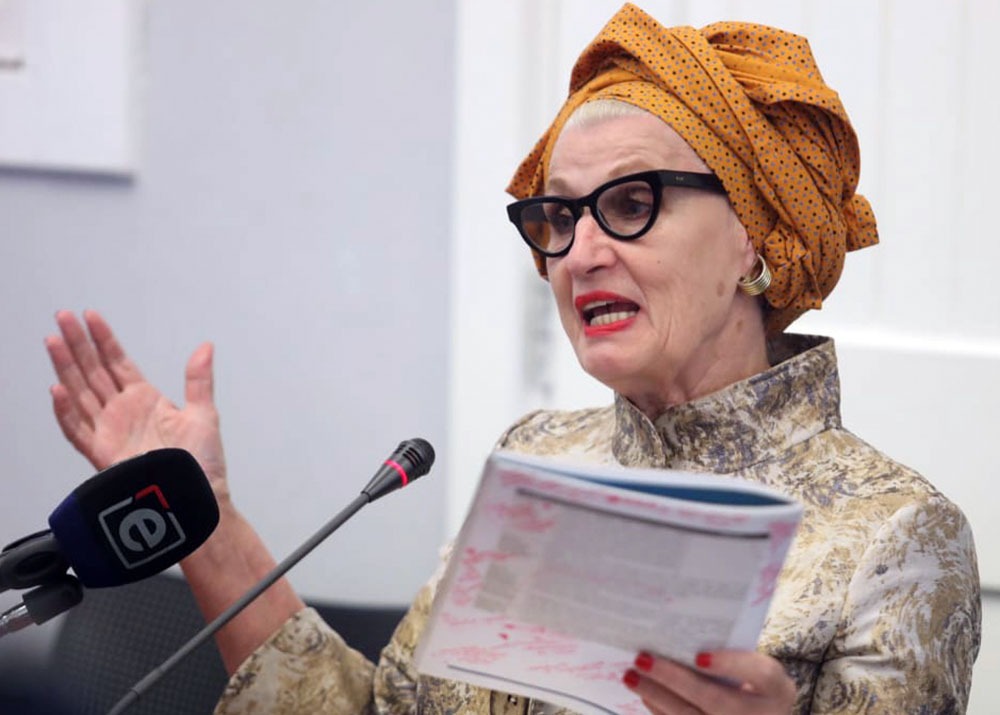
 Marriette Lieferink from the Federation for Sustainable Environment tells the South African Human Rights Commission Gauteng water inquiry panel how the crisis in the province cannot be solved without addressing the widespread contamination of water sources. (Photo: South African Human Rights Commission)
The South African Human Rights Commission’s (SAHRC) investigative inquiry into the water crisis that has gripped Gauteng for several years kicked off at Constitution Hill in Johannesburg on Tuesday, 19 May, where several civil society organisations set the tone for the next three days of proceedings.
Tuesday’s hearings formed part of a scene setter that saw resident associations, environmental organisations and even the Office of the Auditor-General of South Africa deliver submissions that inquiry chairperson, Commissioner Henk Boshoff, said would arm the SAHRC with the information necessary to grill municipal managers and relevant government institutions when they took the hot seat on days two and three of the inquiry.
/file/attachments/orphans/ED_609448_357894.jpg "Henk Boshoff, the chairperson of the South African Human Rights Commission’s Gauteng water inquiry, at Constitution Hill in Johannesburg on 19 May, 2026. (Photo: Gallo Images/Luba Lesolle)")
Thembelihle resident Simphiwe Zwane detailed how her community had only two communal taps, which posed a security risk, particularly for women and children who were allegedly targeted during the long, daily trek to collect water.
/file/attachments/orphans/141522_528636.jpeg "Thembelihle resident Simphiwe Zwane details the difficulties of accessing water in the southern Johannesburg informal settlement to the South African Human Rights Commission’s Gauteng water inquiry at Constitution Hill on 19 May, 2026. (Photo: South African Human Rights Commission)")
Both WaterCAN executive director Dr Ferrial Adam and Amandla.mobi Organising Lead & Fellowship Programme Coordinator Zintle Tyuku explained how the water crisis had led to a reliance on water tankers, particularly in informal settlements and townships, leading to unequal access.
/file/attachments/orphans/ED_577751_601915.jpg "Residents from Water Works informal settlement in Soweto collect water from JoJo tanks on 7 October 2025. (Photo: Gallo Images / Sharon Seretlo)")
Daily Maverick has reported extensively on the governance, financial and infrastructure failures that brought the crisis in the province to a head, at immense cost to the province’s residents, but the environmental toll of the ongoing crisis took centre stage during the first day of proceedings.
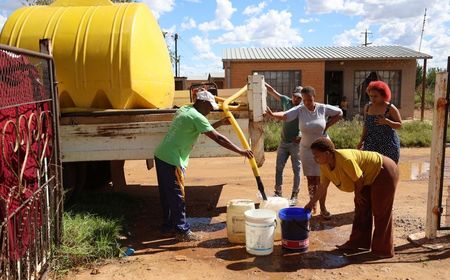
Environmental degradation in the West Rand
While the immediate human suffering is undeniable, the environmental degradation caused by this crisis is equally severe. Decades of neglected maintenance, failing wastewater treatment plants and infrastructure collapses have allowed untreated sewage and pollutants to compromise local ecosystems.
Trevor Brough from the Cradle of Humankind World Heritage Association brought the physical reality of Gauteng’s environmental collapse directly into the inquiry room.
Presenting double-bagged sample bottles to the commission, Brough made submissions on how the combination of acid mine drainage and raw sewage was ravaging the Unesco-listed Cradle of Humankind and Magaliesberg Biosphere Reserve catchments.
/file/attachments/orphans/141551_631027.jpeg "Trevor Brough from the Cradle of Humankind World Heritage Association holds bottles filled with allegedly contaminated water during his submission at the South African Human Rights Commission’s Gauteng water inquiry in Johannesburg on 19 May, 2026. (Photo: South African Human Rights Commission)")
“From 2002 till 2006, we effectively had raw, highly acidic mined water with a pH of between 2 and 3 flowing through the area,” Brough testified, noting that such levels of acidity dissolve a metal soda can within a month. This extreme acidity poses a threat to the region’s famous dolomitic caves, rapidly accelerating the erosion of the very geological structures where world-famous fossils are discovered.
According to Brough, the environmental degradation compounds further downstream, where acid mine drainage meets human waste. Brough presented a second sample taken just metres from the outflow of the Percy Stewart wastewater treatment works.
He added that roughly 2.3 megalitres of this contaminated river water per kilometre seeps directly into the groundwater daily.
Both Brough and Charice Rocha from the Lammermoor Residents and Landowners Association told the commission how the widespread pollution had allegedly triggered socioeconomic ripples throughout the valley.
They detailed how farmers relying on the river network to irrigate their crops had begun reporting levels of contamination of the food source.
Brough detailed how one Global Gap-certified lettuce and micro-herb farmer in the West Rand was forced to completely shut down operations after his crops tested positive for E. coli, rendering 60 seasonal workers unemployed.
Additionally, nearby tourist attractions, such as local trout farms, have seen visitor numbers plummet because trout cannot survive the polluted water. Meanwhile, guest lodges lose business as winter temperature inversions trap a thick, unbearable stench of sewage over the river, forcing guests to demand refunds and flee.
Beyond the economic fallout, the health risks are hitting home for local communities. Brough highlighted research showing that crops irrigated with such water accumulate the highest levels of contaminants directly in their root structures, threatening food security for anyone consuming local carrots, beetroots or potatoes.
An uncaring culture of institutional neglect
For Commissioner Boshoff, the most damning part of the submissions was the lack of response from the Mogale City Municipality, which, according to Brough and Rocha, had failed to respond to concerns raised with the Utilities Management Services dating back to 2019.
Responding to the presentation, Boshoff expressed deep concern over the municipality’s blatant non-responsiveness. He noted that a refusal to respect authority or implement court orders had become a malignant trend across South African local government.
“We have seen an uncaring culture in this province,” Boshoff said, promising that the commission would directly confront the Mogale City municipal manager and issue damning recommendations to national departments.
“Departments simply don’t care about people any more, if they allow this situation where people have to consume contaminated water without understanding the serious implications.” DM


Comments
Scroll down to load comments...