




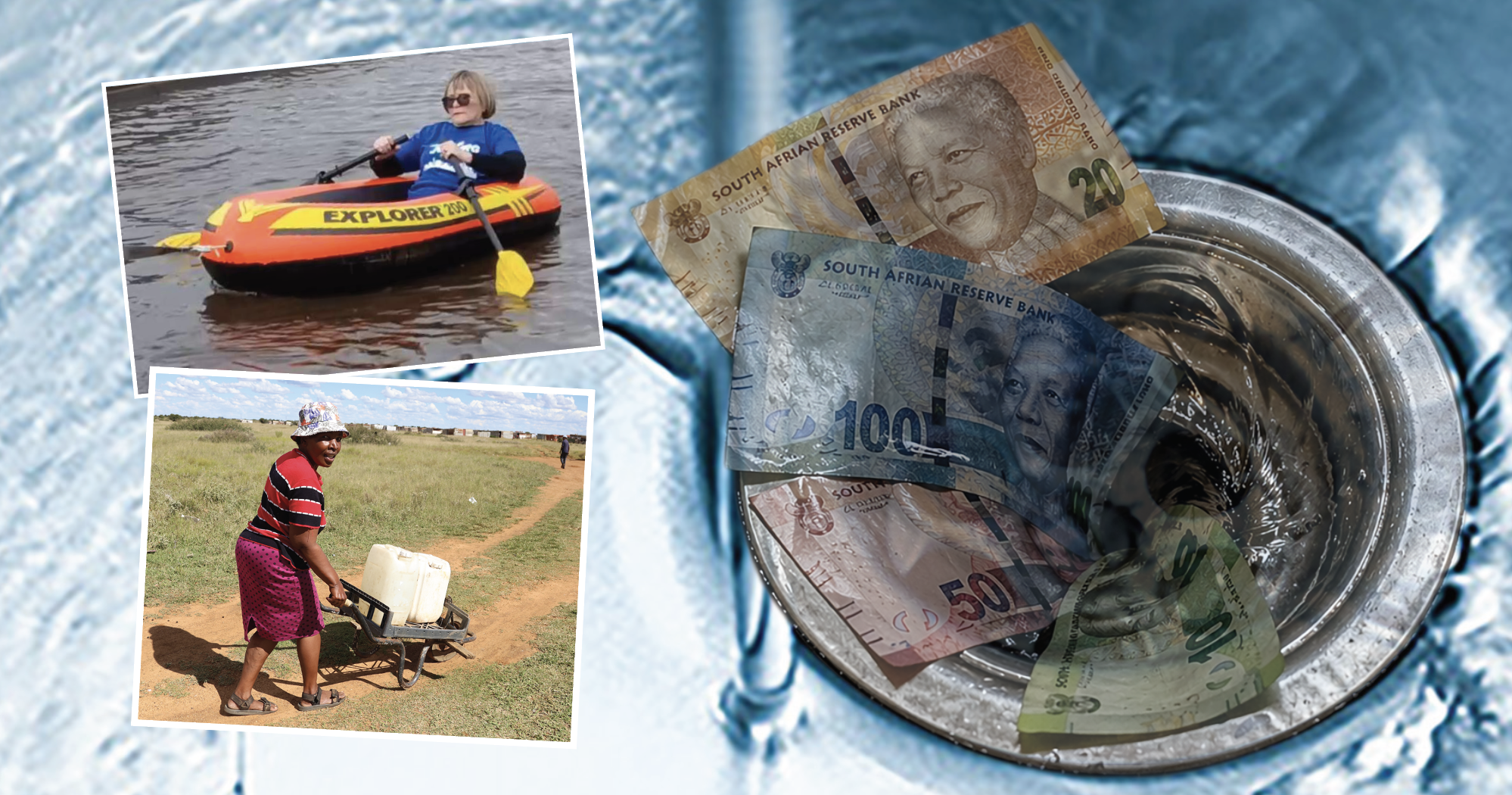
 Illustrative image: Sink. (Photo: iStock); Money down the drain. (Image: ChatGPT); Helen Zille. (Photo: Gallo Images); Woman with wheelbarrow. (Photo: Felix Dlangamandla); Design: Bogosi Monnakgotla
In every corner of South Africa (SA), people have become familiar with the nation’s deepening water crisis – from burst pipes, dwindling dams and reservoirs that just don’t seem able to keep up with demand to widespread contamination of the valuable natural resource. In many areas, going days on end without water has become the norm.
But the crisis has moved beyond a problem of scarcity caused by drought and unpredictable rainfall to one spurred by infrastructure and governance collapse – and it cost taxpayers R18.98-billion in the 2023/24 financial year alone.
This is according to Auditor-General Tsakani Maluleke’s latest report on SA’s entire water value chain, which details a severe water crisis characterised by decaying infrastructure, poor governance and a lack of accountability.
Biggest offenders in almost R19bn leak
Unsurprisingly, water losses to leaks, illegal connections and billing failures have cost taxpayers the most money. The latest Green Drop, Blue Drop and No Drop reports released in March by the Department of Water and Sanitation found that roughly 47% of SA’s treated water is lost before reaching customers, well above the international average of 30%. In rand amounts, the water losses added up to R14.89-billion in the 2023/24 financial year.
/file/attachments/2991/P4leratowatercrisis1_626240.jpg "Access to water in South Africa. (Map image: Wikimedia Commons; Graphic: Jocelyn Adamson)")
More than half the nation’s audited water service authorities have blown past the 30% “acceptable loss” threshold. Leading the charge is Gauteng, with water worth R6.9-billion lost, closely followed by KwaZulu-Natal (KZN) with R3.45-billion. Together, the two provinces accounted for R10.35-billion in losses, representing more than 70% of the national total. In KZN, 92% of its water authorities (12 out of 13) are failing to meet the basic 30% efficiency benchmark.
The anatomy of this collapse isn’t found in a lack of rain, but in a chronic lack of care. The Auditor-General’s report identified the “four horsemen” of municipal mismanagement that are causing these losses:
- Inadequate maintenance of ageing infrastructure;
- The complete absence of leak detection programmes;
- Broken meters that fail to track consumption; and
- A crippling shortage of qualified technical staff to steer the ship
‘Water tanker mafia’ crisis – billions flow through broken system
The South African Human Rights Commission warns that the country’s deepening water crisis is no longer just a constitutional failure; it is fuelling a shadow economy. At its centre are the so-called water tanker mafia, described by the commission as informal, exploitative networks thriving off communities left without a reliable supply.
What began as an emergency intervention – municipalities outsourcing water delivery to private tankers – has, in many areas, spiralled into a system vulnerable to corruption and abuse. Criminal syndicates are alleged to secure lucrative contracts through irregular procurement, sabotage infrastructure to prolong demand and, in some cases, charge residents for water that is meant to be supplied at no cost.
/file/attachments/2991/P4leratowatercrisis4_570115.jpg "The amount of money lost to water leaks, according to the Auditor-General’s report. (Graphic: Jocelyn Adamson)")
The scale of the problem is stark. In the 59 water service authorities, spending on tanker services has ballooned to R2.32-billion, with nearly R420-million flagged as irregular expenditure. Weak oversight and poor internal controls have allowed payments to be made without any proof that services were delivered.
In Limpopo, the Mogalakwena Local Municipality paid R11.36-million for tanker services in 2020/21 without evidence that the water was ever supplied, a scandal that ultimately led to the dismissal of a senior official. Meanwhile, in the Northern Cape, Sol Plaatje Local Municipality’s tanker bill doubled to R1.66-million in 2023/24, driven in part by the absence of a proper water services development plan.
Originally intended as a short-term fix, using water tanks has hardened into a costly, entrenched system, one that drains public funds and risks deepening the very crisis it was meant to alleviate.
Billions lost, irregularities deepen water crisis
The audit also revealed the staggering cost of mismanagement in SA’s water sector, with 55 material irregularities alone accounting for confirmed financial losses of R1.76-billion. These losses stem from systemic failures, including unbilled revenue, payments for undelivered services, poorly protected infrastructure and mounting penalties from late payments.
In total, 131 water-related material irregularities were identified between April 2019 and late 2024, yet only one in five had been resolved at the time of reporting – a sign of deep-rooted dysfunction and weak accountability across municipalities.
/file/attachments/2991/P4leratowatercrisis2_788546.jpg "Alternative sources when taps run dry.<br>(Photos: Sharon Seretlo / Gallo Images; Fani Mahuntsi / Gallo Images; Kevin Sutherland / Sunday Times / Gallo Images. Graphic: Jocelyn Adamson)")
(Photos: Sharon Seretlo / Gallo Images; Fani Mahuntsi / Gallo Images; Kevin Sutherland / Sunday Times / Gallo Images. Graphic: Jocelyn Adamson)
Beyond financial losses, the human and environmental toll is severe. At least 76 of these irregularities caused significant harm to communities, largely through the pollution of rivers and groundwater linked to mismanaged landfill sites and failing wastewater systems.
Among the worst cases, the City of Tshwane’s Rooiwal wastewater treatment plant has been operating beyond capacity for more than a decade, releasing effluent into the Apies River and Leeuwkop Dam.
In the Eastern Cape, repeated warnings about dam safety at Mthatha were ignored by the water trading entity, culminating in a near-total collapse of local water supply.
In eThekwini, untreated sewage from the Umbilo wastewater works flowed into the Umbilo River, with officials failing to act even after being alerted – prompting the matter’s referral to the Department of Water and Sanitation in April 2025.
Where municipalities failed to respond, the Auditor-General escalated interventions, taking remedial action in eMalahleni (Mpumalanga) and Ngwathe (Free State), initiating debt recovery processes in Ngaka Modiri Molema District Municipality (North West) and referring 51 cases to external authorities.
Given that 8.5 million people have no access to basic water services at all, and some communities face considerable challenges daily and must walk great distances just to get water, the almost R19-billion waste is inconceivable. The Auditor-General found that this poor quality of spending and weak revenue management drains essential capital that could otherwise be used to fix the crisis.
/file/attachments/2991/P4leratowatercrisis5_792859.jpg "Fetching water. (Photo: Fani Mahuntsi / Gallo Images)")
Politicisation of water crisis
With local government elections approaching, water is set to be a big deciding factor at the polls. Parties have already begun politicising the water crisis, particularly in Johannesburg, where the DA’s Helen Zille has hinged her mayoral campaign on the city’s water woes, using highly effective visual tactics like swimming in water-filled potholes, canoeing in flooded streets and joining protests across the city.
As the national water crisis deepens and the amount of money lost to it gets bigger, all eyes are on the newly minted National Water Crisis Committee. In his February State of the Nation Address (Sona), President Cyril Ramaphosa made a move that signalled the gravity of the country’s water shortages. He announced the establishment of the committee, a high-level body modelled directly on the National Energy Crisis Committee, which was tasked with ending load shedding and, by all accounts, succeeded.
The National Water Crisis Committee’s mandate is a three-pronged strategy designed to bypass the bureaucratic gridlock that has paralysed local government service delivery. The strategy includes:
Coordinated intervention: acting as a “single coordinating body”, the committee is empowered to deploy technical experts and resources from the national government directly into municipalities where systems have collapsed.
Legislative teeth: it is tasked with fast-tracking the Water Services Amendment Bill, which would allow the government to strip failing municipalities of their status as water service providers.
Infrastructure investment: the committee oversees the roll-out of the R54-billion performance-linked reform grant, ensuring that water revenue in metros is ring-fenced for repairs rather than being diverted to other municipal expenses.
The committee’s “commissioners” are a mix of political veterans: Ramaphosa (chairperson); Minister Pemmy Majodina (Water and Sanitation); Minister Khumbudzo Ntshavheni (Presidency); and Minister Velenkosini Hlabisa (Cooperative Governance and Traditional Affairs).
/file/attachments/2991/P4leratowatercrisis3_302665.jpg "Functionality of water supply – reliability at the tap. <br>(Photo: Sharon Seretlo / Gallo Images)")
(Photo: Sharon Seretlo / Gallo Images)
‘Missing’ plans and information requests
Despite the high-stakes launch, the committee is already facing a storm of scepticism about whether it will be successful. ActionSA and the MK party labelled the committee an “empty promise” and a reactive measure rather than a proactive solution. Other critics highlighted that this committee follows previous failed water task teams, including one led by Deputy President Paul Mashatile, raising doubts about its effectiveness.
During the Sona debate, Ntshavheni promised that a comprehensive water action plan would be finalised by mid-March. However, as April progresses, the plan remains incomplete.
On 2 April, the DA filed a Promotion of Access to Information Act request to the Presidency. The party’s spokesperson, Stephen Moore, alleged that parliamentary inquiries had revealed the committee had not even met by the time the plan was supposed to be finished. The DA’s legal move seeks to force the government to “play open cards”, demanding the release of the committee’s internal minutes, attendance registers and elusive action plan.
All eyes now turn to the scheduled 30 April meeting, where the committee must prove it has a plan that is more than just paper, but actual water in the pipes. DM
This story first appeared in our weekly DM168 newspaper, available countrywide for R35.
/file/attachments/2991/DM-24042026_276262.jpg)


Comments
Scroll down to load comments...