




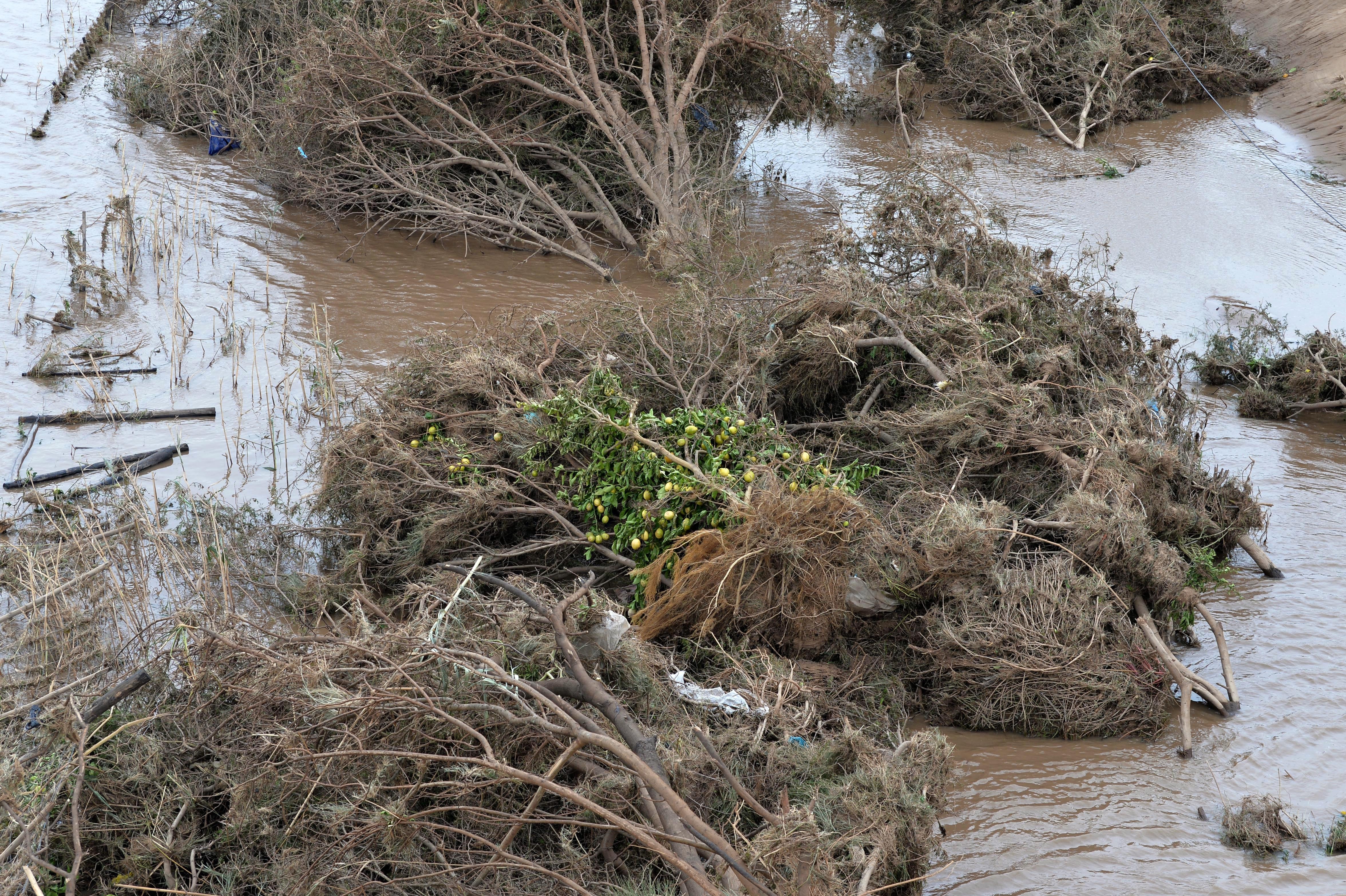
 One of countless lemon trees that were completely uprooted and swept downstream when floods hit Patensie, one of the Eastern Cape's citrus production hubs. (Photo: Deon Ferreira)
Driving along a dirt road that was still flooded only a few short days ago, Frederick Melville struggled to find the words to describe his feeling of helplessness.
All along the road the aftermath of last week’s flood – the worst in recent memory in the Gamtoos River Valley – was clearly visible.
Fields where pumpkins were ready to be picked a few days ago have been wiped clean. In their place a few tiny potatoes, which were planted on a completely different section of the farm further upstream, were strewn on the ground.
A few of his pumpkins were caught on the frame of a R1-million centre pivot used to irrigate the fields that were completely erased. Farm workers needed ladders to salvage the pumpkins on the metal structure, close to 1.5 metres off the ground.
/file/attachments/orphans/Riaan-PatensieFloodDamage13_574792.jpg "Farm worker Flippie Koeberg checking to see if pumpkins that were washed away by floods in Patensie can be salvaged. These pumpkins came downstream and were caught on a centre pivot used for irrigation. (Photo: Deon Ferreira)")
Next to the field a small pile of rubble is all that is left of the brick structure that housed the water pumps that fed the centre pivots.
“I lie awake at night trying to wrap my head around what I have lost, but my mind does not want to do that maths yet. Right now, it looks like I lost half of my harvest,” Melville said, his voice trailing off as he stared at the mud covered fields.
The harvest he refers to includes his citrus production, his main source of income that occupies the bulk of his farm.
When the Gamtoos River flooded its banks last Thursday (7 May) it created massive dongas that effectively cut his orchards in half. Some of the trees that survived being uprooted seem to be hanging in the air, their roots exposed as the ground beneath them was swept away.
/file/attachments/orphans/Riaan-PatensieFloodDamage16_239744.jpg "Citrus orchards in Patensie that were not complete washed away were buried in thick mud and sludge left behind by the floodwaters. (Photo: Deon Ferreira)")
Meanwhile, many of the trees that remain are buried in mud and sludge left behind as the flood subsided.
Large sections of his farm are covered by specialised netting to protect the trees and fruit from birds, insects and the elements – an expensive investment that pays dividends when picking season comes around. Unfortunately, much of this netting was also swept away.
On the side of his orchards the netting is still caked in mud, indicating that the floodwaters were close to three metres deep in places, completely submerging his citrus trees.
“Calculating the total damage and losses at this stage would be impossible. Most of the orchards are still waterlogged or covered in mud, making them inaccessible,” Melville said.
“The bulk of our income is derived from citrus, and we plant the other crops to keep our businesses afloat when it is not citrus season. Now that cash flow is dead, and much of the citrus that needed to be picked over the next couple of weeks is ruined.”
Melville explained that farmers in the region have been spending the past few weeks preparing for the citrus that needed to be picked now, but the current conditions have in effect ruined the harvest. Some fruit will probably rot on the trees, and that which can be picked will no longer be export grade.
“We will have to see what we can salvage and how we can keep the business running. And the worst part is, there are farmers in this valley that suffered far greater losses than I have,” Melville said.
On a neighbouring farm a large centre pivot stands in a field of what seems to be river reeds. However, upon closer inspection the short brown stalks proved to be maize that was cut short and washed up by the flood. Close to 30 hectares of maize, nearly ready for harvest, was destroyed in a matter of hours.
/file/attachments/orphans/Riaan-PatensieFloodDamage1_976937.jpg "Farms in Patensie suffered immeasurable damage after torrential rains and floods swept through their valley. In this picture, 30 hectares of maize was completely destroyed. (Photo: Deon Ferreira)")
While maize yields vary from one region to the next, a conservative estimate is that this field could have produced in the region of 240 tonnes of maize, which at current market value would have fetched close to R800,000.
Phillip Dempsey, the local representative for the Citrus Growers Association of Southern Africa, said it was still much too early for any loss estimates.
“We are working closely with the farmers’ association to tally the damage, but we will only have a better picture later in the week or next week. At this stage any estimated losses, or losses in export fruit, would be premature,” Dempsey said.
To illustrate the reach of the havoc caused by the flooding, beachgoers between the Gamtoos River mouth and Nelson Mandela Bay have reportedly found pumpkins in various places along the coastline, which in all likelihood originated from the Gamtoos River Valley.
/file/attachments/orphans/Riaan-PatensieFloodDamage15_199693.jpg "Farmers in Patensie have yet to calculate their losses as citrus orchards remain waterlogged and inaccessible following last week’s flooding. (Photo: Deon Ferreira)")
But while farmers counted crop losses, workers returned to homes many barely recognised.
The Miggels family, who work on farms in the region, are also counting their losses. When the initial flood warnings came last week they were among the first to be evacuated to a nearby church hall, and they were only able to return to their homes earlier this week.
“I wish we could rather have stayed at the shelter,” Koos Miggels said.
The mud in the basin in his bathroom was a clear indication of the water levels inside his home. A fridge has been moved from its normal spot, and on Tuesday, 12 May, drawers in the bedrooms still had water in them.
Clothes, bedding and mattresses were set outside in the sun to dry, and shoes were lined up on the veranda, caked in mud.
/file/attachments/orphans/Riaan-PatensieFloodDamage8_153211.jpg "Farm workers in the Patensie region were moved to shelters when floodwaters started threatening their homes. When they returned, they were met with devastation as many of their belongings were destroyed. (Photo: Deon Ferreira)")
“There were floods in 1971, and the house also had some water in it, but nothing like this time. Nothing could have prepared us for something like this,” Miggels said.
At the NG Church Gamtoosvallei, on the outskirts of town, more than 100 people, from 19 farm worker households, took shelter. While many of them have returned to assess the damage at their homes, dozens of children have stayed behind until their homes are ready for them to return.
On Tuesday, members of the church came to read them stories and brought them paper to draw on and pictures to colour in. In one corner of the church hall, a group of boys started a soccer match with a deflated ball.
“On Thursday, we were told to pack the essentials and be ready to move at a moment’s notice. When our bosses came and told us the dam was overflowing, the decision was made to leave our homes, because even if they did not flood, we would have been completely cut off from town,” said farm worker Mona de Bruyn.
/file/attachments/orphans/Riaan-PatensieFloodDamage12_865938.jpg "Farm workers’ children were forced to play inside as strong winds and more rain battered Patensie and the surrounding region. Farm workers took shelter at the NG Kerk Gamtoosvallei when floods threatened their homes. (Photo: Deon Ferreira)")
She said some homes were flooded up to their roofs, and many families lost most of their possessions. Many of them still spend the nights at the shelter where they receive a hot meal prepared by De Bruyn and some of the workers’ wives.
“We have been inundated with help and sponsorships from local farmers, shops and churches. Without them we would not have been able to survive here at the shelter,” De Bruyn said.
Beyond Patensie, the Kouga Municipality is slowly regaining its feet as it continues to tally the extent of the damage caused by the floods.
In a statement, the municipality said that while more than 300 people had been displaced, it was grateful that no loss of life had been reported, and thanked businesses and residents for assisting those in need.
“Kouga Local Municipality teams have been working around the clock, leading extensive mop-up operations, assessing damage and restoring critical services under extremely difficult conditions. Roads throughout the region have taken a severe beating, with potholes and wash-aways posing significant risks to motorists.
“At the same time, electricity teams have worked tirelessly – often through the night and in dangerous weather conditions – to restore power to affected communities. While many areas have already been reconnected, some communities supplied through the Eskom network remain without electricity due to inaccessible terrain and extensive infrastructure damage.”
/file/attachments/orphans/Riaan-PatensieFloodDamage14_887007.jpg "While the main structure of a bridge in Patensie remains intact, railings and barriers around the bridge were completely destroyed. This is just one example of the infrastructure around Patensie that was damaged by the floods. (Photo: Deon Ferreira)")
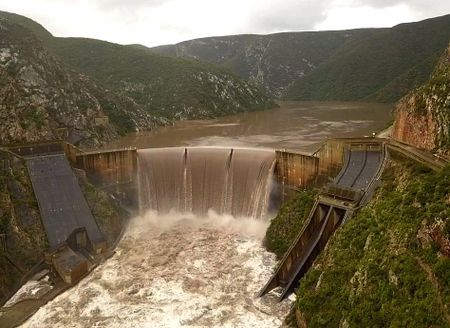
Gamtoos Water, which manages operations at the Kouga Dam, said on Tuesday that conditions at the dam had improved significantly. It was at 103% capacity and overflowing at 161,000 litres per second, much slower than last week’s 2.2-million litres per second, which contributed to the devastating flooding.
“Our main concerns at this stage are to contain broken pipes and to clear roads that will allow us better accessibility throughout the valley,” the company said in a statement.
As of the weekend, the Department of Cooperative Governance and Traditional Affairs has declared the flooding in several provinces across the country, including the Eastern Cape, a national disaster.
The declaration enables the national government to strengthen and coordinate disaster response and recovery efforts across affected provinces. DM
Comments
Scroll down to load comments...