




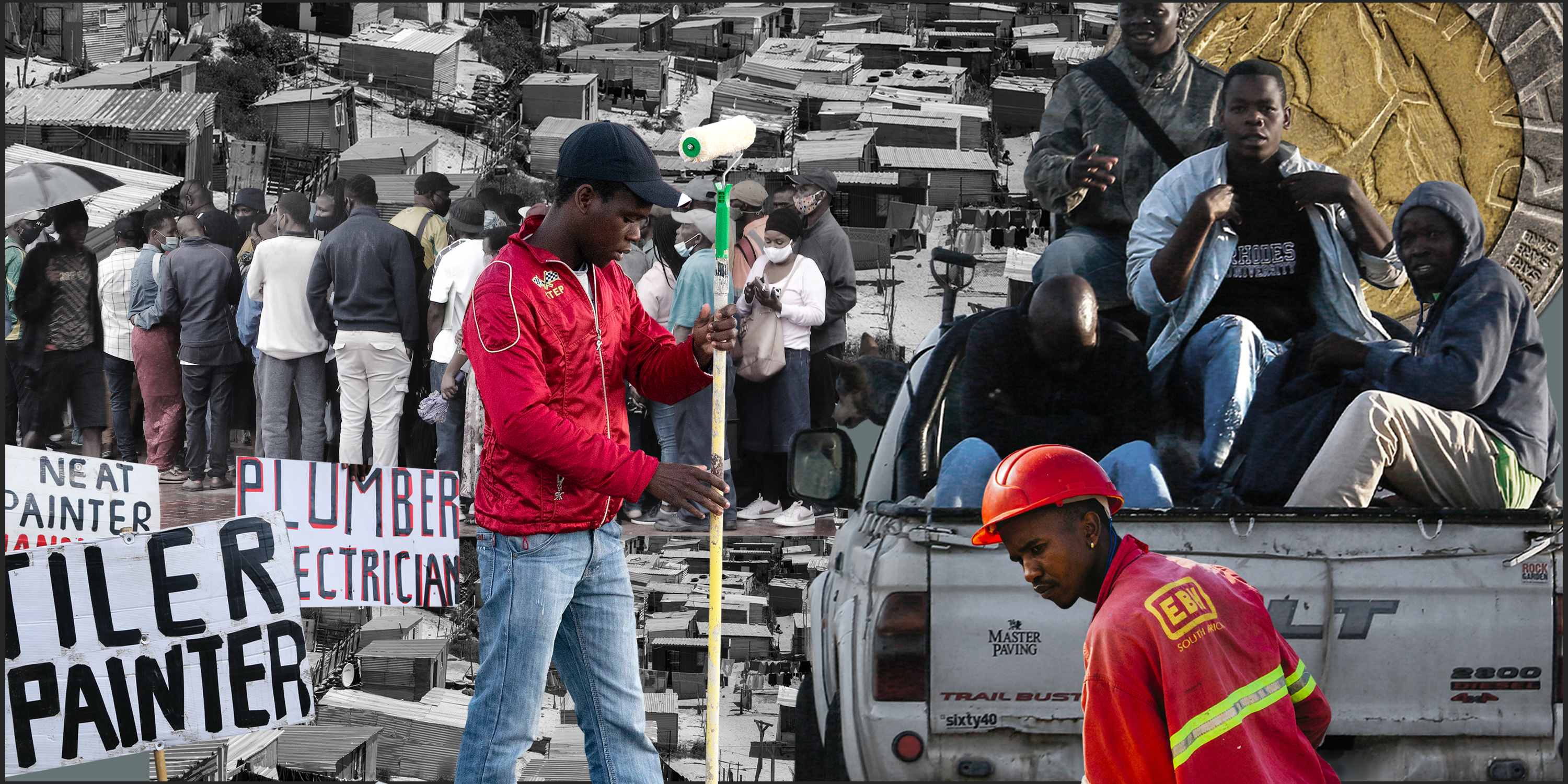
 Illustrative image: People seeking work stand near their signs: (Photo: Luba Lesolle / Gallo Images) | Informal workers on a bakkie: (Photo: Nic Bothma / EPA)
 /file/dailymaverick/wp-content/uploads/2025/10/label-analysis-2.jpg)
South Africa’s woeful unemployment situation is on a descent from terrible to Hell on Earth, a state of affairs that will exacerbate poverty and inequality and fan the flames of social unrest in a vicious cycle that will perpetuate this seemingly intractable challenge.
In the first quarter (Q1) of this year, the unemployment rate rose by 1.3 percentage points from the previous three-month period to 32.7% — a level that should be shocking but remains unsurprising, as the last time the number was below 30% was in Q2 of 2020.
An unemployment rate of over 30% is the “new normal” for South Africa, an insidious indicator that has defined this decade and Cyril Ramaphosa’s presidency. And it could yet surpass the record of 35.3% reached in Q4 2021.
The reasons for this are many, but they are never addressed with the required seriousness and urgency — a reflection ultimately of state failure.
South Africa, as my colleague Rebecca Davis recently reminded us, placed last among 57 countries in the 2021 Progress in International Reading Literacy Study. The failure of a state school system that still subjects young learners to the indignity of pit latrines goes a long way toward explaining the chronic “skills shortage” that many commentators rightfully bang on about.
Simply put, too few of the swelling ranks of new entrants into the labour market have the skills required to land a job. Pointedly, youth unemployment surged to 60.9%, an almost four percentage point increase.
Then there is the overall investment environment, which has been undermined by the accelerating failure of local governments — water, roads, power — and often ham-fisted policies at the national level, as well as the concerns regarding crime, corruption and insecurity and the costs these entail.
In the 12 quarters between the start of 2023 and the end of 2025, according to Stats SA data, gross fixed capital formation — a broad measure of investment — declined in seven of the 12 quarters and in seven of the last 10. It did grow marginally in the last two quarters of 2025, but from a very low base.
“This rise in the unemployment rate is symptomatic of an economy that has lost its dynamism,” George Glynos, the head of research at ETM Analytics, told Daily Maverick.
“Until we start to prioritise investing in the backbone of the economy, which is infrastructure, reform the government’s overreach into the economy, and focus on making it easier for the private sector to do business, the economy will stagnate, and employment growth will remain sub-trend.”
At least some of South Africa’s economic ailments were being addressed, notably inflation. But that spectre has been raised again by surging fuel and other prices in the wake of the Iran conflict unleashed by the US and Israel, with global and, by extension, South African economic growth also seen slowing as a result.
The SA Reserve Bank’s hard and often thankless efforts at making a 3% inflation target the “new norm” have now evaporated, and the growing consensus is that inflation will probably accelerate to 5% this year, which means higher interest rates are in the pipeline.
“Prior to the onset of the war in the Middle East, South Africa was on a more favourable growth path, supported in part by progress towards easing structural impediments,” Investec economist Lara Hodes said in a note on the data.
“However, the ongoing war has led to high levels of uncertainty globally, driving up transport and other input costs, weighing on confidence and, accordingly, businesses are likely to defer the hiring of new employees in the current uncertain climate.”
Higher inflation will hurt the jobless the most and also squeeze the budgets of households with people who have jobs and support several unemployed dependents.
Rise of the machines.
As if this were not depressing enough, there is a looming “jobalypse” driven by automation and digitisation — areas where South Africa is far behind the curve but needs to catch up if the economy is to remain globally competitive.
The global number of robotaxis is currently around 7,000, and Goldman Sachs projects this fleet will soar to six million by 2035 — a market it estimates will be worth $435-billion by then.
Meanwhile, the cost of autonomous trucking in the US is projected to drop below that of human-operated fleets by 2028, further accelerating the transition. And the Estonian technology company Starship Enterprises has surpassed 10 million deliveries of meals, groceries and industrial parts with its expanding fleet of small, automated robot vehicles.
On a related front, global humanoid robot installations reached 16,000 units in 2025, marking the “Genesis Year” for the sector’s commercialisation. This coming army of robots will do many of the tasks that domestic workers and those in manufacturing and other industries currently perform.
/file/attachments/2991/GettyImages-2272005790_404301.jpg "A humanoid robot runs at the start of the Beijing Humanoid Half Marathon on 19 April in Beijing, China. (Photo: Kevin Frayer / Getty Images)")
Oh, and then there is AI, which could yet pose a threat to journalists on this and other media publications.
This is not the stuff of sci-fi set in the distant future. It is here and now, and about to take off at an escalating trajectory.
This all means that even much faster rates of economic growth than the tepid 1.1% South Africa managed to eke out in 2025 will do little to create jobs — or at least many of the jobs that the unemployed currently do in this country.
The standard narrative in South Africa for decades has been that faster rates of economic growth are needed to reduce unemployment, poverty and inequality. But such an analysis now seems like a quaint prognosis from a distant past.
One thing that does seem certain is that significantly higher rates of unemployment — and the unrest this could unleash alongside the potentially violent backlash to the coming automation revolution — will worsen South Africa’s investment profile in a cycle of despair.
That need not be the future. But, with our current trajectory, it is a plausible and chilling scenario.
Returning to Tuesday's jobless data, it also showed that the expanded definition of unemployment rose to 43.7% from 42.1%. The “new normal” for the main unemployment rate could be at those levels, defining the next decade. DM