




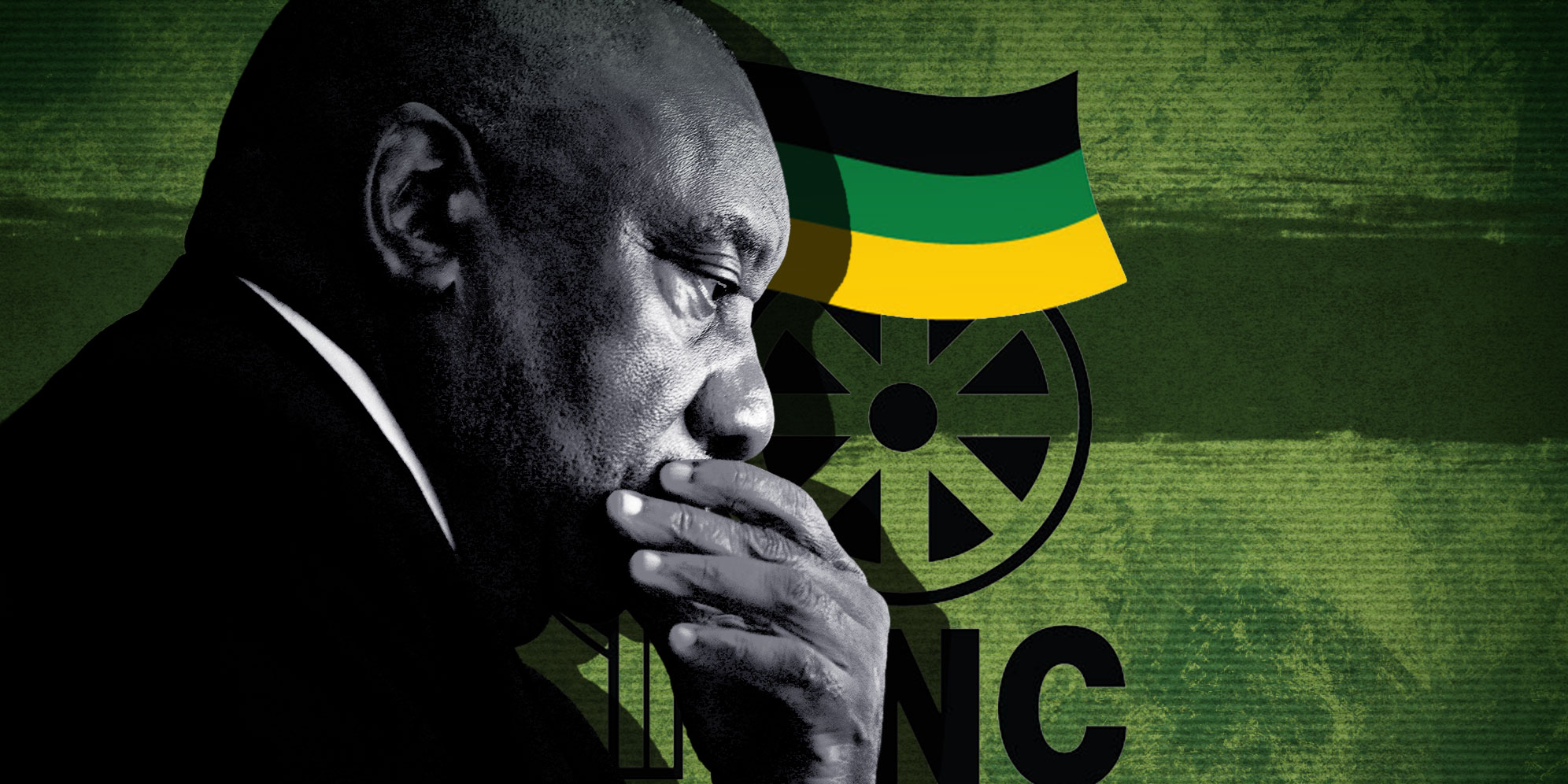
 Illustrative image: President Cyril Ramaphosa is banking on a legal challenge to the Section 89 independent panel report to avoid the public humiliation of an impeachment inquiry into his conduct in the Phala Phala saga. (Photo: Gallo Images / ER Lombard) | ANC Logo. (Image: Wikicommons) | (By Daniella Lee Ming Yesca)
 In essence, impeachment is the mechanism a nation’s legislature or another legally empowered body uses to bring charges against a public official for misconduct in order to remove that individual from office. In simple terms, think of impeachment effectively as an indictment or criminal charge and a conviction as the guilty verdict.
In practical terms, impeachments tend to be confined to high-level officials such as ministers, cabinet officials or heads of government. Lower-level officials usually lose their jobs (or should do so) through standard personnel or human resources channels.
Impeachment is used for senior officials because the unique nature of their positions may put them effectively beyond the reach of the law to prosecute, or if their misconduct is not codified into law as an offence, save as in charges of serious violations of the standards and expectations of their high office, or effectively criminal behaviour.
In the US, at the national level, impeachment is limited to charges of “treason, bribery, or other high crimes and misdemeanours,” although the latter half of that phrase does not have an explicit definition in the Constitution. Essentially, it is a “we’ll know it when we see it and we really don’t like it” approach. Other nations may employ more explicit terms of reference for impeachment charges.
Impeachment has been invoked numerous times around the world. One head count notes that between 1990 and 2020, there have been at least 272 impeachment charges brought against 132 heads of state in 63 countries.
/file/attachments/orphans/GettyImages-598124954_542633.jpg "President Dilma Rousseff delivers her farewell address in Alvorado Palace on 31 August 2016 in Brasilia, Brazil. Rousseff was impeached by the Senate and was permanently removed from office, replaced by Michel Temer. (Photo: Mario Tama / Getty Images)")
In Latin America, which includes almost 40% of the world’s presidential (as opposed to parliamentary) systems, 10 presidents from seven countries were removed from office by their national legislatures via an impeachment or a declaration of incapacity between 1978 and 2019. One of the most infamous of those was the removal from office of Brazilian President Dilma Rousseff in 2016.
In many democratic nations, impeachment processes involve an apex court in some way. The US is a notable exception in this regard, as the lower house of Congress is charged with voting on a bill of impeachment and then the upper house, the Senate, votes for or against removal from office. This second vote requires a super majority to succeed, given the gravity of the action.
Naturally, while national legislative and constitutional frameworks differ regarding the specifics of the consequences and definition of impeachment, the clear intent is the offender’s removal from office.
Usually, an official is considered to have been impeached after the commencement of the charges, but some version of an adversarial trial is generally required for a conviction and removal from office. In that sense, an impeachment should not be conflated with the actual conviction and removal from office.
Another distinction is between an impeachment and a vote of no confidence in a parliamentary system. In the latter, a parliamentary motion of censure and a vote of no confidence can be used to remove a government and its ministers from office. Following a vote of no confidence, the sitting prime minister resigns his or her office, and a new government is formed.
This differs from presidential governments, where chief executives serve fixed terms of office, regardless of having, or not having, a majority or governing coalition in their national legislature.
/file/attachments/orphans/GettyImages-463975927_644088.jpg "Andrew Johnson, 17th President of the United States. Johnson (1808-1875) was Abraham Lincoln’s vice president and succeeded Lincoln as president after his assassination. Radical Republicans in Congress made two attempts to have Johnson impeached, the second of which failed by only one vote in the Senate. (Photo: The Print Collector / Getty Images)")
Thus, impeachment and conviction ultimately become a political question beyond the power of judicial review. In US history, three presidents (Andrew Johnson, Bill Clinton, and Donald Trump – twice – have undergone impeachment votes, although none were convicted by the Senate. Richard Nixon resigned from office rather than face the near-guarantee of an impeachment conviction as a result of the Watergate scandal and its related crimes.)
/file/attachments/orphans/GettyImages-772144_542285.jpg "Former US President Richard Nixon delivers farewell remarks to his presidential cabinet and to members of the White House staff in the East Room of the White House upon his resignation from the presidency on 9 August 1974. Behind him stand his daughter, Patricia ‘Tricia’ Nixon Cox and her husband, Edward Ridley Finch Cox. (Photo: Dirck Halstead / Liaison)")
/file/attachments/orphans/GettyImages-1413323_373005.jpg "President Bill Clinton at a press conference on 16 January 2000 in Washington, DC. Clinton served two terms as US president, faced impeachment and was governor of Arkansas before being elected president in 1993. (Photo: Robert Giroux / Liaison)")
/file/attachments/orphans/13968501_280892.jpg "US President Donald Trump has twice faced impeachment. (Photo: EPA / Aaron Schwartz)")
The official website of the US Senate notes the specifics of impeachments, saying: “The United States Constitution provides that the House of Representatives ‘shall have the sole Power of Impeachment’ (Article I, section 2) and “the Senate shall have the sole Power to try all Impeachments … [but] no person shall be convicted without the Concurrence of two-thirds of the Members present”. (Article I, section 3)… “[T]his congressional power is a fundamental component of the system of ‘checks and balances”.
“In impeachment proceedings, the House of Representatives charges an official of the federal government by approving, by simple majority vote, articles of impeachment. After the House of Representatives sends its articles of impeachment to the Senate, the Senate sits as a High Court of Impeachment to consider evidence, hear witnesses, and vote to acquit or convict the impeached official. A committee of representatives, called ‘managers’, act as prosecutors before the Senate. In the case of presidential impeachment trials, the chief justice of the United States presides. The Constitution requires a two-thirds vote of the Senate to convict, and the penalty for an impeached official upon conviction is removal from office.”
The term “impeachment” ultimately derives from the Latin “impedīre,” to catch or ensnare by the foot. In the modern, western context, the idea of impeachment in the term was first used by the English parliament against Baron William Latimer in the 14th century. Building upon English precedents, the constitutions of Virginia (1776), Massachusetts (1780) and, subsequently, other states adopted an impeachment mechanism. Historians note other similar antecedents around the world, such as the “destooling” of an Ashanti ruler or the impeachment process of the Goryeo dynasty in Korea.
Given the fraught, stressed politics in so many nations these days (fill in the blanks yourselves), it seems we certainly will be reading much more about the possibilities of impeachments in the future — and perhaps convictions as well. DM
Comments
Scroll down to load comments...