




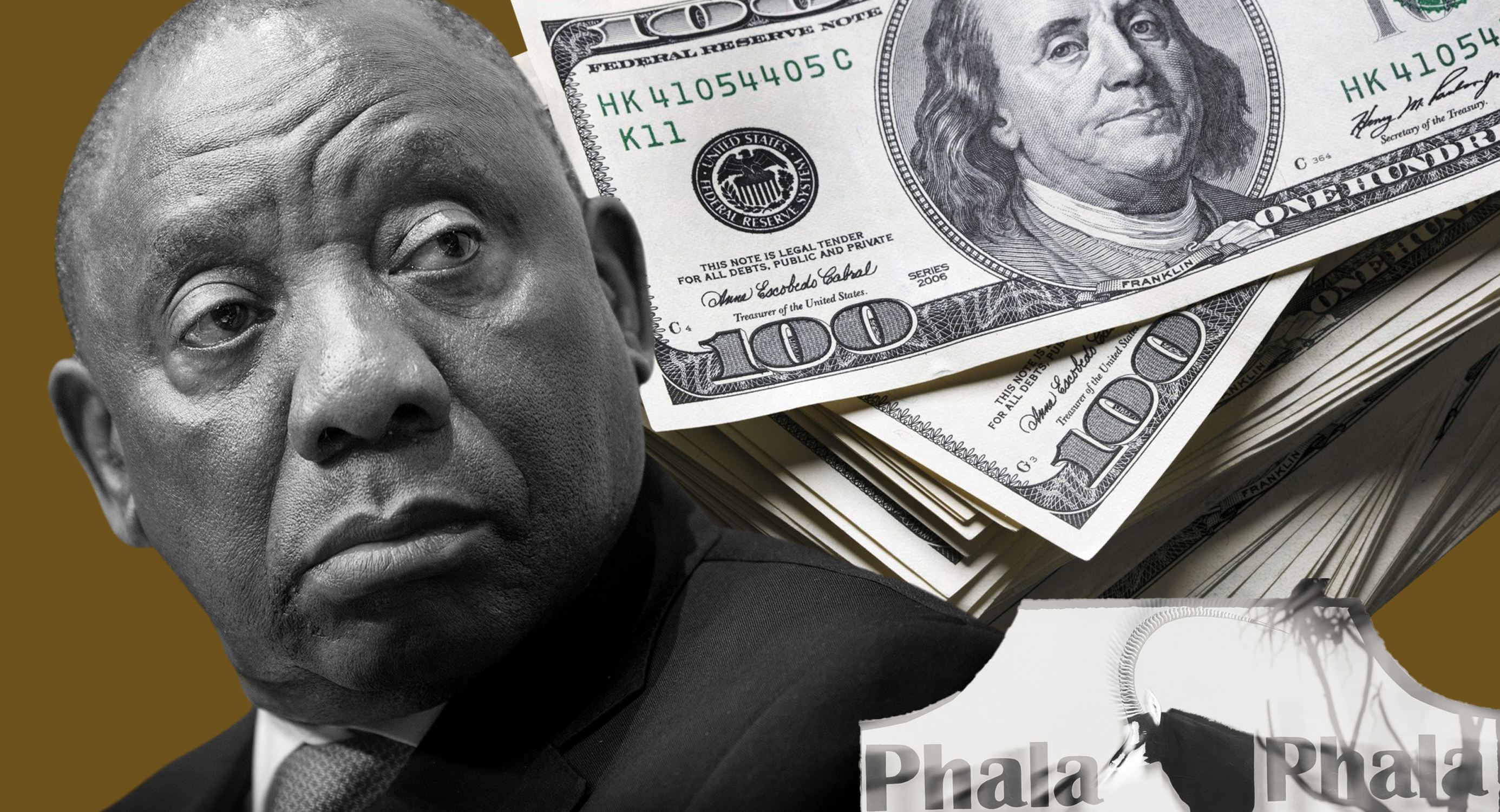
 Illustrative image, sources: President Cyril Ramaphosa. (Photo: Jaco Marais / Gallo Images) | US dollars. (Photo: iStock) | President Cyril Ramaphosa’s Phala Phala farm in Limpopo. (Photo: Leon Sadiki)
President Cyril Ramaphosa is banking on a legal challenge to the Section 89 independent panel report to avoid the public humiliation of an impeachment inquiry into his conduct in the Phala Phala saga.
Ramaphosa announced on Monday night, 11 May, that, following advice from his legal team, he would take the report of the panel chaired by former chief justice Sandile Ngcobo on judicial review.
The legal action could delay the President’s day of reckoning. While a review could take up to a year, the process could run in parallel with an impeachment committee sitting.
But a review could allow the ANC to cry sub judice and argue that questions about Ramaphosa’s conduct should be discussed only once the matter is concluded in court.
/file/attachments/orphans/ED_608020_793246.jpg "EFF members picket before the delivery of the Phala Phala judgment at the Constitutional Court in Johannesburg on 8 May 2026. (Photo: Gallo Images / Luba Lesolle)")
The Constitutional Court cleared the path on Friday, 8 May, for a public impeachment hearing into Ramaphosa’s conduct in the Phala Phala saga.
South Africa’s highest court found that Rule 129I of the Rules of the National Assembly was unconstitutional and set it aside. It also set aside the National Assembly (NA) vote in December 2022, in which it declined to refer the Section 89 independent panel report into Ramaphosa’s conduct over Phala Phala to an impeachment committee.
The panel’s report found that Ramaphosa had a case to answer over the theft of $580,000 in cash hidden in a sofa at his Phala Phala farm.
The Constitutional Court ordered that the report be referred to an impeachment committee.
Speaker outlines impeachment inquiry process
Before Ramaphosa’s announcement, National Assembly Speaker Thoko Didiza outlined six steps she would undertake after the Constitutional Court judgment:
1. In line with the revised reading of Rule 129I, Didiza will formally inform the NA of the Section 89 independent panel report by tabling it through the appropriate journals of Parliament.
2. She will provide Ramaphosa with a copy of the report.
3. She will begin the process of constituting an impeachment committee in terms of rules 129J to 129O of the NA Rules, to consider the report.
4. She will formally refer the report to the impeachment committee.
5. She will refer the Constitutional Court judgment to the NA subcommittee on the review of rules to consider and process the amendments required to the NA Rules pursuant to the findings and directions of the court. The subcommittee will report on its work to the rules committee, which will then submit its recommendations to the NA for consideration.
6. Finally, she will determine the “appropriate programme, procedural arrangements, timeframes and institutional support measures” needed for the impeachment committee to undertake and conclude its work effectively, fairly and within the framework of the Constitution and the NA Rules.
Ramaphosa previously approached the Constitutional Court in December 2022 for direct access to challenge the Section 89 report. However, the Constitutional Court dismissed his application to set aside the report, saying that he had not made a case for going directly to the apex court.
This review application was later abandoned by Ramaphosa’s legal team as a result of the National Assembly vote in which the report was rejected.
Now, Ramaphosa will seek to revive the matter in a lower court.
“The Constitutional Court judgment last week means that the report of the independent panel now has legal consequences, as it now stands to be placed before the impeachment committee,” Ramaphosa said on Monday night.
“As the court ruled, the independent panel’s recommendation to proceed with an impeachment inquiry must be implemented, unless and until the report is set aside on review.
“On the basis of advice from my legal team and as envisaged by the Constitutional Court when it said ‘unless and until the report is set aside on review’, I have therefore decided to proceed to take the independent panel’s report on review on an expeditious basis,” Ramaphosa said.
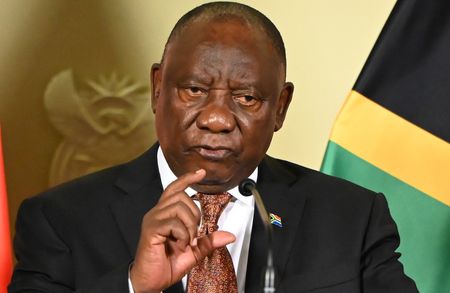
The President said he had taken this decision “not out of disrespect” to Parliament or its processes, but to affirm the need for such findings to be correct in law and in fact.
He added that he accepted and respected the Constitutional Court’s ruling.
‘A case to answer’
The 89-page independent panel report was handed over to then Speaker of the National Assembly Nosiviwe Mapisa-Nqakula on 30 November 2022.
The panel was unconvinced by Ramaphosa’s account of the theft of $580,000 from a couch in a room on his Phala Phala farm in February 2020, and did not accept his claims that the money had been the proceeds of a buffalo sale.
It found that Ramaphosa had a case to answer over serious violations of the Constitution for exposing himself to a conflict of interest, doing outside paid work and contravening the Prevention of Corrupt Activities Act.
/file/attachments/orphans/WhatsAppImage2026-02-19at173924_656301.jpeg "President Cyril Ramaphosa has announced that he will take the Section 89 Phala Phala report on review. (Photo: Phando Jikelo / RSA Parliament)")
The report found that the information placed before the panel, “discloses, prima facie, that the President may have committed” serious violations of the Constitution and the law and serious misconduct within the meaning of Section 89(1) of the Constitution.
It concluded:
“Viewed as a whole, the information presented to the panel, prima facie, establishes that:
- There was a deliberate intention not to investigate the commission of the crimes committed at Phala Phala openly.
- The misconduct based on violations of the provisions of section 96(2)(b) and the violation of section 34(1) of Precca were committed to keep the investigation a secret.
- The request to the Namibian Police to “handle the matter with discretion” confirms this intention.
- The President abused his position as Head of State to have the matter investigated and seeking [sic] the assistance of the Namibian President to apprehend a suspect.
- There was more foreign currency concealed in the sofa than the amount reflected in the acknowledgement of receipt. This raises the source of the additional currency.”
The President has denied any wrongdoing related to the Phala Phala saga and maintained that the report remains flawed.
“Since a criminal complaint was laid against me in June 2022, I have consistently maintained that I have not stolen public money, committed any crime nor violated my oath of office. From the beginning, I said that I would cooperate with all institutions that are mandated to deal with these types of matters.
“I have indeed cooperated with all investigations and inquiries into the matter. And I will continue to cooperate with all institutions that are mandated to deal with these matters,” Ramaphosa said on Monday.
‘Say-so’ information not enough
Ramaphosa filed his application to the Constitutional Court on 5 December 2022, to review and set aside the Section 89 report and to invalidate any impeachment inquiry that may result from it.
In his affidavit, Ramaphosa accused Ngcobo’s panel of basing its conclusions and recommendations on hearsay information given by former State Security Agency (SSA) head Arthur Fraser. Fraser’s criminal complaint against Ramaphosa in June 2022, in which he claimed Ramaphosa had concealed the theft at his farm, is what put the public spotlight on Phala Phala.
Ramaphosa argued that the panel failed in its mandate to test the “nature, reliability and probative value” of Fraser’s information, which ought to have been considered under the Law of Evidence Amendment Act.
“What actual evidence supports those conclusions? There is only Mr Fraser’s allegations and a redacted report of the Namibian Police Crime Intelligence.
“Mr Fraser’s allegations are just that: allegations, which are based on speculation, fiction and conjecture. They are not evidence. It is understandable why the panel ended up like this – it drew no distinction between evidence and information. Yet the rules of Parliament require it to focus on evidence,” Ramaphosa said in his affidavit.
“If anything, it is charitable to describe Mr Fraser’s allegations as hearsay,” he added.
“They are better characterised as conjecture and speculation, without a single fact to underpin them.”
The panel, Ramaphosa said, failed to test Fraser’s information for admissibility in two crucial respects: whether it had been lawfully obtained and whether it was all hearsay. There had been no explanation as to how a confidential Namibian report had found its way into Fraser’s hands or how he had obtained this, according to Ramaphosa.
Furthermore, he argued the panel had misunderstood its mandate in “at least two respects” in that it had interpreted “whether sufficient evidence exists” to mean “whether there is a prima facie case”.
Ramaphosa also said the panel had made prima facie findings against him beyond the charges that he was asked to respond to.
‘Treated with urgency’
Members of the ANC’s highest decision-making body will gather in Cape Town on Tuesday to discuss the Constitutional Court ruling.
The special meeting of the ANC National Executive Committee was called by secretary-general Fikile Mbalula on Monday, and members are expected to receive a briefing from top ANC officials, reported TimesLive.
This comes after senior ANC officials met with Didiza, ANC chief whip Mdumiseni Ntuli and advocate Thembeka Ngcukaitobi on Monday to consider the matter.
On Monday, DA leader Geordin Hill-Lewis said Parliament had to urgently obtain legal advice on the implications of Ramaphosa’s decision, including whether it affected the establishment and work of the impeachment committee, or whether the committee might continue its work while the review process was under way.
Hill-Lewis said the party would be guided by the Constitution.
/file/attachments/orphans/Sune-GeordinHill-Lewis2_267997.jpg "DA leader Geordin Hill-Lewis. (Photo: Gianluigi Guercia / AFP)")
“Given the serious constitutional consequences of this matter, and the massive public interest in it, Parliament must take the South African people into its confidence by sharing that legal advice once it receives it. This matter must be handled lawfully, transparently and with the constitutional seriousness it deserves.
“This remains an ANC-made crisis, rooted in serious unanswered questions about the President’s conduct and the ANC’s long record of shielding its own leaders from accountability,” he said.
Following its win in the Constitutional Court, the EFF intends to oppose Ramaphosa’s review application and will demand that the matter be “treated with urgency” on the court roll. The EFF and ATM have both said that Didiza must also act swiftly in convening the impeachment committee. DM
Additional reporting by Nonkululeko Njilo.
Comments
Scroll down to load comments...