




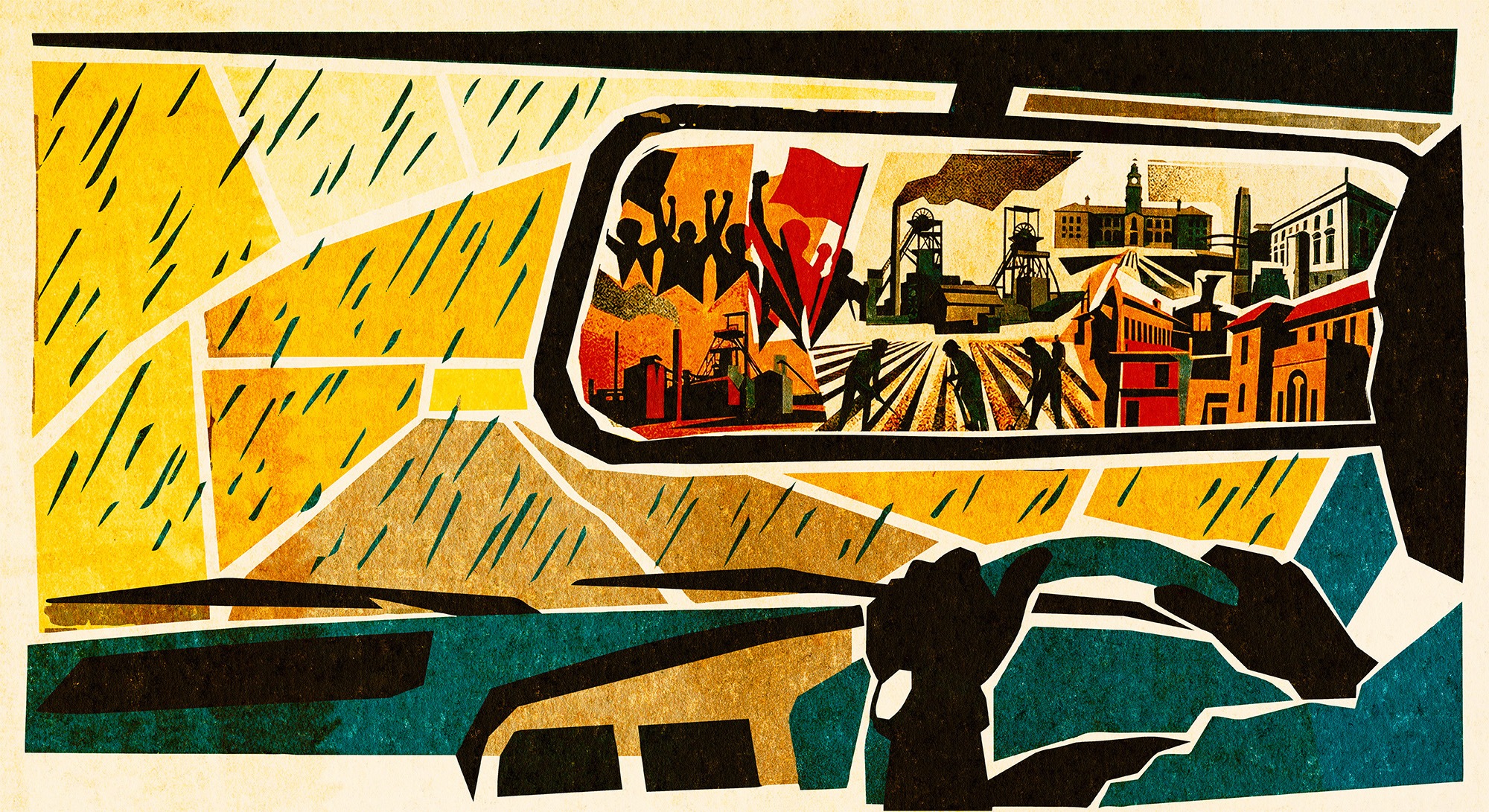
 (Illustrative image: Source generated with Google Gemini Flash Image 2.5.)
The Gauteng Scenarios 2035, a collaborative project between the Gauteng City-Region Observatory (GCRO) and the Mapungubwe Institute for Strategic Reflection, outlines optimistic and pessimistic development trajectories for local government, serving as a strategic framework to guide public policy for the Gauteng provincial government and the province’s 11 municipalities.
Titled “Finding our rhythm: Pathways and futures for the Gauteng City-Region”, the project outlines three potential scenarios for the province leading up to 2035. In a nod to South Africa’s cultural heritage, each scenario is named after a popular local song released before the country’s transition to democracy in 1994.
The scenarios
It’s About Time (Boom Shaka’s 1993 hit debut) describes a province that, although constrained by political instability, economic stagnation, socio-spatial disparities and unemployment, is also incrementally stabilising through modest governance improvements, infrastructural maintenance and policy coordination.
Homeless (a haunting 1986 collaboration between Paul Simon and Ladysmith Black Mambazo) is the most pessimistic of the three scenarios. It describes a province marked by party-political fragmentation, authoritarian populism, deepening disparities, institutional decay, weak coalition governance, centralised and corrupt power, a brain drain and little-to-no democratic accountability.
Paradise Road (an uplifting 1980 classic by Joy, an all-female black band) is the most optimistic scenario. It depicts a desirable future in which the province, although constrained by challenges, remains resilient and finally succeeds in building consensus around an inclusive, empowering, and coordinated developmental agenda.
Developmental goals
The project sought to adapt and refine the national Indlulamithi Scenarios 2035 to Gauteng’s distinctive economic, social and governance context as South Africa’s most unequal and most populous yet most industrialised region.
The scenario-building processes were developed in alignment with the National Development Plan 2030’s overarching strategic developmental goals — economic growth, poverty reduction, reducing inequality and lowering unemployment.
The scenarios are being launched in a watershed year for South Africa’s local governments. For one, the country’s seventh municipal elections are slated for November 2026. Notably, the upcoming municipal polls will take place against the backdrop of growing concerns about governance, progressively lower voter turnout and apathy, and dramatic declines in big parties’ electoral support.
Municipalities in the province face what the Gauteng Scenarios 2035 call a “fundamental dilemma”. For instance, while Gauteng’s youth unemployment currently stands at 46%, this figure rises sharply to over 60% in Emfuleni, a municipality seen as an embodiment of service delivery breakdown and rapid deindustrialisation, owing to governance collapse and Arcelor-Mittal’s closure of its steel operations.
Political instability
The scenarios also tackle a governance issue that is central to the province and municipalities within it during an election year — political instability as embodied by unstable governance coalitions.
As South Africa’s biggest political parties have been unable to secure outright majority wins at local polls since 2016, hung councils have become a staple of South Africa’s electoral politics, growing from 27 in 2016 to 66 in 2021. While coalition governments are not inherently “bad”, Gauteng’s case indicates that in the absence of laws governing coalitions, political opportunism and manoeuvring may arise and cripple municipal governance.
This is most evident in Gauteng’s three metropolitan municipalities — Johannesburg, Ekurhuleni and Tshwane. For instance, since the 2016 local polls, no mayor in Johannesburg has managed to complete their mayoral term, thanks in large part to multiple motions of no confidence. In Ekurhuleni, three mayors and two speakers have held office since the 2021 local government elections, with a recent mayoral committee reshuffle by the ANC-led coalition exacerbating the party-political turmoil within the metropolitan municipality.
The three scenarios offer insightful prospects for Gauteng municipalities beyond the 2026 local elections.
It’s About Time
The It’s About Time scenario projects a Gauteng that is declining, having gradually lost its importance. Its politics and governance are embodied by corrupt populist coalitions that strengthen extremist and anti-democratic political formations. The economy struggles as capital slowly migrates out owing to poor economic management. Water and electricity crises persist due to the unplanned maintenance shutdown of the Lesotho Highlands Water Project and the collapse of municipal electricity departments driven by moneyed residents and businesses opting to go off-grid.
However, this scenario has an ambiguous silver lining: a technology boom resulting from Gauteng’s elite compact that saw the roll-out of advanced internet access that bypasses local infrastructure, ushering in a new era of connectivity with highly skilled individuals participating in the digital economy. But the benefits accrue primarily to people already well advantaged.
Homeless
The Homeless scenario paints an especially bleak prospect for Gauteng. It is generally characterised by a collapsing and politically authoritarian province. The installation of a populist coalition has led to loyalists being installed into key positions, institutions hollowed out and public resources looted. Skilled human capital has left for greener pastures, while collapsing infrastructure and substantial unemployment have left the economy trapped in a vicious cycle. The overall climate has created the conditions for a “gangsters’ paradise” and the withering of civil society.
Paradise Road
Lyrics of the Paradise Road song invite people to “Come with me down Paradise Road/ This way please, I’ll carry your load/ This you must believe/ There are better days before us”. In this spirit, this scenario presents the pathway to a seamless and inclusive Gauteng. The dynamic and inclusive Gauteng economy vigorously promotes special economic zones focused on the digital economy and other rising sectors, responds effectively to the growing demand for critical minerals, and leverages its agglomeration of human and industrial capital. The province retains its dominance in business and financial services, preserving its number one position as the preferred headquarters of major corporations.
In this scenario, there are several other tenets that constitute the pathway to Paradise Road for local government in Gauteng.
Clean governance is good for the economy: Capable, ethical and developmental governance forms the bedrock for economic growth and infrastructure development. Civil society, helped by a revitalised and independent media, thrives.
Coalition governance that works: By 2035, South Africa’s political landscape has transformed from a dominant-party system to a fluid coalition-based system that is regulated by law and encompasses parties that cooperate on the basis of an agreed compact.
Infrastructure that works: Gauteng, by 2035, has made progress on spatial transformation, allowing cities to grow, ensuring an adequate supply of housing and integrating new urban developments into the province’s transport and commercial networks. Major infrastructure developments such as the Gautrain extension, high-speed interprovincial rail links and the Lesotho Highlands Water Project are either completed or in an advanced stage of development. Municipalities have honed their skills and ensured sufficient budgetary provision to enable effective maintenance of their infrastructure networks.
Healthy urban spaces: Municipalities are focused on building sustainable and resilient human settlements to withstand environmental, economic and social challenges, and have shifted to more compact, mixed-use developments that reduce urban sprawl and improve access to services and employment opportunities.
Addressing the climate crisis: As the effects of the climate crisis increase over time, local government responds in a manner that “climate-proofs” its infrastructure, protects human settlements from adverse climate conditions, and ensures all-around climate resilience.
Getting on top of crime: Local government plays a crucial role by developing its municipal safety strategy that includes data-driven evidence, safety through environmental design, and social crime prevention.
The scenarios will be launched at a webinar on Wednesday and have been published in a GCRO Occasional Paper titled Finding our Rhythm: Pathways and Futures for theGauteng City-Region. DM
Thembani Mkhize, Rashid Seedat and Shannon Whitaker work at the Gauteng City-Region Observatory (GCRO) as researcher, executive director and junior researcher, respectively.
Comments
Scroll down to load comments...