




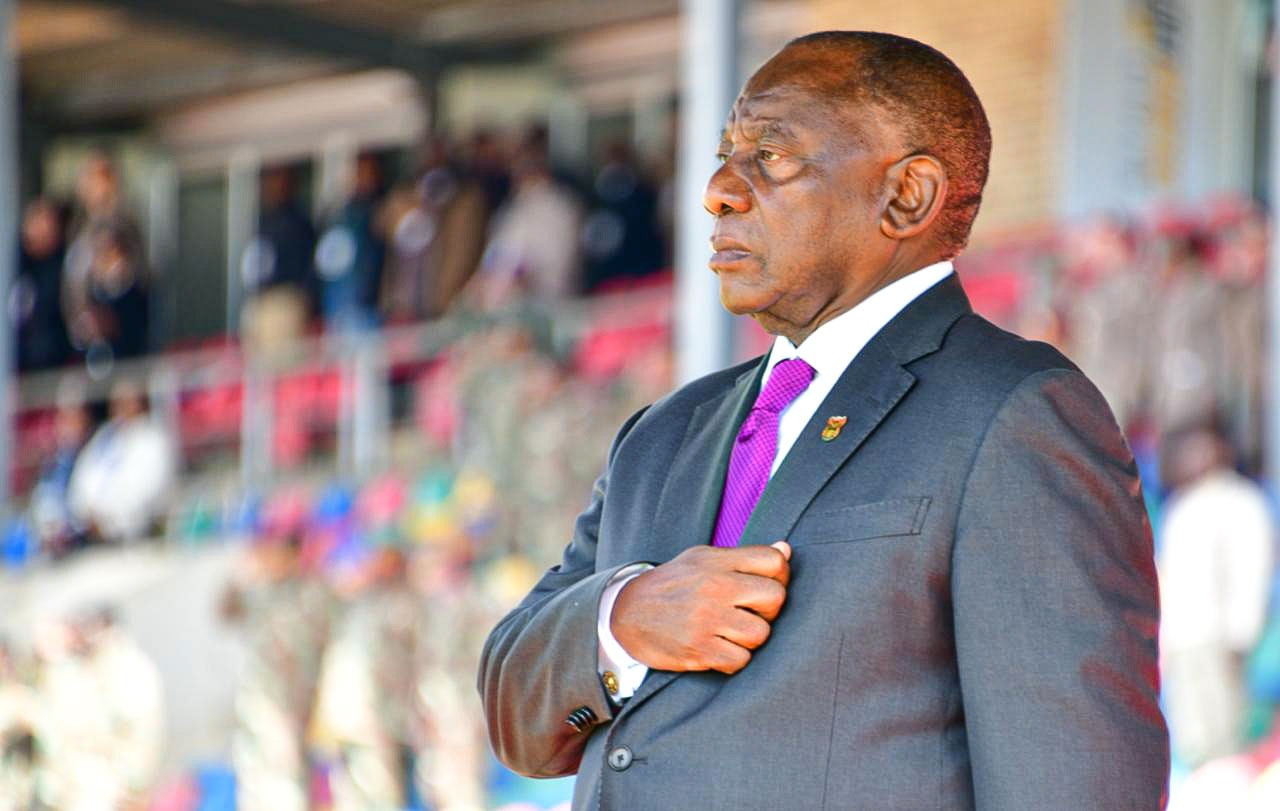
 President Cyril Ramaphosa, pictured at the 2026 Freedom Day commemoration, faces an uncertain future as Parliament is set to consider his impeachment. (Photo: GCIS)
Friday’s Constitutional Court ruling that Parliament had behaved unconstitutionally by not proceeding with an impeachment committee sets in train a process that will force MPs to consider the evidence against President Cyril Ramaphosa.
On the face of it, the evidence against him is strong.
As has been outlined several times in the past, it is obvious he has not been honest about where the US dollars stolen from his couch came from. Even his own version is nonsensical.
However, while the impeachment proceedings do have a legal aspect, the decision about whether to remove Ramaphosa is up to the National Assembly. It is a political decision.
The Constitution demands that two-thirds of the 400 MPs must support the motion. This means that it would require more than even the entire caucuses of the ANC and the DA.
Even if some ANC MPs voted against Ramaphosa (following the lead of Dr Nkosazana Dlamini Zuma, who voted for Parliament to continue with the report in 2022), it seems unlikely that he would lose such a vote.
It would instead require the ANC to turn wholesale against Ramaphosa for this to happen. But it is almost certainly not in the interests of the party for him to leave office now.
Read more: Will President Cyril Ramaphosa resign? Five questions we answer for you
Ramaphosa has been at all times central to the national coalition. If he were to leave office, whether voluntarily or through impeachment, it is not clear that the coalition would survive.
The DA’s messaging, sometimes more implicit than explicit, has made it clear that they are prepared to work with Ramaphosa but are much less keen on working with Deputy President Paul Mashatile.
This means that for the ANC, losing Ramaphosa also risks losing the coalition.
If the DA were to leave the coalition the ANC would probably have to work with MK and the EFF. While it is possible they could reach an agreement, many in the party would be uncomfortable working with parties whose leaders come from the ANC and have betrayed them.
Coalition negotiations with both parties could break down through a lack of trust, leading to calls for early elections. Were that to happen, the ANC would probably end up with less political power than it has now.
The party would also have to decide who would replace Ramaphosa. And there is no public indication that Mashatile has the support to take that position now.
/file/attachments/orphans/ED_426998_610165.jpg "If President Cyril Ramaphosa leaves office, he may be succeeded by Deputy President Paul Mashatile. (Photo: Gallo Images/Fani Mahuntsi)")
While the ANC could opt for a “caretaker president” as it did with Kgalema Motlanthe in 2008, that was when Jacob Zuma was dominant in the ANC, and had already been elected its leader. He was sure he could remove Motlanthe.
Mashatile is not in that position and would be wary that anyone who assumes the position may find the accommodation comfortable and decide to stay.
All of this may lead to the slightly strange situation where, while there is public pressure on Ramaphosa to leave office, in fact ANC leaders ask him to stay, and promise him protection in return.
However, it would also require more than the ANC to support him. Because while the Constitution does demand a two-thirds majority to impeach a president, scraping through such a process would leave him as a much-diminished figure.
DA’s hand
This might give the DA some significant power in this process.
In the minutes after the judgment, the party’s spokespeople said in television interviews that they would support the Constitution and the law.
This might indicate they would act against Ramaphosa. It would, after all, appear to be in their interests to weaken the ANC. And if the outcome is an early election, then they would stand to benefit (the fact that local elections are looming might well play a part in this; they would want to remind voters what they claim to stand for).
The risk for the DA now is the same as it was in the period immediately after the 2024 elections.
It has consistently told its voters it will do everything it can to prevent what it called a “doomsday coalition”, involving the EFF, MK and the ANC winning power.
It would not want its voters to hold it responsible for allowing that to happen. Especially in the months before a local election for which it has already deployed important resources.
The DA might also find it could extract a certain price for its support, perhaps demanding a crucial ministry from the ANC which it could use to justify its support for Ramaphosa to its members.
EFF, MK hypocrisy
In the hours immediately after the judgment, South Africa’s full range of political hypocrisy was on display.
EFF leader Julius Malema claimed Ramaphosa should resign immediately because he could not deal with impeachment proceedings and the duties of office at the same time.
Huh?
He was essentially arguing that Ramaphosa must resign from his job to keep his job.
He then claimed that because the findings of the three-person panel that made the findings against Ramaphosa had found evidence of wrongdoing, Ramaphosa was facing the equivalent of criminal charges. And thus he should step aside.
/file/attachments/2991/WhatsAppImage2026-05-08at112744_302463.jpeg "EFF leader Julius Malema addresses supporters after the Constitutional Court ordered Parliament to consider the impeachment process against President Cyril Ramaphosa in the Phala Phala scandal. (Photo: Reitumetse Pilane)")
Malema has been convicted of a criminal case for firing live ammunition above a crowd using an automatic weapon and is still an MP and leader of the EFF.
And he said ANC MPs should follow the example of Dlamini Zuma on this issue and vote their conscience. What has happened to EFF MPs who have spoken their minds in the past?
MK’s Nhlamulo Ndhlela told Newzroom Afrika that Ramaphosa was a “constitutional delinquent” who should resign because he had broken the law.
This from a party led by someone who himself refused to resign as president when the Constitutional Court ruled the Public Protector’s findings against him on Nkandla were binding. Who had to be sent to prison for refusing to obey the law.
And, the irony of a party using the phrase “constitutional delinquent” as an insult when it wants to do away with that self-same Constitution beggars belief.
There will be much more hypocrisy to come, including from the ANC that may well claim to be upholding the law while protecting its leader and his nonsensical explanation for Phala Phala, and from the DA which will say it’s protecting the Constitution and yet may find itself not voting to remove Ramaphosa.
MK and the EFF were hoping to use the emotions in the aftermath of the judgment to guide the national narrative – they’re hoping to build momentum against Ramaphosa, so as to weaken him and the ANC.
President’s prerogative
As that emotion wears off so the actors involved may seek to behave rationally and go back to what is in their interests. For the moment, those interests suggest Ramaphosa may be able to stay in office.
However, our politics is nothing if not unpredictable. He came incredibly close to resigning in 2022. He may decide enough is enough, that he no longer has the stomach for the fight.
Crucially, his power in the ANC seems stronger now than it did then. And, for him to end such a long and impressive career in public life under this kind of cloud, possibly ending the reforms he has started, might be very unattractive.
He may wish to, or need to, avoid a public process that could include him having to give evidence under oath. Or, as Mpumelelo Mkhabela pointed out on Friday night, protect people involved in the saga.
It should also be remembered how the emergence of the Phala Phala scandal was such a huge shock. Very few people had any idea that such a theft had occurred or that Ramaphosa was keeping large amounts of US dollars in a couch.
Were some other shock to occur now, that might spell the end of the road. Even the presence of some kind of secret might be enough to convince Ramaphosa to step down.
Just because it is not in the interests of most of the decision-makers and parties involved doesn’t mean that it can’t happen. DM
Comments
Scroll down to load comments...