




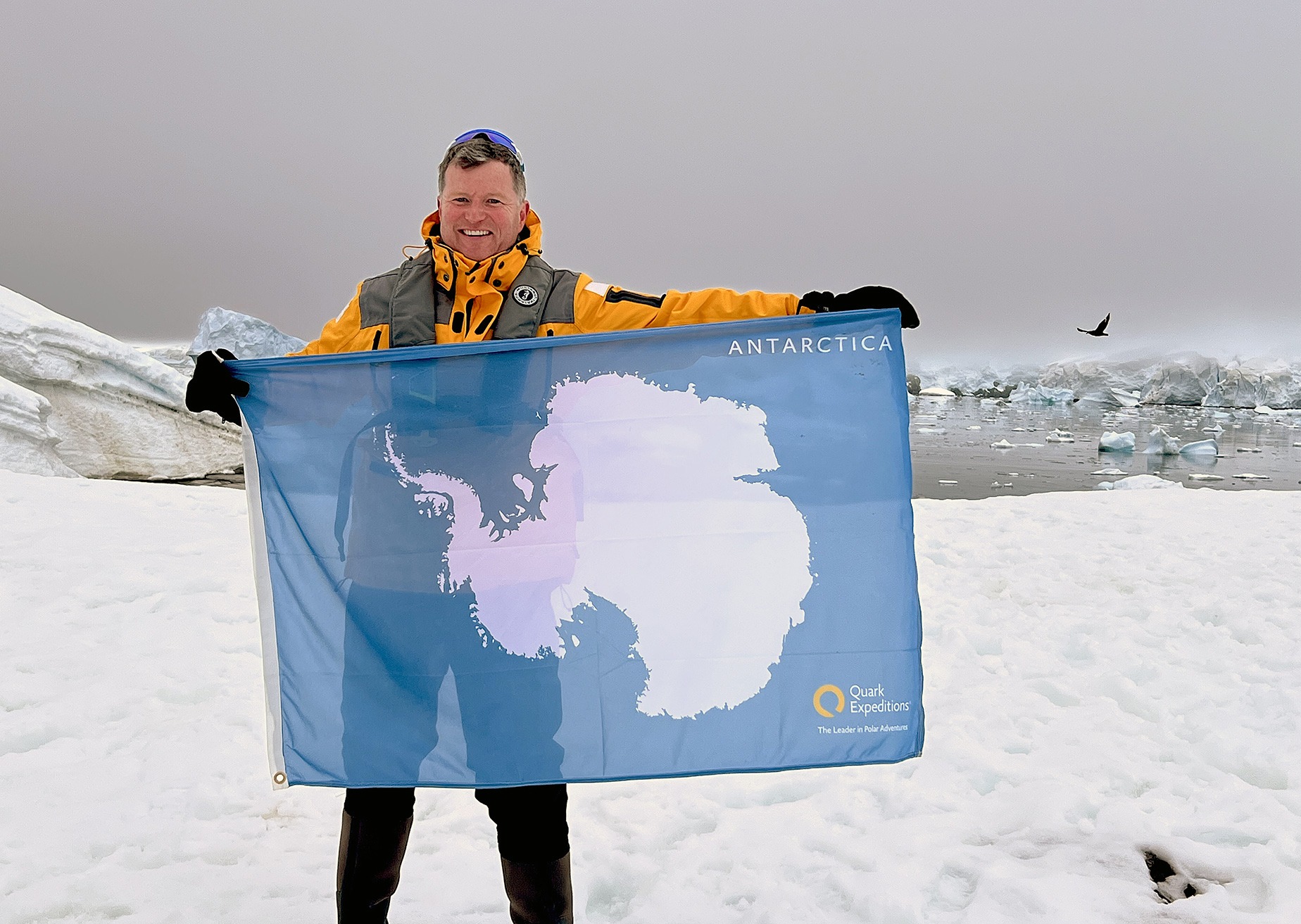
 Malcolm Byrne, holding a flag of Antarctica on the Peninsula, is the first Teachta Dála to successfully promote an Antarctic Treaty accession Bill through the first critical stage in the Irish Parliament. (Photo: Malcolm Byrne)
As Antarctic Treaty states prepare to gather in Hiroshima this week for what is likely to be a contentious annual summit, an Irish backbencher has taken on a quest in Shackletonian style: steering Dublin’s accession boat towards Antarctica’s closed diplomatic circle.
Remarkably, Sir Ernest Shackleton’s birth nation has still not traversed its own political waters to join the 1959 treaty, the benchmark polar pact with 29 consultative and 29 non-consultative states.
But after years of debate that has ebbed and flowed within domestic politics since the early 2000s, Malcolm Byrne in March became Ireland’s first Teachta Dála (TD) to push a treaty accession Bill through the initial stage in the lower house of Parliament. The Bill also seeks to accede to the Madrid Protocol, the treaty’s environmental constitution.
/file/attachments/orphans/LaunchingTheJamesCaird2_637918.jpg "The James Caird launches from the shores of Elephant Island in April 1916. (Photo: South, William Heinemann, London 1919 / Wikimedia Creative Commons.)")
An unlikely outsider, tempestuous times
Dublin’s boat, to put it delicately, faces headwinds.
In Hiroshima, the treaty’s delegates will have to face off with a burgeoning line of states knocking on their drawbridge with polite battering rams.
That’s because, since 2021, Belarus’s accession overtures have been vetoed by Ukraine. Chinese and Russian vetoes have held back the bridge since 2022, leaving Canada – a native polar state – stranded in accession limbo. There is little indication that Belarus and Canada are an inch closer in 2026 and now Türkiye is on the agenda to join the hopefuls’ queue.
And then there is the apparently indomitable Ice Curtain.
By most sane contemporary standards, anyone from Tokyo to Terra Nova Bay is legally allowed to watch the latest accession skirmish during Hiroshima’s 12 May “public” opening. With hours to go before the meeting, Daily Maverick has yet to receive a virtual link or even press accreditation from the foreign ministry, which we first emailed in August 2025.
And, on Marion Island in the remote Southern Ocean, South African researchers are forced to “load-shed” power because the US, the treaty architect, is waging a war in the Middle East that has plunged global fuel supplies into chaos.
A TD – an elected parliamentary member – from the centrist Fianna Fáil party, Byrne introduced a private members’ Bill to get Dublin a treaty seat. For now, it would be only an observer’s seat with no consultative (decision-making) powers. And the Bill’s multistage voyage launches just as treaty meetings appear to be tipping towards a veto-driven diplomatic culture increasingly at odds with Dublin’s democratic instincts.
Forged in the shadow of the Cold War, the treaty was born on an extraordinary premise: rival states could suspend territorial conflict to devote the entire Antarctic to peace and science. To do this, it has carved continental Antarctica into seven territorial pie slices eyed by seven states no one can legally own.
It is awkward, but it has kept the peace for some seven decades.
‘We’re not an imperialist nation’
And this is where Byrne is making the right noises.
Unlike Irish businessman Declan Ganley and his Rivada Networks space-telco firm, which has former Australian Prime Minister Tony Abbott on its board, Byrne says Dublin has zero territorial designs in the bottom 10% of Earth. When pressed, he is explicit: “We’re not an imperialist nation.”
Instead, Byrne frames potential Irish accession around multilateral scientific governance in a region of exceptional wilderness value. Antarctica, he stresses, should remain anchored in “peaceful purposes”.
/file/attachments/orphans/MalcolmByrneIrelandAntarctica_819852.jpeg "Irish parliamentarian Malcolm Byrne on the Antarctic Peninsula. (Photo: Malcolm Byrne.)")
“I’d love to see a partnership between Ireland and other member states to look at the impact of the polar caps on so many issues,” he says. “From those who are studying botany to marine biology to glaciology or even polar history, there’s a lot of scope for cooperation.”
In a multilateral system where China, the leading scientific nation, ranks among the lowest for press freedom in Reporters without Borders’ 2026 global index, that framing places Ireland in an unusual position.
While China scrapes in third last at 178th position, Ireland ranks seventh in the latest World Press Freedom Index. Though a small Netherlands-led reform coalition called for greater openness at the 2025 Antarctic Treaty consultative meeting, only nine of the treaty’s 29 decision-makers, including South Africa, rank among the press index’s top 21 positions.
Byrne points out that Ireland traditionally supports both confidentiality and transparency in intergovernmental systems, arguing that, “no different to any multilateral organisation, there are meetings done in closed session for a variety of obvious reasons”.
“But I think Ireland will always support press freedom … It certainly helps that the media are able to report on decision-making processes.”
An advocate for LGBTQ rights, the progressive gay politician also serves on the respective committees for AI, media and climate.
Why so late?
Asked why Ireland has never acceded to the treaty despite its storied polar history, the diplomat within Byrne notes: “I don’t think there’s ever been active opposition. But probably in the list of foreign and international policy priorities, it hasn’t really featured … It’s just a question of getting around to doing it.”
He alluded to experiencing something akin to an overview effect when visiting Antarctica after the Covid-19 pandemic.
Often attributed to Apollo astronaut Edgar Mitchell, the overview effect is the cognitive shift of seeing Earth from outer space; the “instant global consciousness” that leads to a “compulsion” to “do something about the state of the world”.
“It’s very hard to describe,” says Byrne, recalling kayaking alone off the Antarctic Peninsula when a fur seal dived from the shoreline and swam alongside the boat. “You read about things in books or you see things on screens, but there’s nothing like being there, being engulfed in just the sheer beauty of the place.”
/file/attachments/orphans/MalcolmByrneIrelandAntarcticaSelfie_391370.jpeg "While on the Antarctic Peninsula, Irish parliamentarian Malcolm Byrne captured his perspective-altering experience by snapping a selfie. (Photo: Malcolm Byrne.)")
As part of his submission during the Bill’s debate, he told Parliament:
“Antarctica is the most beautiful place you could ever visit and I would certainly encourage anyone who has the opportunity to do so to see it. It shapes your view of the world in a very different way. We should be providing similar opportunities to so many of our researchers.”
Oil beneath the ice: The fight over what may lie below
Byrne’s submission argued that the Bill “would also allow us, from Ireland’s perspective, to say very clearly in a formal sense that we believe the southern continent should only be used for peaceful purposes and should never be exploited, particularly when it comes to the risk of it being exploited for fossil fuels”.
In October 2021, Daily Maverick revealed that Russia’s state mineral explorer, Rosgeo, had not stopped searching the Southern Ocean for banned oil and gas via Cape Town since the mining prohibition entered into force in 1998.
The firm’s Antarctic chief, Pavel Lunev, previously told us the work is pure science and has since been promoted to head the entire Russian Antarctic Expedition. He sits on Moscow’s Antarctic Treaty System (ATS) delegations as an adviser.
Asked why he opposed “fossil fuel” mining in his submission, Byrne says his personal view is that “the potential impact it could have on the climate balance on this planet could be quite serious … If we are to look at Antarctica as a shared resource for humanity, the research should be scientific.”
Byrne’s endurance test
The imagery evoked by Byrne feels almost like a generational inversion of Ireland’s Antarctic inheritance.
On this day 110 years ago, Shackleton and his five-man rescue crew reached South Georgia. It would become one of the most celebrated survival journeys in polar history. They had crossed 1,300km of the storm-tossed Southern Ocean in the lifeboat James Caird.
/file/attachments/orphans/LandingSouthGeorgia_884954.jpg "A depiction of the James Caird landing at South Georgia at the end of its voyage on 10 May 1916. (Photo: South, William Heinemann, London 1919 / Wikimedia Creative Commons.)")
The Antarctica of a liberal Irish politician kayaking peacefully beside a wild seal may now be less imperial than Shackleton’s brutal Antarctica.
The new frontier is whether nations can conserve Earth’s most inviolate commons from the climate and geopolitical pressures reshaping life on the pale blue dot.
Small country. Small boat. Long odds. Difficult seas. Byrne’s Bill has passed stage one in the Dáil Éireann, the lower house. It needs to pass 10 more in a political endurance test that includes the Seanad Éireann, the upper house, before being signed into law.
Landfall was in reach, he told the lower house. “This is a relatively simple Bill and I would hope it could be moved reasonably quickly through these houses.”
Byrne also told Daily Maverick that advancing a private members’ Bill in Ireland may be “like starting to push a stone up a hill” – the fate of the Greek king Sisyphus.
Then he smiled. It is, as Nobel laureate Albert Camus noted in Le Mythe de Sisyphe, necessary for Sisyphus to be happy. DM


Comments
Scroll down to load comments...