




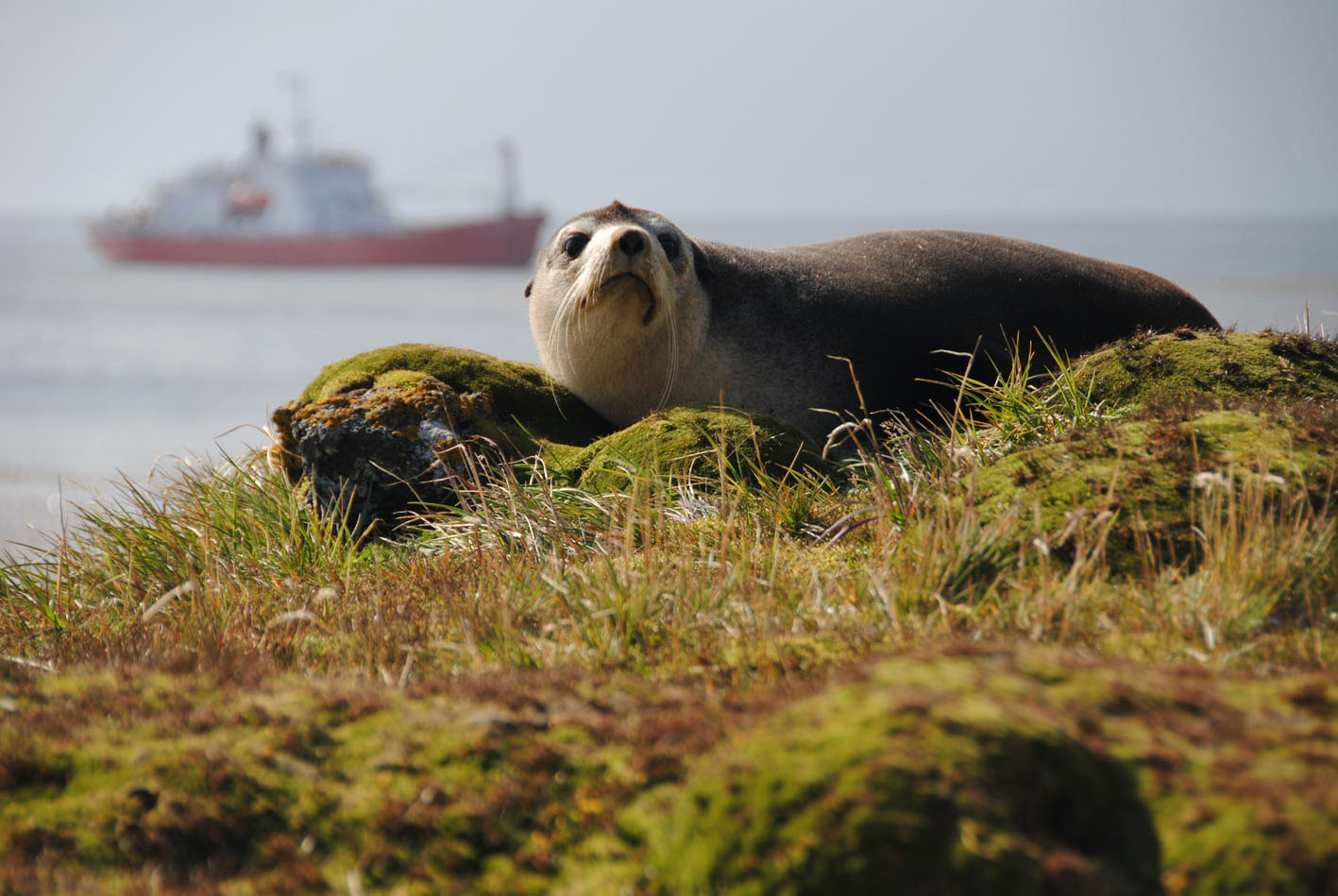
 A fur seal framed by the SA Agulhas I research and resupply vessel during the base’s grand official launch in March 2011. (Photo: Tiara Walters)
South Africa’s annual relief mission to the sub-Antarctic has become an illustration of how the US-Israel onslaught on Iran is rippling out to the remote Southern Ocean.
As Pretoria prepares to take its seat at the annual Antarctic Treaty meeting in Hiroshima, Japan, this week, the Department of Forestry, Fisheries and the Environment (DFFE) has confirmed that Middle East instability has now also disrupted the departure of the SA Agulhas II to Marion Island.
South Africa owns the island and its research station, where an annual team of scientists and technical crew spend about a year conducting climate change and other natural-science studies. The relief voyage, then, represents crucial supplies and a lifeline to return home.
Responding to Daily Maverick questions, the department attributed the setback “primarily” to “the global scarcity of fuel products linked to ongoing geopolitical developments in the Middle East”.
“Specialised” polar diesel, it said, was required for “extremely cold weather conditions”.
/file/dailymaverick/wp-content/uploads/2025/04/Marion-location.jpg "Marion Island’s remote location in the South Atlantic, halfway to Antarctica. (Source: Google Maps)")
The US and Israel have been at war with Iran since late February.
This has triggered the world’s biggest oil supply disruption since at least the 1970s energy crisis, which led to a heated 20-year debate on whether to open Antarctica to mining. A regional mining ban entered into force in 1998.
Daily Maverick understands the vessel was originally expected to depart at 2pm on 9 April, but the fuel shipment only arrived at a Cape Town refinery on 1 May. A “specialised blending process” and laboratory testing had to be fulfilled before refuelling the vessel.
The department said it had explored sourcing the product from other coastal refineries, including East London, Gqeberha and Durban but supplies were unavailable.
DFFE Minister Willie Aucamp said officials were “working closely with all relevant stakeholders to minimise the delay without compromising safety”.
“Every precaution,” Aucamp said, “is being taken to ensure our team returns safely.”
/file/dailymaverick/wp-content/uploads/2025/04/Marion-from-the-shore.jpeg "South Africa’s R200-million Marion Island research base during its March 2011 unveiling. (Photo: Tiara Walters)")
The SA Agulhas II is geopolitically unique as Africa’s only national polar research vessel.
It also serves as the logistical backbone of the country’s Antarctic and sub-Antarctic programme, transporting scientists, supplies, fuel and replacement crews to East Antarctica as well as Gough Island in the South Atlantic.
Maintaining uninterrupted access to these locations is therefore not only a scientific concern, but part of sustaining an African operational footprint in an ocean where island ownership is dominated by South American and Western sovereignty.
The department insisted there was “currently no immediate risk” to the overwintering team stationed on Marion Island.
Existing polar diesel reserves on the island were sufficient, it argued – but only until “approximately 20 May 2026 in the absence of fuel-saving measures”.
Food supplies were expected to remain adequate for “approximately another two months”.
Asked to address the status of communications devices, it conceded that reconfiguration of the station’s VSAT satellite connection was “taking longer than expected”.
“The VSAT line has always been in use at Marion although its bandwidth is low,” it said. “Once reinitialised due to the VSAT reconfiguration and creation of a speedier line, it will commence full operation.”
/file/attachments/orphans/Polardieselsnowstorm_957035.jpg "A polar diesel tank caught in a snowstorm during South Africa's 2009/10 annual summer resupply mission to SANAE IV, the country's East Antarctic station. The tank was temporarily detached by South African defence personnel during a fuel transportation train from the edge of the ice shelf. The tank was subsequently safely towed to the station. (Photo: Tiara Walters)")
Contingency systems were in place on the island, it added, including reserve fuel supplies, back-up petrol generators and several “stocked research huts”.
Still, in polar and sub-polar logistics, weather windows are narrow, and the Southern Ocean encompasses the most testing latitudes on the planet.
This war, then, is a cautionary tale for all countries with polar research programmes, especially the 29 consultative states meeting in Hiroshima this week. If anything, it has flushed out the extent to which volatility in global energy and shipping markets could expose highly specialised scientific operations in the southern frontier.
/file/dailymaverick/wp-content/uploads/2025/04/Researcher-with-penguins.jpeg "Seabird researcher Linda Clokie at a Marion Island king penguin colony, March 2011. (Photo: Tiara Walters)")
/file/dailymaverick/wp-content/uploads/2025/03/Yolokazi-Galada-and-wandering-albatross.jpg "Former Marion Island researcher Yolokazi Galada next to a wandering albatross in March 2011. (Photo: Tiara Walters)")
A “mainland” representative of an overwintering islander, speaking on condition of anonymity, told Daily Maverick that the station was already implementing power “loadshedding”.
A scientist, also speaking anonymously, said the delay threatened to upend long-planned research.
“The mixing and testing of the product is underway and fuel delivery to the vessel is expected to commence within two days of completion and laboratory confirmation that the polar diesel mix is correct,” the department said.
The annual relief voyage to the island typically takes roughly five days in favourable conditions. The department said on Saturday “delivery to the vessel will commence within the next two days and upon completion the vessel will depart immediately”.
If all goes to the very latest plan, the SA Agulhas II will likely only set sail by mid-week on what is now effectively a rescue mission. After braving the wintry, often storm-tossed Southern Ocean, it would make landfall at Marion – in the nick of time. DM


Comments
Scroll down to load comments...