



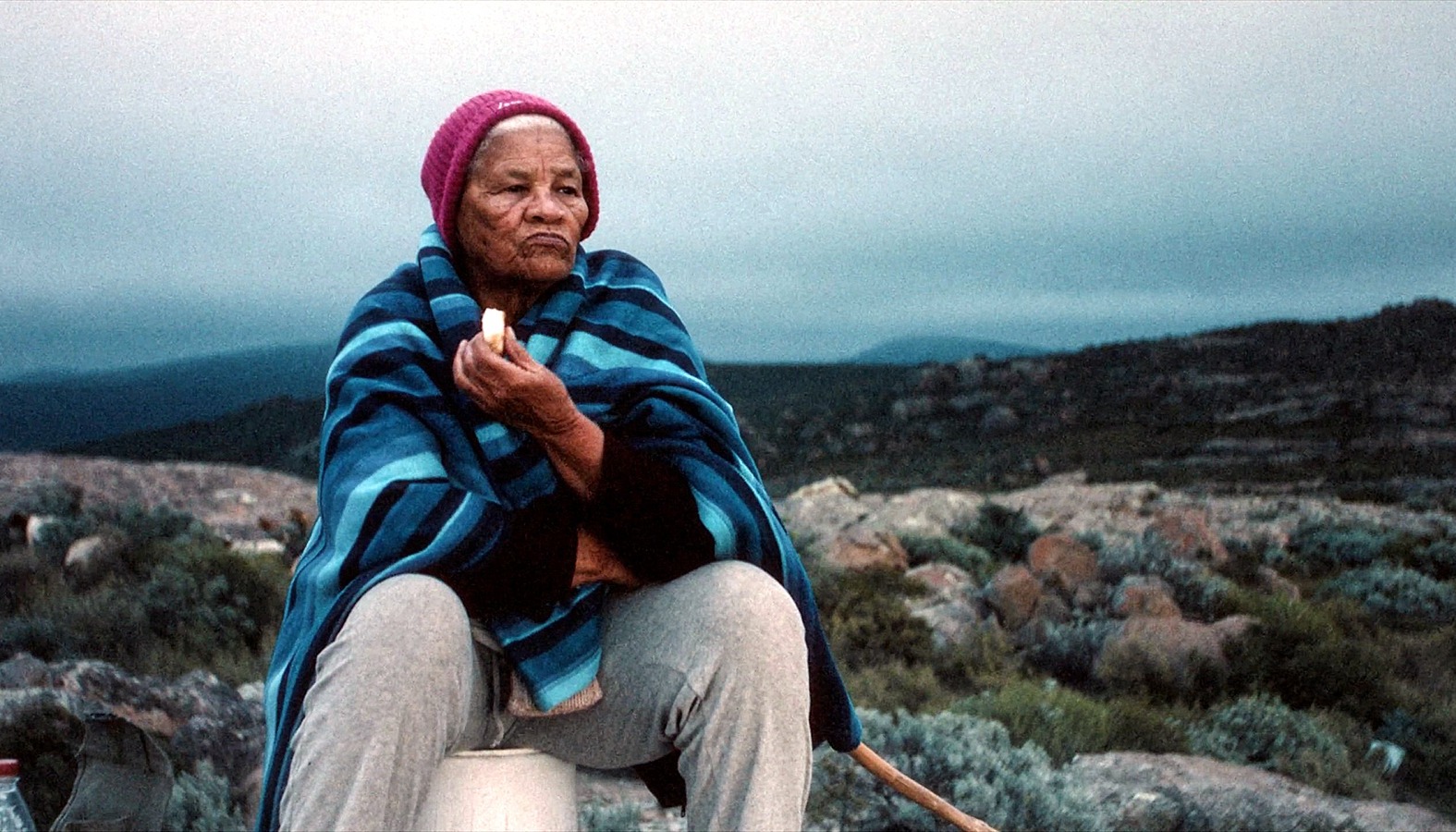
 Hettie Farmer as Hettie in Variations on a Theme. (Photo: KRAAL)
 Just about every frame of Variations on a Theme, a new South African film directed by Jason Jacobs and Devon Delmar and shot by Gray Kotzé, has potential as a standalone work of art.
Some frames perfectly express the melancholic beauty and wonder of the serene and slightly mystical, empty, undulating landscapes that surround Kharkams, the remote Northern Cape town in which the film is set.
Others capture, documentary-style, a way of life that is too rarely seen on cinema screens. The camera takes us into the kitchens, bedrooms and living rooms of the poor, the elderly, the marginalised, people whose rural existence renders them half-forgotten.
There are frames that are almost entirely black, the darkness broken only by a few flickering candles and hints of moonlight filtering in through an open window. Or scenes featuring huddles of villagers sat on their deeply shaded porches discussing the latest gossip or news.
The film mixes scenes that could pass for fly-on-the-wall footage of everyday life with a kind of magic realism. While there is a central storyline that grapples with the sociopolitical complexities of communities still suffering the consequences of historical exploitation, there are also fable-like mini-narratives that illuminate something powerful about the human spirit.
It’s a film that, with its languid pace, unassuming tone and occasional glimmers of sublime humour and magisterial poetry, takes you by surprise, steadily creeps under your skin and then shocks you with its devastating surrender to the mysteries of the universe.
Its disparate yet intricately intertwined moments provide insight into quite a collection of characters, their antics collectively painting a bittersweet portrait of life somewhere at the uneasy intersection of tradition and modernity.
It is very much a film about community, about people whose lives are intimately interwoven in ways that city folk don’t necessarily fully understand. And it is about a certain rhythm of life that is interrupted by various external forces.
The setting is a laid-back, economically left-behind community where, one suspects, little of note happens. For the most part, it’s fabulously, almost fantastically still, the kind of place young people leave as soon as they get the chance. Those left behind somehow survive.
It’s especially tranquil when the camera takes us away from the little village and into its even more rural surrounds, an expansive countryside defined by distant mountains and wide-open space, where the filmmakers have captured a haunted, melancholic atmosphere.
It’s here that the film’s silently contemplative central figure, an ancient lady named Hettie, tends to her goats.
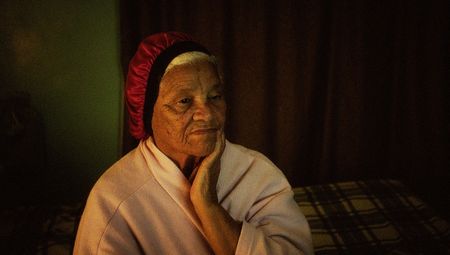
Each day, her routine follows a similar pattern: wake up, minister to her goats, go home, listen to the ceaseless chit-chat of a talkative neighbour (Hettie barely saying a word), cook, eat, wash dishes and watch nonsense on TV before turning in.
The film deliberately organises itself according to a similar routine structure, repeating itself visually over a number of days so that it’s the nuanced variations between scenes and within familiar frames that become part of the pleasure of watching. There’s a deep sense of time slowed down, the painterly stillness within the frames expressing something of the endless waiting that the characters must endure.
/file/attachments/orphans/Hettielistensinsilenceasherneighbourbendsherear_KRAAL_661614.jpg "Hettie listens in silence as her neighbour bends her ear. (Photo: KRAAL)")
This meditative quality asks the audience to pay attention and to really notice. In many scenes almost nothing actually happens. There are minutes-long static shots, for example, when all there is to see is a pair of donkeys, total charmers, staring resolutely at the camera, apparently wondering when the directors are going to call “action”.
But action is not what this film is about, it’s about inaction, about a form of systemic abuse that was meted out by a colonial regime decades ago and is being meted out to this day in the form of political inaction and now also by criminals who appear to have their hooks in the community at the heart of this film.
Discord has arrived in Hettie’s village in the form of announcements that the descendants of war veterans can claim compensation for their ancestors who fought for the British during World War 2.
To qualify for these long-overdue reparations, people like Hettie need only fill out a form – and submit a processing fee.
It’s essentially an analogue version of countless online scams.
And it’s not too dissimilar from the weird dream one of Hettie’s neighbours has, that if he digs a hole in his bedroom he will find buried treasure.
It’s in its lyrical unfolding that the film quietly compares the British regime, which 70 years ago undercompensated brown South African soldiers, with the criminal scammers who are taking Hettie and those like her for a ride. All that’s changed are the terms of abuse, and the means by which vulnerable people are targeted.
Things reach a kind of breaking point when Hettie’s quiet, uncomplicated life is interrupted by the arrival of her rather vast family, adult children and young grandchildren filling her house for a couple of days on the occasion of her 80th birthday. Suddenly her routine is disrupted and she has to cater and socialise and endure both the pleasures and irritations that accompany family gatherings.
/file/attachments/orphans/HettieandherdaughterinVariationsonaTheme_KRAAL_215362.jpeg "Hettie and her daughter in Variations on a Theme. (Photo: KRAAL)")
Not only does her family take over her home, but soon they decide that she is incapable to taking care of herself. She has begun to forget things, and there are concerns about her health. Some members of her family want her to leave her home and come and live with them.
But what, one wonders, will Hettie do without her goats, her silent moments spent in nature, her daily routine and her independence?
The hope lies in Hettie’s persistently stoic silence. Without saying a word, she kind of reminds us of her resilient spirit, hints that she’ll not be lulled nor bullied into giving up.
Unshakeable, too, is the sense of watching a film that deliberately muddies the line between reality and fiction. Cast from members of the community, with the role of Hettie played by co-director Jacobs’s own 80-year-old grandmother, Hettie Farmer, the film straddles an uncomfortable but curious intersection between telling a story and documenting life.
What’s more, the story is inspired by the fact that Jacobs’s great-grandfather fought for the Allies in World War 2.
“He was 19 when he signed up,” says Jacobs. “Like many others, he must have returned with his head full of nighttime terrors, of artillery fire and screams heard in dark and foreign lands, of bombs, falling planes and burning cities. His payment after four years of service? At the harbour in Cape Town, before heading home to his goats, he received a pair of boots and a bicycle.”
The film premiered earlier this year at the International Film Festival Rotterdam, where it was awarded the top prize. It won Best African Film at the Joburg Film Festival and last month was shown at the Hong Kong International Film Festival and at New Directors/New Films, a collaboration between The Museum of Modern Art and Film at Lincoln Centre in New York.
It was also screened for the community of Kharkams, where it was shot, during a three-day red-carpet event. DM
Variations on a Theme will screen at The Labia and Ster-Kinekor V&A Waterfront in Cape Town as well as at The Bioscope and Ster-Kinekor Rosebank Nouveau in Johannesburg. Screenings happen from 8 May for one week only.