




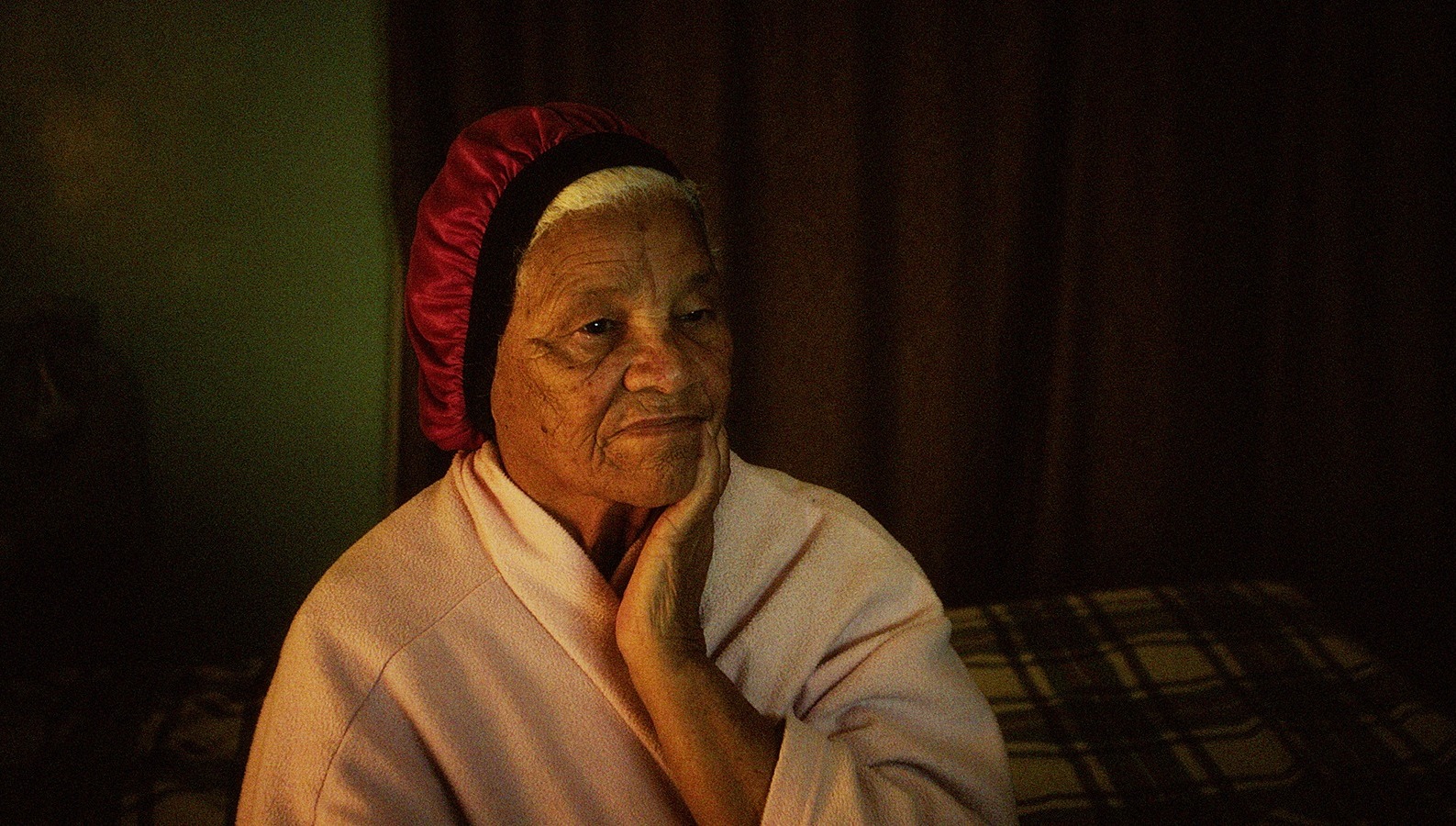
 Hettie Farmer as Ouma Hettie in Variations on a Theme. (Photo: KRAAL)
In 1941, a young man named Petrus Jakobus Beukes embarks on his first journey beyond his Northern Cape home town of Kharkams. At 19 years old, he, along with thousands of other young men, are sent to the battlefields of Europe, armed with no more than assegais — iron-tipped, wooden spears.
Upon his return, with the sounds of falling bombs and screams lingering in his mind, Petrus receives payment for his four years of service: a pair of leather boots and a bicycle.
Now, 79-year-old Ouma Hettie, a goat herder in Kharkams and descendent of Petrus, fills out a blue form from the “The War Veteran Descendants Relief Fund”.
For an administrative fee, this small South African community is promised long-awaited reparations for their ancestors’ service in World War 2. And yet, they wait and wait for a payment that will never arrive.
It’s these true events that set the scene for the film Variations on a Theme.
Having already earned critical acclaim – most notably winning the Tiger Award, the top prize at the 2026 International Film Festival Rotterdam – the co-directors and co-writers of Variations on a Theme, Jason Jacobs and Devon Delmar share the origins, intention and creative process behind their film in joint responses to Daily Maverick.
“When we learnt that elders were and are being scammed out of their Sassa grants (in most cases, this is their sole monthly income) through fraudulent application fees for alleged reparations, we knew this story had to be told,” they explain.
“We felt an urgent responsibility to raise awareness about this exploitation and to confront a colonial legacy of shame, guilt and erasure that continues to silence so many people in small communities.”
Variations on a Theme is built on the knowledge and experience of an eight-year collaboration between Jacobs and Delmar, who describe their creative partnership as “one of the great blessings” in their lives through which they “create works that transcend both of [their] realities”.
“Before we put any words down on a page, we first spend months and months talking, and we pretty much have the story and characters down in our heads,” they say about their developmental process.
“It’s in those early conversations where it feels the most magical and alive, where we like to transcend our socially dictated identities, the silos that history has plonked us in, and we feel that they don’t matter here.”
And yet, the duo are unafraid of creative differences, embracing them with the trust that those divergences might lead to alternative revelations.
“We’d be creating very boring things if we didn’t have creative differences here and there,” they observe. “But if such a difference arises, we take our time to unravel where that disparity arose, and if we have enough time to trace it back, we usually end up with a third solution that is better than the ones we would have arrived at on our own.”
/file/attachments/orphans/JasonJacobsandDevonDelmarco-writersandco-directorsofVariationsonaTheme_KRAAL_643871.jpg "Jason Jacobs and Devon Delmar, co-writers and co-directors of Variations on a Theme. (Photo: KRAAL)")
Being a fictional film based on lived experiences, Jacobs and Delmar approached the making of Variations on a Theme with the intention of honouring the real community in Kharkams on which the story is based.
The casting process was not centred on scouting for talent, but on “honouring legacy and lineage”.
With the cast being drawn from existing relationships – including Jacobs’s grandmother, Hettie Farmer, as Ouma Hettie – the co-directors were able to work with the community from a “baseline of trust”.
“Hettie being cast the lead was not a matter of convenience, but a creative necessity,” Jacobs and Delmar emphasise. “The film is born from our daily observations of her life, and it felt natural and very important to cast her as the lead actor in the film. It was a decision we as directors knew just made complete sense, especially because the story came from her obsession to be respected by our government in the form of reparations.”
In scripting Variations on a Theme, Jacobs and Delmar took a similar approach to their debut feature, Carissa, in that they built the narrative around the cast’s “existing routines and designed a way of working that allowed them to structurally improvise”, but “without losing the importance of what need[ed] to be said or performed”.
“At the end of the day,” the filmmakers tell Daily Maverick, “it remains the people’s story, and we are the ones who are only a bit more knowledgeable on how to craft it in a way that speaks to our artistic voice as a duo.”
/file/attachments/orphans/TheartistryofVariationsonaThemealsoexistsinitsvisuallanguagewhichcarriesthefilmsthemesonametalevel_KRAAL_106484.jpg "The artistry of Variations on a Theme also exists in its visual language, which carries the film’s themes on a meta level. (Photo: KRAAL)")
The artistry of Variations on a Theme is crafted not only in its narrative depth and intentionality, but also in its visual language and soundscape.
“There is something beautiful in the notion that the camera and musical language are not merely there to depict the goings-on of Kharkams, but that they carry the theme on a meta level,” Jacobs and Delmar note.
“The film unfolds according to a repeating visual structure inspired by the musical compositional form ‘Theme and Variations’, the most famous of which is Bach’s The Goldberg Variations.”
Working closely with cinematographer Gray Kotzé and composer Mikhaila Smith, the filmmakers were able to construct the central motifs that transition through five variations over the course of the film’s five story days.
The piano-driven score evokes this movement particularly through its change in keys and instrumentation.
“Over the course of the story, things shift and change within the frame. The frame remains constant, but the life inside each shot changes: gestures, conversations and small movements become the material of variation.”
A characteristic that especially captures this nature of the film stems from its fusion of realism with elements of magical realism.
A glass of milk slides across Ouma Hettie’s bedside table when she’s not looking. A chair pulls itself out from the kitchen table as if occupied by an invisible being.
“These variations accumulate new meaning and trace the rhythm of waiting time, as well as the subtle peaks and troughs that define Ouma’s days,” Jacobs and Delmar explain.
/file/attachments/orphans/VariationsonaThemefusesrealismwithmagicalrealismtoconjurehistorysghostlypresence_KRAAL_519403.jpg "Variations on a Theme fuses realism with magical realism to conjure history’s ghostly presence. (Photo: KRAAL)")
As much as Variations on a Theme is about the ghostly company of historical traumas on living descendants, it is also about the realities and vulnerabilities of ageing.
“We wanted to explore this friction between family desire to protect an elder and the elder’s right to maintain their autonomy and spiritual connection to their home,” the filmmakers say.
While measuring Ouma Hettie’s blood pressure, for instance, a nurse expresses her concern about Hettie living on her own: “You’ve already had one bad fall. You were lucky one of the children found you. But what if you were to fall out there in the veld? Who’s going to find you then?”
Later on, Ouma Hettie hears similar sentiments from her family who arrive to celebrate her 80th birthday and urge her to move to the city to live with them – a suggestion borne more out of duty than desire.
Jacobs and Delmar illustrate how their film interweaves these themes as a way of bringing the stories of people like Ouma Hettie, who rely on financial sources like government grants, to “national and international attention”.
“We observed that modern exploitation often targets the elderly’s historical memories and their sense of duty towards their ancestors. By focusing on Hettie’s age, the film highlights how predatory modernity (the scammers) invaded the old peace of her life. The film is about waiting, grief and loss, which are ingredients connected to the loss of independence.”
/file/attachments/orphans/OumaHettiesfamilycelebratesher80thbirthdayinVariationsonaTheme_KRAAL_435678.jpg "Ouma Hettie’s family celebrates her 80th birthday in Variations on a Theme. (Photo: KRAAL)")
There’s a scene in Variations on a Theme in which four older men reflect on the disparities between how their forefathers were compensated for their war service compared with their white counterparts.
“I heard that some of our people here from Kamiesberg area were paid for their service with a bicycle,” one of the men remarks. “Were they supposed to eat the bicycle?”
This conversation speaks to the overall significance of Jacobs and Delmar’s work.
“The film remains a social and political testimony about a community in a permanent state of waiting. We hope that South African audiences will recognise the weight of this waiting: waiting for reparations, justice and the acknowledgement of ancestral contributions (specifically the Coloured and indigenous soldiers of WW2).
“Justice delayed is not just a community issue but a spiritual burden that shapes many generations and their descendants. We wish to spark conversations about how modern exploitation preys on historical trauma and ask what happens with our most vulnerable who struggle to fight for their dreams, hopes and wishes in a democratic society they voted and fought for.”
Although this filmmaking duo didn’t go into the making of Variations on a Theme with the intention of creating a history lesson, they do recognise how crucial the subject of their work is in bringing to light this unrelenting haunting of the past.
In their words: “We need to speak about the past, confront it head-on and continue to deal with the reckoning regardless of how painful it may be.” DM
From 8 May Variations on a Theme will screen at The Labia and Ster-Kinekor V&A Waterfront in Cape Town as well as at The Bioscope and Ster-Kinekor Rosebank Nouveau in Johannesburg for a limited one-week run.
Comments
Scroll down to load comments...