



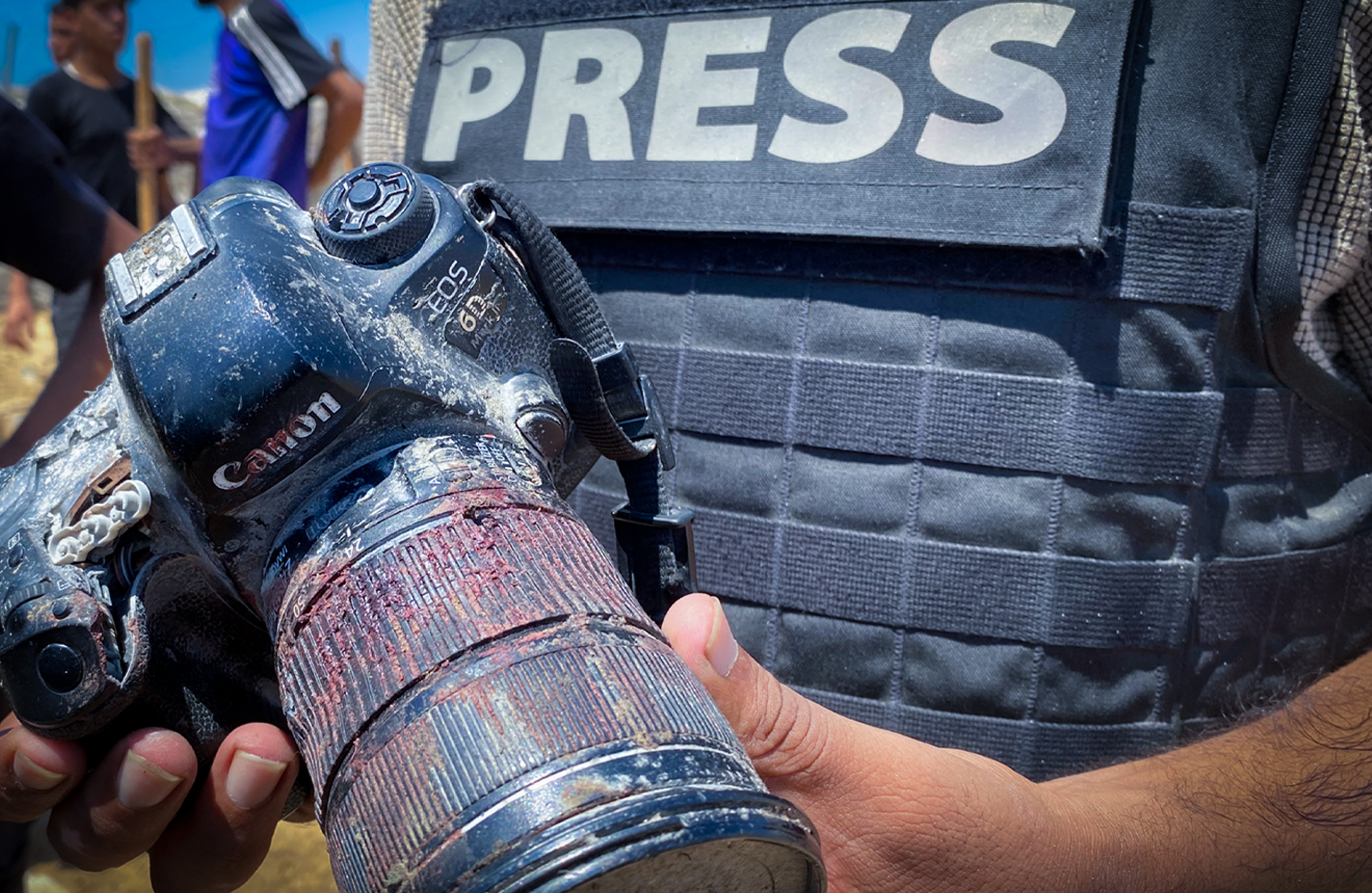
 A journalist holds the blood-covered camera belonging to Palestinian photojournalist Mariam Dagga during her funeral on 25 August 2025. Dagga freelanced for AP since the start of the Gaza war and was killed in an Israeli strike on Nasser hospital in Khan Younis in the southern Gaza Strip. (Photo: AFP)
The era of cold, purposeful apathy is upon us. Like the astronauts on Nasa’s Artemis II, we stare down at Earth detached, the umbilical cord cut from the planet below, rendered silent and small. Close, but no longer reachable. It feels as if we are imprisoned on an AI-created, neon-lit moonscape, aimless, sealed off from what is real.
Death has become wallpaper. The names of the dead are swallowed by the white noise we have collectively agreed to live inside: the scroll, the clip, the broadcast, the conference panel where someone explains, with great authority, what it all means. We have built a civilisation-sized machine for not feeling things, and it is working.
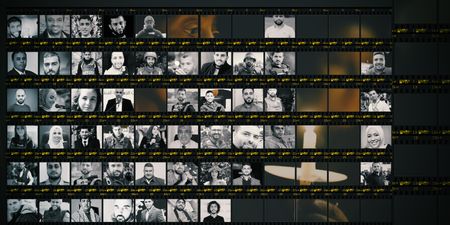
As of 28 April 2026, the Committee to Protect Journalists reported that at least 262 journalists and media workers have been killed in the Israel-Gaza war and related conflicts since 7 October 2023.
There is a word for this now: journacide. Not because journalists’ lives matter more than any others, they do not. But without reporters in war zones, the world goes dark. Not metaphorically dark. Actually dark: curtains drawn, lights off, no witness, no record, no reckoning.
On 22 April 2026, Amal Khalil, a 43-year-old Lebanese journalist reporting for Al-Akhbar, was killed in southern Lebanon by an Israeli drone strike in the village of al-Tiri. It was a double-tap strike: the second missile timed to kill those who came to help.
Khalil and her colleague Zeinab Faraj, a freelance photographer, were covering developments near al-Tiri when an initial Israeli drone strike hit a vehicle directly in front of them, killing two (yet again nameless) people. Amid the deadly attacks, the two women took shelter in a nearby three-storey house.
/file/attachments/2991/1013262318_242960.jpg "People gather during the protest Nijmegen for Palestine in solidarity with Palestinians in Gaza, at the train station in Nijmegen, The Netherlands, on 14 August 2025. Special attention was paid to Al Jazeera journalist Anas Al-Sharif, who was killed by the Israeli army, and his four colleagues. (Photo: EPA / Marcel Krijgsman)")
A subsequent Israeli air strike directly and deliberately targeted the house, causing it to partially collapse. Lebanese officials and the Committee to Protect Journalists (CPJ) reported that rescue teams were initially blocked from accessing the building for several hours by continued Israeli fire and a stun grenade directed at rescuers.
Faraj was rescued with serious injuries, while Amal Khalil remained trapped and was later found dead under the rubble. A double-tap attack is one that refers to a second strike on the same target, aiming at rescuers or those fleeing the first impact.
Reports indicate both women were clearly identifiable as journalists, with Faraj noting that Khalil was documenting the scene when the attack occurred. Khalil had previously stated she was the recipient of direct, personal death threats from an Israeli phone number in 2024, telling her to stop reporting in southern Lebanon.
The Israeli military denied targeting journalists, stating it struck vehicles “linked to Hezbollah” that posed an immediate threat. Amal Khalil was widely regarded as a voice of the south who continued to work on the frontlines throughout the escalation of conflict. Khalil was in the prime of her life, killed because she was doing her job. Her death, like all the deaths of other journalists, hardly made a blip on the world’s joint radar screens.
/file/attachments/2991/13869278_242897.jpg "Members of the Union of Journalists in Lebanon, along with activists, carry placards during a solidarity stand condemning the Israeli air strike that killed Hezbollah’s Al Manar TV correspondent Ali Shoeib, Beirut-based Al Mayadeen TV reporter Fatima Ftouni and her brother, video journalist Mohammed on 28 March 2026. (Photo: EPA / Wael Hamzeh)")
/file/attachments/2991/13869271_479509.jpg "Union of Journalists in Lebanon members at a solidarity stand at Martyrs’ Square in Beirut on 28 March 2026 condemning the Israeli air strike that killed TV correspondent Ali Shoeib, TV reporter Fatima Ftouni and her brother, video journalist Mohammed in a vehicle in the town of Jezzine in southern Lebanon. (Photo: EPA / Wael Hamzeh)")
She had covered the assassination of former Lebanese prime minister Rafik Hariri in a massive car bomb in Beirut in February 2005, which triggered the Cedar Revolution and Syrian troop withdrawal from Lebanon. Khalil also reported on the 34-day war between Israel and Hezbollah in July-August 2006, which caused widespread destruction across Lebanon, especially in the south and Beirut suburbs, killing more than 1,000 Lebanese (mostly civilians), displacing hundreds of thousands and severely damaging infrastructure.
She covered the implosion of the Lebanese economy and 15 years of slow political collapse. Born in 1983 in al-Baisariyah, Khalil never married or had children, choosing instead to devote herself entirely to bearing witness for the people of southern Lebanon. At home she planted fruit trees with her father and tenderly cared for stray cats, often favouring the weakest and sickest ones. Colleagues remembered her as someone who carried that same compassion into her journalism, even stopping mid-report to rescue injured animals from the rubble, and who believed, with an almost old-fashioned conviction, that the job was simply to be there: to see it and write it down.
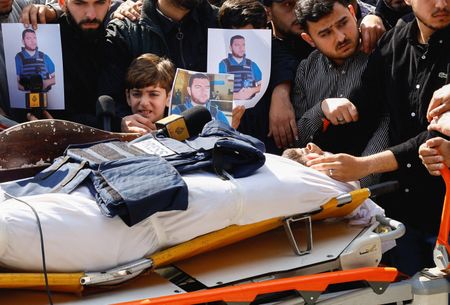
Alongside her was Faraj, a young freelance photographer and video journalist from the south. She had come to journalism from a family that had watched the village of al-Tiri change hands, be bombed, be rebuilt and be bombed again. Her images from the border had been picked up by wire agencies across the world. Neither woman had any military affiliation. Neither was protected by any country’s foreign ministry.
On Sunday, 3 May it was World Press Freedom Day and Reporters Without Borders released its annual World Press Freedom Index. The picture it painted was the bleakest in the index’s 25-year history.
For the first time, more than half the world’s countries are now classified as either “difficult” or “very serious” environments for journalism. The global average score for press freedom has never been lower since the index began in 2002.
Authoritarian regimes and, increasingly, democracies are reaching for national security laws, anti-terrorism legislation and abusive Slapp (Strategic Lawsuit Against Public Participation) lawsuits to restrict what journalists can say and publish. Only 1% of the world’s population now lives in a country with press freedom, down from 20% in 2002.
/file/attachments/2991/1013925772_225594.jpg "People carry the coffin of Lebanese journalist Amal Khalil during her funeral procession in the village of Baisariyah, southern Lebanon, on 23 April 2026. (Photo: EPA / Wael Hamzeh)")
Police surveillance of journalists and the use of counterterrorism powers at borders have raised alarm among press freedom groups. The US fell seven places, its decline accelerated by the return of a presidency that has censored government data, targeted critical outlets through lawsuits and regulatory pressure, and attempted to install loyalists in media leadership.
In London, Iranian-British journalist Pouria Zeraati, a TV presenter for the London-based Persian channel Iran International, was stabbed in the leg in March 2024. Taken together, the Reporters Without Borders index describes a world in which journalism is becoming structurally more dangerous across the board, not merely in active war zones, but in countries that regard themselves as models of democratic governance. Against that backdrop, what is happening in Gaza, the West Bank and Lebanon is the extreme end of a deteriorating continuum.
A vocabulary for something without precedent
The term that has attached itself to that extreme is journacide: a portmanteau of “journalist” and “genocide”, migrated rapidly from activist circles into the mainstream press. John Simpson, the BBC’s world affairs editor and one of the most experienced foreign correspondents alive, used it in an essay for The Nerve in April 2026.
Mehdi Hasan, Redi Tlhabi, Katy Katopodis and Christina Lamb have reached for the same word with increasing regularity. Its use signals that what is happening in Gaza, the West Bank and Lebanon is not incidental killing in the chaos of war, but the deliberate, systematic elimination of the people who report from the heart of death.
The numbers demand that argument be taken seriously. The Committee to Protect Journalists, a New York-based organisation that has tracked journalist casualties since 1992, says that between 250 and 274 journalists and media workers have been killed since 7 October 2023.
Of those, more than 205 were Palestinian journalists and media workers killed in Gaza. At least six Lebanese journalists died (thus far) in the conflict in Lebanon. Four journalists were killed in the West Bank.
/file/attachments/2991/1013254542_997243.jpg "Palestinians attend the funeral of journalists killed in an Israeli strike, outside Al-Shifa Hospital in Gaza City, on 11 August 2025. At least seven people, including five Al Jazeera media team members Anas Al-Sharif, Mohammed Qreiqeh, Ibrahim Zaher, Moamen Aliwa and Mohammed Noufal, were killed in an Israeli strike on their tent outside the hospital on 10 August 2025. (Photo: EPA / Mohammed Saber)")
/file/attachments/2991/1013254423_138952.jpg "Palestinians inspect the destroyed tent of the Al Jazeera team following an Israeli strike, outside the Al-Shifa Hospital in Gaza City on 11 August 2025. At least seven people, including five Al Jazeera media team members Anas Al-Sharif, Mohammed Qreiqeh, Ibrahim Zaher, Moamen Aliwa and Mohammed Noufal, were killed in the strike on 10 August 2025. The Israel Defense Forces claimed direct responsibility for the attack. (Photo: EPA / Mohammed Saber)")
The Watson Institute for International and Public Affairs at Brown University has calculated that this combined toll already surpasses the number of journalists killed across World War 1, World War 2, the Korean War, the Vietnam War, the Yugoslav wars of the 1990s and the post-2001 war in Afghanistan, all of them added together. The first month of the conflict alone, from 7 October 2023, was the deadliest for journalists in the committee’s entire recorded history.
How they are killed
Israeli drone strikes alone have accounted for many premeditated deaths. The reasons are obvious: control the narrative by eliminating the people who expose the truth. Others have died in missile strikes on vehicles or in the shelling of their homes, the latter accounting, by the Palestinian Journalists Syndicate’s estimate, for between 80% and 90% of all media worker deaths in Gaza. On average, across the first years of the conflict, a Palestinian media worker died on every day of the war.
Senior figures in Gaza’s media community have been killed with what critics describe as striking regularity. Belal Jadallah, founder of Gaza Press House and widely regarded as the godfather of Gazan journalism, died in a missile strike on his car. Salam Mema, head of the Women’s Journalist Committee in the Palestinian Media Assembly, was killed when her house was shelled. Anas al-Sharif, a 28-year-old Al Jazeera correspondent, died in August 2025 when Israel accused him, without producing evidence that satisfied independent investigators, of having led a Hamas terrorist cell.
A BBC investigation found that although al-Sharif had worked briefly for a Hamas media team before the war, he had publicly criticised Hamas on social media. Israel killed him anyway, along with another correspondent, three camera operators and a freelance reporter. The other five died because they happened to be with him.
Shuruq As’ad, a board member of the Palestinian Journalists Syndicate, told Equal Times plainly: “Journalists are targeted. It’s not something that happens by coincidence. They don’t want the story to get out. They want to make journalists afraid.” The syndicate’s vice-chair, Tahseen al-Astal, went further, stating that Israeli forces had telephoned journalists in Gaza to warn them and their families that they were going to be targeted, and that the strikes then came. Yet, there is mostly a code of silence, a collective omertà from media houses and its consumers of news. Likewise, locally, specifically, the Afrikaans media.
The killing of Shireen Abu Akleh in May 2022 has become the defining case study in the literature of journacide. The Palestinian-American Al Jazeera correspondent was shot in the head by an armour-piercing bullet while wearing a clearly marked press vest during an Israeli army raid on the West Bank town of Jenin.
She was 51. Simpson, writing in The Nerve, noted that the ammunition used indicated that her killer was a trained sniper, and that snipers rarely kill people by accident. The Israeli government denied involvement for months. Hasbara as a form of unhinged and ungovernable psychosis. The Israel Defense Forces (IDF) eventually acknowledged a high probability that she had been struck by Israeli fire; no criminal investigation was opened. A subsequent television documentary claimed to have identified the soldier responsible. Israeli colleagues reportedly used Abu Akleh’s photograph for target practice.
The architecture of exemption
What makes journacide distinct from the ordinary, terrible toll of war reporting is the licence to kill without consequences. Simpson, in his Nerve essay, described a world in which an informal international norm – kill a reporter and face serious consequences – has now entirely collapsed. The Israeli human rights organisation Yesh Din has documented that Israeli forces operate with what it describes as near-total immunity from prosecution in cases where Palestinians are harmed by IDF soldiers. The practical consequence, as Simpson put it, is that there are not, and perhaps never will be, any consequences whatsoever for killing journalists in this conflict, regardless of who they are or the circumstances. Omertà. Shhht. Look away.
/file/attachments/2991/1010749762_879982.jpg "Journalists in front of the Israeli consulate in Istanbul, Turkey protest over the death of Al Jazeera correspondent Shireen Abu Akleh on 12 May 2022. Abu Akleh was shot and killed on 11 May 2022 by Israeli forces during a raid in the West Bank town of Jenin. (Photo: EPA / Sedat Suna)")
/file/attachments/2991/1010748083_561485.jpg "Palestinian journalists protest over the death of Al Jazeera journalist Shireen Abu Akleh at the the Church of the Nativity in the West Bank city of Bethlehem on 11 May 2022. (Photo: EPA / Abed Al Hashlamoun)")
/file/attachments/orphans/RC2ILKASWJF0_948900.jpg "Mourners attend the funeral of Al Jazeera journalist Mohammad Weshah, who was killed in an Israeli strike, according to medics, at Al-Aqsa Martyrs Hospital in Deir al-Balah, central Gaza Strip, on 9 April 2026. (Photo: Reuters / Mahmoud Issa)")
When Israel’s military killed Ali Shoeib, a veteran correspondent of nearly 30 years for the Lebanese station Al-Manar TV, in a drone strike near Jezzine on 28 March 2026, it posted on social media that Shoeib had “operated for years under the guise of a journalist” and was in fact a Hezbollah intelligence operative. As evidence, the IDF published a photograph of Shoeib in military uniform. When Fox News asked for the origin of that photograph, an IDF spokesperson replied that it had been photoshopped. If Israel was a person on the couch of a psychiatrist, it would have personality disorders in a file the size of the old Yellow Pages.
/file/attachments/2991/1013869033_120893.jpg "Policemen inspect a destroyed vehicle hit by an Israeli strike that was carrying Hezbollah’s Al Manar TV correspondent Ali Shoeib, Beirut-based Al Mayadeen TV reporter Fatima Ftouni and her brother, video journalist Mohammed Ftouni, in the town of Jezzine in southern Lebanon on 28 March 2026. (Photo: EPA)")
Travelling with Shoeib that day were Fatima Ftouni, a reporter for Al-Mayadeen TV whom colleagues called the channel’s flower, and her brother Mohammed, a cameraman. Neither had any connection to Hezbollah. Both died in the same strike. Lebanon’s president, Joseph Aoun, himself a fierce critic of Hezbollah, described the killings as a blatant crime violating all international protections afforded to journalists in wartime.
Carole Cadwalladr, the investigative journalist who exposed the Facebook-Cambridge Analytica scandal, noted in The Nerve in March 2026 that there had been not a murmur of condemnation about those three deaths from Israel’s allies, including Britain. “Targeting reporters and killing them […] isn’t just a war crime,” she wrote. “It’s a bellwether of what’s to come.”
The playbook of denial
Writing in 2022 after the killing of Abu Akleh, Canadian legal scholar Azeezah Kanji offered a systematic account of how colonial and occupying powers manage the storyline around the killing of journalists. Drawing on philosopher Harry Frankfurt’s concept of bullshit, defined not as lying, which retains a relationship with the truth, but as the production of statements for which truth is simply irrelevant. Kanji described what she called settler bullshit: the production of knowledges that enshrine the colonial project’s self-image as legitimate and just, even in the face of incontrovertible evidence to the contrary.
The playbook, she argued, runs through consistent stages. First comes projection and gaslighting: blame the colonised for the violence perpetrated against them. When Abu Akleh was killed, Israel’s prime minister initially claimed there was a good chance that armed Palestinians, firing wildly, had caused her death, against the testimony of every eyewitness present and the forensic analysis of video footage.
Then comes obfuscation: generate enough confusion to create plausible deniability and prevent the attribution of responsibility. Then false equalisation: describe colonial domination as a situation of clashes between both sides. Then mystification: attribute the death to an accident or a technological failure.
Then justification: Abu Akleh was, in the words of an Israeli military spokesperson, “armed with cameras”. Then dissociation: treat each killing as an isolated tragedy, not a pattern. Then self-sanctification: Israeli police insisted they had charged into Abu Akleh’s funeral procession to prevent her coffin from being stolen. Then inversion: depict the coloniser as the ultimate victim, the target of inflammatory rhetoric. Finally, investigation: defuse calls for accountability with official inquiries whose conclusions of self-exoneration are practically pre-ordained.
The cases of Abu Akleh, al-Sharif, Shoeib, Khalil and hundreds of others can be mapped, with uncomfortable precision, onto each element of this framework. The cover-up, as Kanji argues, does not conceal the crime. The patient on the psychiatrist’s couch is evil, not banal, but criminal to the core.
Whose lives count?
There is a question that sits beneath all of this, rarely asked directly in the mainstream press, because it is too uncomfortable to confront: why are the lives of journalists of colour treated as less important than the lives of their white Western counterparts?
/file/attachments/2991/1010759204_940749.jpg "Palestinians walk in front of a mural for Al Jazeera journalist Shireen Abu Akleh in the West Bank city of Bethlehem on 16 May 2022. (Photo: EPA / Abed Al Hashlamoun)")
/file/attachments/2991/1010750030_563147.jpg "Palestinian artists paint a mural for Al Jazeera journalist Shireen Abu Akleh in Gaza City on 12 May 2022. (Photo: EPA / Mohammed Saber)")
When James Foley, an American journalist, was killed by the Islamic State in Syria in 2014, it produced wall-to-wall coverage, presidential statements and a documentary film. When Marie Colvin, the Sunday Times correspondent, was killed in Homs in 2012, there were tributes in the House of Commons, a legal case against the Syrian government and a feature film about her life.
Their deaths were genuine losses and genuine outrages. But they were not more dead than Amal Khalil, or Anas al-Sharif, or the 200-plus Palestinian journalists killed in Gaza since October 2023. They were simply more legible to Western editors, Western governments and Western audiences as fully human, as people whose deaths required an explanation, a response, a reckoning. The hubris of whiteness.
The journalists dying in Gaza are overwhelmingly Palestinian, overwhelmingly Arab, overwhelmingly Muslim, and overwhelmingly working for outlets that Western media institutions have spent decades treating with varying degrees of suspicion. Their deaths are reported as statistics, when they are reported at all. Their names appear briefly in Committee to Protect Journalists press releases and then recede. The systematic nature of their killing, the targeting of media offices, the shelling of homes where journalists have sheltered, the pre-strike phone calls, has not produced the kind of sustained investigative journalism that the killing of a single Western correspondent would instantly have generated.
This is not simply a matter of editorial bias, though it is partly that. It reflects a deeper structure in which certain lives are understood, implicitly and institutionally, to be more grievable than others. The philosopher Judith Butler described this as the politics of grievability: the social frameworks that determine whose deaths are acknowledged as losses, whose deaths produce mourning, and whose deaths simply happen. In the coverage of journacide, that politics is operating with brutal clarity.
Arthur Neslen, writing in Equal Times in November 2023, reached for a direct image: Gaza, he wrote, had become an abattoir for workers who bear witness. That formulation of a slaughterhouse, the place where animals are massacred, was not accidental.
It reminds one of necropolitics: the politics of who may die. A concept developed by Cameroonian philosopher Achille Mbembe, extending Michel Foucault’s biopolitics. While biopolitics describes how power regulates life, necropolitics describes how sovereign power determines who may be allowed to die, or must be made to die. Mbembe developed the concept to analyse colonialism, apartheid and contemporary conflict zones where entire populations are subjected to conditions of “social death” or exposed to lethal violence with impunity.
In Nazi lexicon: Lebensunwertes Leben, life unworthy of life. This phrase was used to label individuals who were deemed genetically or socially “inferior”, including the disabled, mentally ill and others. It was a basis for the Nazi euthanasia programmes and other forms of systematic murder.
Untermenschen, subhumans. The Nazis used this derogatory term to describe people they considered racially or socially inferior, such as Jews, Slavs, Roma and others, dehumanising them to justify discrimination and violence.
Herrenvolk: Master race, God’s chosen people. This concept promoted the belief that the Aryan or Germanic peoples were superior to all other races and destined to rule over them.
Ausrottung, extermination. This term refers to the deliberate and systematic killing of entire groups of people, notably used in the context of the Holocaust and other genocidal actions. Sound familiar?
What is means when the West looks away
The silence of Western governments in the face of the killing of journalists in Gaza, Lebanon and the West Bank, treated as a strategic choice, tells us something important about the state of press freedom globally, and about where it is heading.
The structural reasons for that silence are not difficult to identify. Western governments maintain deep military, economic and intelligence relationships with Israel, relationships that create powerful institutional incentives against public criticism. The framing of the conflict as a counterterrorism operation provides rhetorical cover for actions that would be condemned outright if carried out by a state without such alliances.
And the deliberate exclusion of international journalists from Gaza, maintained by Israel throughout the war, means that the primary witnesses to what was happening were Palestinian journalists, whose accounts could more easily be dismissed, discredited or ignored. And silenced.
There was a moment when the machinery of that exclusion became visible. A US official, quoted in Politico, reportedly expressed concern that a pause in fighting might have the unintended consequence of allowing journalists broader access to Gaza and the opportunity to further illuminate the devastation there, and in so doing turn public opinion against Israel. The suppression of witnesses had become inseparable from the prosecution of the war itself.
When a democracy decides that the killing of journalists in a conflict zone does not warrant comment, it is establishing a norm, a precedent that says this category of killing is acceptable, or at least tolerable, as long as the political relationship at stake is valuable enough. Cadwalladr, in The Nerve, argued this point with force. “These new norms travel,” she wrote, “like the Covid virus, to every other would-be demagogue around the world.” America was already at the arresting-journalists stage. Britain was sliding on every press freedom metric. The lesson being absorbed by authoritarian governments from Minsk to Caracas is not a complicated one: you can kill reporters, and the West will find reasons not to notice.
The killing of journalists in West Asia is the most extreme expression of a global tendency; but it is part of the same tendency. When the West permits journacide in Gaza without consequence, it weakens the case for press freedom everywhere, including at home.
A word with ancient roots
In Arabic, the word for a martyr or one killed in struggle is shaheed, and the word for witness, shaahid, share the same root. To bear witness to power is to become a target of power.
That is the meaning of journacide: not that journalists are being killed, but that they are being killed because they are journalists. The press vest is described, in the IDF’s own social media posts, as a cover for terror.
What accountability would look like
The question of whether it can be restored, through law, through political pressure, through the weight of accumulated testimony from those still alive and still filing, is the question on which the future of conflict journalism, and perhaps something considerably larger, depends. On World Press Freedom Day, with the Reporters Without Borders index recording the worst global picture in its history and the death toll of journalists in Gaza still rising, the answer remains out of reach.
Shame on the silence. Shame on the omertà. Shame on us. DM
Comments
Scroll down to load comments...