




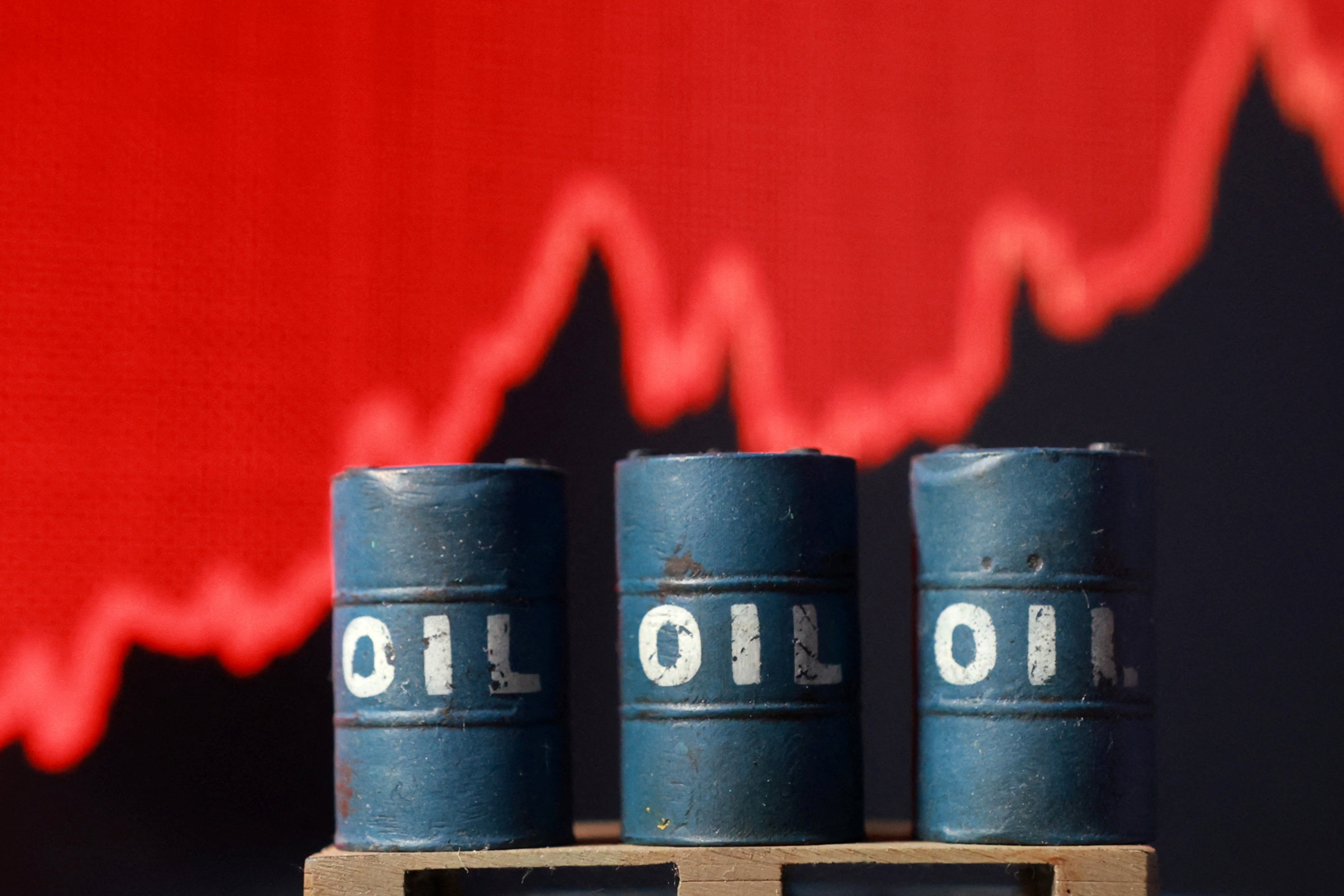
 The World Bank forecasts two possible scenarios for Brent oil prices in 2026, ranging from $86 to $115 per barrel. (Image: Dado Ruvic / Reuters)
 In normal times, cutting the global oil supply by 1% translates to a 6% increase in the price of a barrel of oil. The current disruption is different. Right now — well, actually as of a couple weeks ago, according to the World Bank experts and their April commodity markets outlook special focus on oil — that translation is working out to 11.5%.
We’ve been living with an average Brent barrel price above the magical $100 mark since March … and an associated supply shortage of around 20%, depending on where the US and Iran are in their negotiations around the Strait of Hormuz.
To answer the question posed in the headline, oil almost kissed $130 per barrel on the Brent ticker in March 2022, when the world was calling Russia to order with sanctions after it invaded Ukraine.
The highest price ever recorded? You’d need to cast your mind back to 11 July 2008, when China was starting to aggressively flex its industrial muscle, and the money that got burnt in the financial crisis wanted to capitalise on the demand.
It peaked at $147.50 (about $200 in today’s inflated petrodollars) before falling to under $40 per barrel by the close of the year — still higher than what Tina Joemat-Pettersson and Sibusiso Gamede got for selling SA’s strategic reserves in 2015.
Dancing on the ceiling
The World Bank’s April outlook lists two possible scenarios. If trade disruptions peak in May and normalise by October, then “the Brent oil price is expected to average $86 per barrel this year ... before reverting to $70/bbl in 2027”.
However, if the conflict and associated supply blockages are more severe or lasting, then “the Brent oil price in 2026 could average $95 to $115 per barrel”.
This is in keeping with the updated relationship between supply disruption and price increase — the old model looked at conventional supply disruptions like natural disasters or standard Opec quota changes. This current outsized price response is, according to the World Bank, driven by “efforts to secure physical supplies (or near-term deliveries) immediately after a shock, as well as speculative market responses”.
“One of the things that I learned when I joined the oil industry 30 years ago was that US motorists would not tolerate $4 a gallon (about R18/litre) for gasoline,” Simon Warren, an analyst at the commodities trading company Vitol, told the African Refiners and Distributors Association (Arda) conference audience during his market overview keynote.
And while this historical ceiling usually holds true, he explained that the current market shocks have consumers in places like California “facing $6 a gallon for gasoline and potentially $8 a gallon for diesel”.
The market is experiencing an (and here’s that dreaded word again) unprecedented structural imbalance, having lost approximately 10 to 12 million barrels per day (mb/d) in supply through the closing of the Strait of Hormuz. This has a counterintuitive effect, though: when supply disappears overnight, astronomical price increases become the primary mechanism to force demand destruction.
/file/attachments/2991/13922393_734401.jpg "Iranians drive past a huge billboard in Tehran on 22 April carrying a sentence reading in Persian, ‘The Strait of Hormuz remains closed’. (Photo: Abedin Taherkenareh / EPA)")
Don’t hate the players, hate the market
Warren had an explainer ready for the natural balancing mechanism in the market: “Now what price has to do is essentially kill demand. And we’ve got to ask ourselves, ‘Are these price moves strong enough to arrest the demand numbers that we’re projecting?’ I suspect they’re not.”
There’s a practical example from the start of the current crisis in the Gulf. While tens of thousands of flight cancellations in the wake of the war resulted in a demand drop of only about 300,000 barrels per day, the supply side has suffered catastrophic losses (remember when FlySafair was the first South African airline to blink, sending air travel costs through the roof?).
In Warren’s assessment, overall, the market is facing a “potential demand loss there against half a billion barrels that we’ve lost on supply”.
It sounds strange, but the International Energy Agency (IEA) corroborated this in its April oil market report, which projects that as this relationship plays out, the forced destruction of demand will only expand.
“Initially, the deepest cuts in oil use have come in the Middle East and Asia Pacific... However, demand destruction will spread as scarcity and higher prices persist.”
In more human-friendly parlance: the IEA estimates that skyrocketing prices and severe economic damage will reduce demand by a 5mb/d year-on-year average from this quarter through to the year-end. In this environment of continued conflict, “soaring oil prices function as the main driver of demand destruction” — basically, you stop buying what you can’t afford and find alternatives.
The World Bank concurs with this shift, predicting that “global oil consumption is expected to decline marginally this year, reflecting higher prices and proactive policy efforts to limit consumption amid shortages in some countries”. Across the 38 Organisation for Economic Co-operation and Development countries, these wholesale costs are already being passed on to retail fuel prices, but the economists are playing it off as a long-term positive: “soaring oil prices function as the main driver of demand destruction”.

How long is a piece of string?
The 2022 oil price surge pushed the SA petrol price beyond R26/litre, which would have been even higher had the government not intervened with a reduction in the general fuel levy.
This time round, inland diesel customers have already seen an all-time high of R26/litre, while the coastal price is flirting with the 2022 record of R25.53. More price hikes are coming next week.
But here’s the thing about what the experts mean when they say “demand destruction”: it’s because governments are rationing citizens to balance strategic reserves.
The context for the IEA’s extreme demand destruction is one of pure necessity; without it, the global market would face a shortfall that lifts the global call on stocks to an untenable 6mb/d, or almost two billion barrels in aggregate losses by year-end.
“This means deliberate, widespread demand reduction policies will be the only way to balance the market and prevent total economic failure” (read: fuel rationing).
While the IEA, World Bank, and private trading houses are modelling demand contractions and forced market destruction, Opec’s official 2026 outlook denies that an endgame of collapsed demand is inevitable. Instead, the organisation asserts in its April outlook that “global oil demand is forecast to grow by a healthy 1.4mb/d year-on-year”. But that was before the UAE exited the club.
Now we can only rely on history for hope in these unprecedented times. DM