




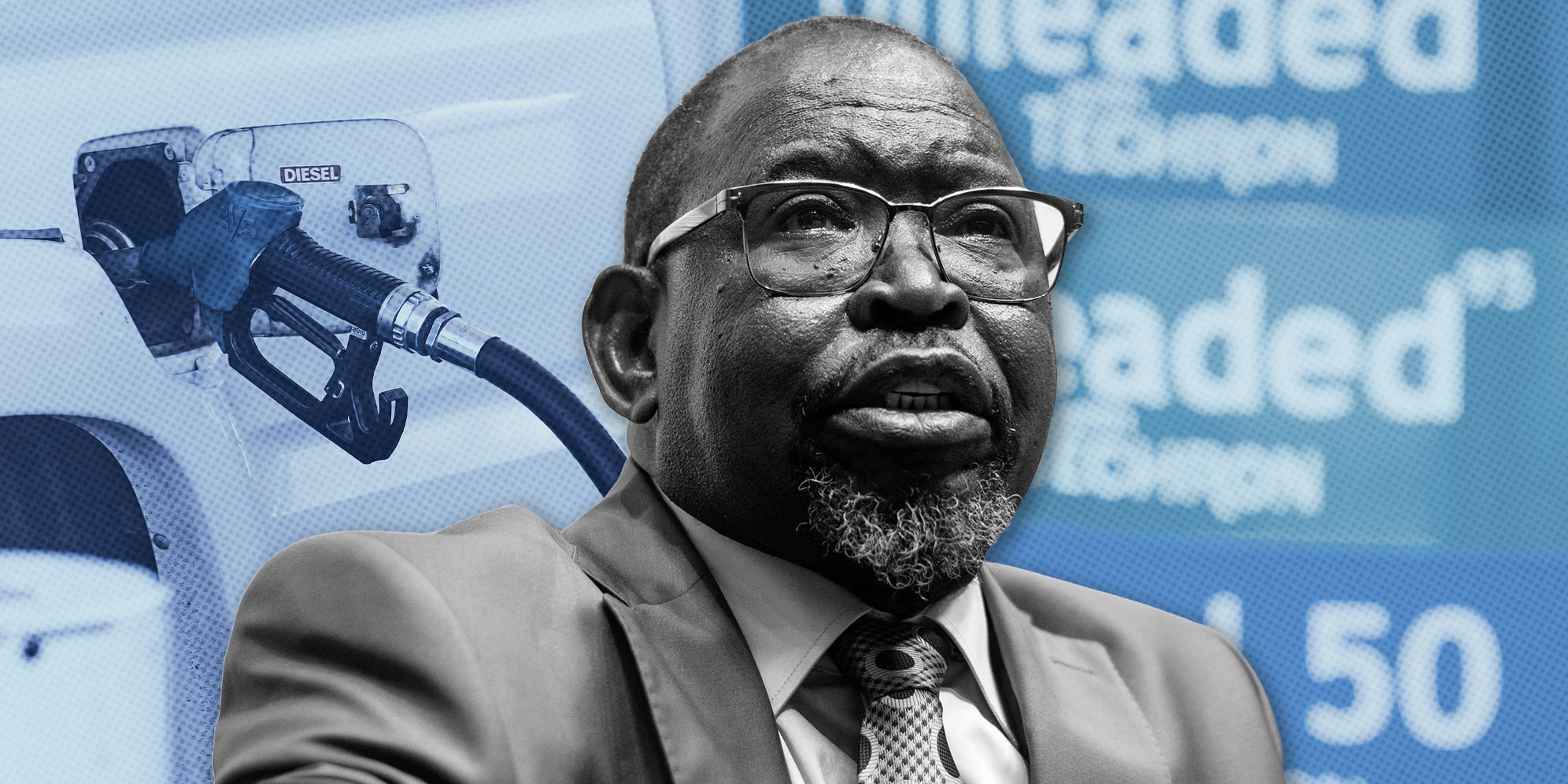
 Illustrative image: A pump fuels a vehicle with diesel at a Texaco fuel station in Pretoria. (Photo: Waldo Swiegers / Bloomberg via Getty Images) | Finance Minister Enoch Godongwana. (Photo: Gallo Images / Brenton Geach)
It’s actually very simple. For every rand that the National Treasury cuts from the fuel levy, it needs to find R2-billion to balance the books.
With that in mind, the Treasury has decided to maintain the R3 fuel levy cut for petrol from 6 May until 2 June. In the same period, there will be a further reduction in the levy on diesel of 93 cents – which means there is no fuel levy for diesel in May.
There is a bet being made on some kind of economic recovery in June because phase two of the fuel price relief plan kicks in then, halving the reductions before returning to the full baseline levy in July.
It may or may not have something to do with the UAE unshackling itself from Opec and becoming free to let the oil flow out of the rapidly filling storage tanks, but hope is on the horizon.
A man on a mission
Finance Minister Enoch Godongwana stepped into 2026 with a singular goal of first preserving and then expanding the structural tax base – to make good on his big talk about stabilising the all-important debt-to-GDP ratio.
Fuel levies were baked into his strategy, yielding a projected R105-billion in gross tax revenue for the 2026/27 fiscal year, which roughly breaks down to R8.74-billion per month in highly reliable, easily collected revenue.
Oh, and he would need to do this in the same cycle of SARS’ leadership transition from staatmaker Edward Kieswetter.
And then the bombs rained down on Iran, sending an inflationary ripple across the globe, which will likely manifest in the Sarb retreating from its consumer-friendly recent rate cuts to defend its inflation target and send us back to austerity.
Treasury is estimating the cost of this extended relief from April to June to be around R17.2-billion in foregone tax revenue. But this mechanism is still Godongwana’s best shot to remain revenue-neutral – because it will be funded through a combination of higher-than-expected tax revenue and departmental underspending. This means the fiscal framework adopted in the 2026 Budget is not compromised, and government can still spend on infrastructure (more on that later).
What makes the rands per litre
Beyond the internationally determined Basic Fuel Price, the Road Accident Fund and general fuel levy make up a matrix of domestic logistical costs and administrative margins that govern the final retail price (think: coastal storage fees, pipeline transportation tariffs, secondary road distribution to retail forecourts and heavily regulated wholesale and retail profit margins).
And then there’s the most volatile and misunderstood component of the price mix: the Slate Levy.
This dynamic tax is untouchable because South Africa’s retail fuel prices are adjusted only once a month – specifically on the first Wednesday of the month – while the BFP fluctuates daily. There’s a discrepancy between the regulated domestic price and the actual daily cost of importing fuel. If the daily BFP is higher across the month, there’s an under-recovery because fuel importing and refining companies are effectively selling liquid fuels at a loss relative to their replacement import costs, and the Slate Levy is applied to clear this deficit over time.
So why not do the permanent 50% cut to the RAF and fuel levy that opposition parties are calling for? Because that would cost up to R19.5-billion a quarter and force the state to take on unsustainable sovereign debt that would drive up borrowing costs and endanger national solvency.
A race against the clock
If global oil prices continue to surge beyond June and the baseline fuel price indeed drives secondary inflation (especially food and logistics) to crisis levels, Godongwana will still have limited, but targeted structural levers to pull – probably diesel refund mechanisms to bring relief to the agriculture and mining sectors, and maybe deregulating 93 octane petrol to get some price competition in the forecourt.
Ultimately, Treasury knows that it cannot continuously shield the economy from global energy realities. The pivot away from consumer price subsidies and toward aggressively expanding domestic rail logistics networks – to permanently reduce commercial diesel reliance and accelerate the adoption of new energy vehicles – is coming.
Additionally, the Department of Mineral and Petroleum Resources has already initiated a broader review of the fuel pricing formula, which will determine how they are regulated. But the path ahead is still long, dark and winding. DM
Comments
Scroll down to load comments...